November 9, 2006

Historical Fiction


Oh, there are so many wonderful books that fall in this category. I don't know if I can limit this list to just 13!

1. Pope Joan by Donna Cross

2. Pillars of the Earth by Ken Follet

3. A Thread of Grace by Mary Doria Russell

4. Falling Angels by Tracy Chevalier

5. Girl with a Pearl Earring by Tracy Chevalier

6.
Sarum: The Novel of England by Edward Rutherfurd

7. Snow Falling on Cedars by David Gutterson

8. The Book Thief by Markus Zusak

9. Fortune's Rocks by Anita Shreeve

10. The Kite Runner by Khaled Hosseini

11. These Is My Words by Nancy Turner

12. The Tea Rose by Jennifer Donnelly

13. Memoirs of a Geisha by Arthur Golden

Others I've read, but didn't necessarily love (or even like!):

Aztec by Gary Jennings


Molokai by Alan Brennert


The Red Tent by Anita Diamant

Girl in Hyacinth Blue by Susan Vreeland

Cold Mountain by Charles Frazier

Follow the River by James Alexander Thom

The English Patient by Michael Ondaatje

And then there are these of which I'm not sure are true "historical fiction." How exactly does one define the genre? By the way, I loved all three of these:

A Fine Balance by Rohinton Mistry

Losing Julia by Jonathan Hull

Atonement by Ian McEwan

November 7, 2006

8th of November

In conjunction with my current challenge, which is focusing on war-related books (in honor of Canada's Remembrance Day and the United States' Veterans' Day, both of which are recognized on November 11th), I thought it might be appropos to share this music video with you. I think it's very powerful and moving.

From The Stacks Winter Reading Challenge


I know. I know. I already have a challenge for November. But how can I possibly resist this one? It has prizes! And I figure I can join in during December and January, easily reading my five selections. Here are the details from Michelle over at Overdue Books:

If you are anything like me your stack of purchased to-be-read books is teetering over. So for this challenge we would be reading 5 books that we have already purchased, have been meaning to get to, have been sitting on the nightstand and haven't read before. No going out and buying new books. No getting sidetracked by the lure of the holiday bookstore displays.

The bonus would be that we would finally get to some of those titles (you know you picked them for a reason!) and we wouldn't be spending any extra money over the holidays.

The time frame would be Nov. 1st until Jan. 30 and there will be some small, fun prizes awarded to random participants and/or those with clever review posts. There will be one random drawing for a prize to those who submit their list of books in the comment section by Nov. 15th but feel free to join any time. There will be another random drawing for those who submit five reviews by Jan. 30 for a small gift certificate to Amazon.

So here's what I selected from my towering stacks:

The Other Side of the Bridge by Mary Lawson FINISHED!

The Swallows of Kabul by Yasmina Khadra FINISHED!

The Baker's Apprentice by Judith Hendricks

Leave Me Alone, I'm Reading by Maureen Corrigan READING NOW

A Circle of Quiet by Madeleine L'Engle


November 5, 2006

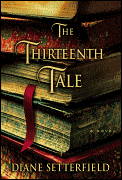
The Thirteenth Tale


The Thirteenth Tale by Diane Setterfield
Contemporary Fiction
Finished on 10/31/06
Rating: B (6/10 So-so)


Each year there seems to be one book about which everyone is talking: The Kite Runner, Bel Canto, Life of Pi, Plainsong, and Cold Mountain, to name just a few. This year’s “book buzz” award goes to Diane Setterfield’s debut novel, The Thirteenth Tale. Bloggers across the globe have been raving about this gothic tale since it hit the shelves earlier this fall (and in some cases, well before, thanks to the ubiquitous Advance Reader’s Copy). Word of mouth is an author’s best friend and bloggers have done nothing but help boost Setterfield’s fame and, undoubtedly, fortune.

I hate to be the voice of dissension, but this book failed to impress me as it did Heather, Dolce Bellezza, Carl, Booklogged, Bluestalking Reader, Di, Lesley, and thousands of other readers.

It’s not that I didn’t like the book (I love the dust jacket with it’s rich cover art and raised lettering, not to mention all the passages about reading and the love of books). I just didn’t feel the magic that so many other readers experienced.

Judging by the number of favorite passages, though, one would think I’d've given the book a higher rating. Unfortunately, I felt the narrative dragged a bit too much and I had a tough time staying focused. I’d curl up with the book, read a few pages only to discover my mind wandering or that I’d drifted off to sleep. Until the last hundred pages, I couldn’t manage to get engrossed in the narrative, only caring for one of the characters (and a secondary character, at that) and finding several that struck me as terribly mean and heartless.

Was it a case of too much hype? There are currently 2,462 posts matching “The Thirteenth Tale” at Blogger! Wrong time, wrong read? Still on too much of a book high after reading The Book Thief? Did I spend too much brain power trying to sort out all the clues in a futile attempt to unravel the book’s mystery? As the pieces of the puzzle began to fall into place during the last quarter of the book, my interest did heighten and I sat and read for a couple of hours, anxious to see how it would all turn out.

Please don’t misunderstand my disappointment. This is certainly not a terrible book. It’s not even a bad book. It simply failed to live up to my expectations for a great read. I didn’t quit reading and there were definitely enjoyable parts that kept my interest, but overall all, meh. Not one I’ll read again and I’m almost sorry I spent the money on a hardcover (although, as I said it is a gorgeous cover and my husband loved the book, so at least we got our money’s worth).


Favorite Passages:

People disappear when they die. Their voice, their laughter, the warmth of their breath. Their flesh. Eventually their bones. All living memory of them ceases. This is both dreadful and natural. Yet for some there is an exception to this annihilation. For in the books they write they continue to exist. We can rediscover them. Their humor, their tone of voice, their moods. Through the written word they can anger you or make you happy. They can comfort you. They can perplex you. They can alter you. All this, even though they are dead. Like flies in amber, like corpses frozen in ice, that which according to the laws of nature should pass away is, by the miracle of ink on paper, preserved. It is a kind of magic.

and

Time was of the essence. For at eight o’clock the world came to an end. It was reading time.

The hours between eight in the evening and one or two in the morning have always been my magic hours. Against the blue candlewick bedspread the white pages of my open book, illuminated by a circle of lamplight, were the gateway to another world.

and

There is one thing on which we are agreed: There are too many books in the world to read in a single lifetime; you have to draw the line somewhere.

and

Of course one always hopes for something special when one reads an author one hasn’t read before… I have always been a reader; I have read at every stage of my life, and there has never been a time when reading was not my greatest joy. And yet I cannot pretend that the reading I have done in my adult years matches in its impact on my soul the reading I did as a child. I still believe in stories. I still forget myself when I am in the middle of a good book. Yet it is not the same. Books are, for me, it must be said, the most important thing; what I cannot forget is that there was a time when they were at once more banal and more essential than that. When I was a child, books were everything. And so there is in me, always, a nostalgic yearning for the lost pleasure of books. It is not a yearning that one ever expects to be fulfilled. And during this time, these days when I read all day and half the night, when I sleep under a counterpane strewn with books, when my sleep was black and dreamless and passed in a flash and I woke to read again – the lost joys of reading returned to me…

and

Whether by luck or accident I cannot say, but I found my way to the library a full twenty minutes earlier than I had been commanded to attend. It was not a problem. What better place to kill time than in a library? And for me, what better way to get to know someone than through her choice and treatment of books?

and

All morning I struggled with the sensation of stray wisps of one world seeping through the cracks of another. Do you know the feeling when you start reading a new book before the membrane of the last one has had time to close behind you? You leave the previous book with ideas and themes – characters even – caught in the fibers of your clothes, and when you open the new book, they are still with you. Well, it was like that. All day I had been prey to distractions. Thoughts, memories, feelings, irrelevant fragments of my own life, playing havoc with my concentration.

November 3, 2006

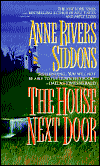
The House Next Door


The House Next Door by Anne Rivers Siddons

Contemporary Fiction
Finished on 10/24/06
Rating: A (9/10 Terrific!)


The year was 1983 and I was in the second trimester of my pregnancy. My husband had left for work and I was still in bed, in that misty, murky area halfway between wakefulness and sleep.

But I wasn’t asleep. I truly believe this.

As I lay in bed, I heard the front door open and someone walk inside. I thought it was my husband returning for some forgotten item. I was surprised to hear the bedroom door open and the sound of light footsteps on the carpet, softly walking toward my side of the bed. For some reason, I knew this was not my husband. But who could it be? And what did they want? And how in the hell did they get in my house?! I felt my pulse quicken and it was all I could do to remain still, feigning sleep, hoping and praying that whomever was at the side of my bed would have a change of heart and leave me unharmed.

My prayers were answered. I heard the soft tread of feet leave the side of my bed and walk toward the door. Soft footsteps fell on the hallway floor and the front door opened once and gently closed. My heart was in my throat, racing as if I’d run a marathon. I leapt from the bed, stealthfully creeping down the hallway toward the front door.

Nobody was there. There was nobody in the yard and no cars in the driveway. Everything was still and silent. We lived in the country and I knew if someone had been quick enough to leave without my notice, I’d at least see the trail of dust on the dirt road. But the air was calm, and there were no signs of any travelers having been down the long gravel road. When I glanced down at the door, I noticed the lock was still engaged.

Who ever had entered had not unlocked the door!

I know what I heard and no, I am not crazy. It’s completely inexplicable yet I believe with all my being that it truly happened and that I wasn’t dreaming.

Do I believe in ghosts and haunted houses? I don’t know. I do know that anything is possible and for whatever reason, something or someone visited me that day in my home and it scared the crap out of me!

So why would I read a novel centered around a haunted house? Curiosity, I suppose.

I’ve read a few of Anne Rivers Siddons’ books (Colony is my favorite so far) and since I was still in the mood for a creepy read after du Maurier’s Don’t Look Now, I grabbed The House Next Door off my shelf and dove in. Quite a departure from her usual “women’s fiction,” this gothic tale had me spellbound. I read for several days solid, stopping only in the early evening hours, since I’d already experienced a disturbing nightmare after reading late the first night. I love Siddons’ descriptive style and fell easily into the narrative, eager to read at every free moment.

What is it about a house with an evil force that causes the hairs to stand on end on the back of one’s neck? The Amityville Horror had the same effect on me. So did The Shining. Shudder. I just went to the official site for the Amityville Horror to double-check the spelling and couldn’t keep the page open for more than a second as it had a picture of THAT house! Creepy! Just like The Shining, I read The Amityville Horror in broad daylight on the beach, surrounded by chattering tourists reeking of Bain de Soleil and coconut oil. I couldn't even watch the movie, and walked out before it was halfway over. I was terrified! So why in the world would I read a book about a haunted house?? (Yes, Heidi, I know our next door neighbors' house looks just like the one in the movie. Thank you very much!)

Curiosity, I guess.

Good thing I’m not a cat.

From Amazon:

Anne Rivers Siddons is a writer of literary fiction whose one foray into the horror genre is this remarkable 1978 novel, The House Next Door. The setting is a wealthy suburb in Atlanta where an ambitious young architect is building a dramatically contemporary house. The novel uses a frame device to put three short stories under a single cover: as each of three families moves into the house in succession, we watch the bad things that happen to them and eventually force them to leave. But the frame itself--the observations of an urbane and sophisticated couple who live next door and become close friends with the architect--is the most deeply involving story in the book.

Stephen King was so impressed by The House Next Door that when he wrote Danse Macabre, his personal tour of the horror genre, he sought out Siddons for an interview. She told him, "The haunted house has always spoken specially and directly to me as the emblem of particular horror. Maybe it's because, to a woman, her house is so much more than that: it is kingdom, responsibility, comfort, total world to her.... It is an extension of ourselves; it tolls in answer to one of the most basic chords mankind will ever hear.... So basic is it that the desecration of it, the corruption, as it were, by something alien takes on a peculiar and bone-deep horror and disgust."

Siddons was also fascinated by how the supernatural has the power to disturb the complacent rich and their comfortable little world: "What has the unspeakable and the unbelievable got to do with second homes and tax shelters and private schools for the kids and a pâté in every terrine and a BMW in every garage? Primitive man might howl before his returning dead and point; his neighbor would see, and howl along with him.... The resident of Fox Run Chase who meets a ghoulie out by the hot tub is going to be frozen dead in his or her Nikes on the tennis courts the next day if he or she persists in gabbling about it. And there he is, alone with the horror and ostracized on all sides. It's a double turn of the screw."

Reading Group Guide from Bookreporter.com

November 1, 2006

Another Challenge!


My Back-to-School Classic Challenge went so well that I started thinking about other ideas for November. I was all set to go with a Non-Fiction Challenge until I stumbled upon Kailana's recent blog entry for a challenge geared to Canada's Remembrance Day. Sassymonkey has also mentioned an interest and has posted a list here. Since I have dual citizenship, I can honor both countries on Remembrance Day and Veteran's Day. Keeping with my goal to read what I already own, I searched through all my bookcases and came up with the following (ok, I cheated - I'm going to buy one that's on the list, but I'd been planning to for a few weeks. Honest!):

1. Schindler's List by Thomas Keneally

2. Birdsong: A Novel of Love and War by Sebastian Faulks

3. The Things They Carried by Tim O'Brien FINISHED A+

4. Pastoral by Nevil Shute

5. Night Watch by Sarah Waters FINISHED A-

6. Obsaban by Joy Kogawa FINISHED C

7. Land Girls by Angela Huth FINISHED B+

8. In Country by Bobbie Ann Mason

9. When the Elephants Dance by Tess Uriza Holthe

10. Band of Brothers by Stephen Ambrose

11. A Day of Infamy by Walter Lord

12. Coming Home by Rosamunde Pilcher

13. A Very Long Engagement by Sebastien Japrisot

Most of these are fiction, either dealing with a particular war (WWI, WWII or Vietnam) or set during that time period. I'm hoping to branch out a little bit and read the few non-fiction works I've selected, but my first choice has always been toward novels, so we shall see. I don't expect to read all 13 in one month, but I hope to make it through at least half.

October 29, 2006

Don't Look Now


Don't Look Now by Daphne du Maurier
Short Stories
Finished on 10/20/06
Rating: A- (8/10 Very Good)


As I recently mentioned, there’s been a plethora of reading challenges within the book-blogging community. I didn’t join in on Carl’s R.I.P. Fall Reading Challenge since I was busy with my own challenge. However, after a month of classics, I decided to wrap it up and move on to something else. With Halloween coming up, I got an itch to read something creepy and gothic. While perusing my TBR shelves, I came across a copy of Daphne du Maurier’s Don’t Look Now. I have no idea where this book came from! It’s an old hardcover with a dust jacket that I can’t seem to locate anywhere online. Either my mom sent it or I picked it up at a library sale or grabbed it from a traveling book box. Who knows?!

Rod and I were on a Hitchcock kick a few years ago and among others, we rented The Birds and Rebecca, but I’ve never read any of du Maurier’s books. (Maybe that’s when I got the book! After our Hitchcock marathon.)

Anyhow, I wasn’t sure what to expect, especially once it dawned on me that I was about to read a collection of short stories and not a novel. I am not a big fan of short stories. I’m always disappointed in them. Just as I’m settling into the narrative and feeling a sense of familiarity with the characters, boom, it’s all over!

Looking through my reading journals, I only come up with a few short story titles that I’ve read: Hateship, Friendship, Courtship, Loveship, Marriage: Stories by Alice Munro; The Love of a Good Woman: Stories by Alice Munro; Ordinary Life: Stories by Elizabeth Berg; and a few collections of shorts by Rosamunde Pilcher. As I recall, I loved the Berg collections, but she’s one of my favorite authors and I’d probably be quite content reading her grocery list. The others were disappointing and I’d pretty much resigned myself to not reading shorts ever again. Part of my displeasure is that none of the stories are memorable, even after just a few days, let alone years.

That said, I was absolutely spellbound and pleasantly surprised when I finished du Maurier’s Don’t Look Now. All but one of the five stories were fantastic, each dripping with sinister suspense and mystery. These psychological thrillers are not chock full of intense action. Instead, internal drama and foreboding tension overshadow the actual plot. The conclusion of “A Border-Line Case” had me shaking my head in disbelief, wondering how in the world I hadn't seen such an obvious finale looming. (I don’t feel too ignorant. Rod didn’t see it coming, either!) Then again, perhaps that's what makes for a satisfying resolution to a mystery: You're amazed that you hadn't seen it coming, but looking back, you see that it was inevitable--it had to end the way it did.

I can picture each and every one of these stories on the big screen and was pleased to hear that Donald Sutherland and Julie Christie starred in one of my favorites, “Don’t Look Now,” which we’ve just received from Netflix. I can’t wait to curl up with a bowl of popcorn and a brownie (or two!) and see if the film is as good as the story.

It occurred to me that I may have misjudged the genre of short stories. Perhaps it’s as simple as just not caring for Alice Munro. And that Rosamunde Pilcher’s sagas are better suited than short stories to her style of descriptive writing. I don’t think I’ll be quite so quick to dismiss short stories in the future. These were great fun and I have a feeling I’ll be ready to read them again next year. du Maurier was quite a prolific author, writing numerous novels, short stories, plays and biographies, and I plan to peruse her bibliography for future ideas, perhaps in time for next year’s R.I.P. challenge. Until then, I have The Collected Stories of Eudora Welty, The Complete Short Stories of Mark Twain and Tales of O. Henry (sixty-two stories!) to keep me occupied. Those should last me a while, don’t you think?

October 26, 2006

Big Fat Books


Since I started this blog, I've noticed that bloggers like a challenge. At least that seems to be true of book bloggers. I missed out on the Summer Reading Challenge and opted out of Carl's R.I.P. Autumn Challenge and Sassymonkey's October Challenge. Booklogged is gearing up for a Classic Challenge and Bookfool has plans for a Chunkster Challenge in 2007. I wonder what it says about those of us who participate in these challenges? Do we all just need an extra push to read some of the books that have lingered on our shelves for too many months (or, in my case, years!)?

Whatever the reason, I am determined to read some of these Big Fat Books for Bookfool's Chunkster Challenge. My goal is to read one a month for the entire year. I may only read a total of twelve books in 2007 (instead of my normal average of 75 or so), but that's ok. It's never been a goal of mine to read a certain number of books in one year. But, wait! That sounds like a good challenge, doesn't it? ;)

1.
The Winds of War by Herman Wouk (1047 pages MM)

2. Lonesome Dove by Larry McMurtry (945 pages MM)

3. The Alienist by Caleb Carr (597 pages MM)

4. The Crimson Petal and the White by Michel Faber (894 pages QP)

5. The Way the Crow Flies by Ann-Marie MacDonald (810 pages QP)

6. Songs in Ordinary Time by Mary McGarry Morris (740 pages QP)

7. East of Eden by John Steinbeck (601 pages QP)

8. Middlesex by Jeffrey Eugenides (529 pages QP)

9. Stones from the River by Ursula Hegi (525 pages QP)

10. Pasadena by David Ebershoff (485 pages QP)

11. Birdsong by Sebastian Faulks (483 pages QP)

12. London by Edward Rutherfurd (829 pages CL)

13. Dreamcatcher by Stephen King (617 pages CL)

Extras:

The Brothers K by David James Duncan (645 pages QP)

The Portrait of a Lady by Henry James (548 pages QP)

The Secret History by Donna Tartt (524 pages CL)


MM = mass market
QP = quality paperback/trade paper
CL = cloth/hardcover

October 22, 2006

Still Life


Still Life by Louise Penny
MysteryFinished on 10/13/06Rating: A- (8/10 Very Good)


Winner of the New Blood Dagger in Britain and the Arthur Ellis Award in Canada for best first crime novel.


Chief Inspector Armand Gamache of the Sûreté du Qu&#233bec and his team of investigators are called in to the scene of a suspicious death in a rural village south of Montreal. Jane Neal, a local fixture in the tiny hamlet of Three Pines, just north of the U.S. border, has been found dead in the woods. The locals are certain it’s a tragic hunting accident and nothing more, but Gamache smells something foul in these remote woods, and is soon certain that Jane Neal died at the hands of someone much more sinister than a careless bowhunter.
Still Life introduces not only an engaging series hero in Inspector Gamache, who commands his forces – and this series – with integrity and quiet courage, but also a winning and talented new writer of traditional mysteries in the person of Louise Penny.

It took me a few chapters to settle into this debut novel, but once I got a handle on all the various characters (many of whom were possible suspects in the death of Ms. Neal), I couldn’t put it down, anxious to get back to my reading and trying to solve the crime as I went about my daily activities.Still Life is not a hard-boiled thriller, but rather a gentle “drawing room” mystery in which the chief investigator relishes a warm café au lait and flaky croissant as he ponders the details of the crime, while enjoying the peacefulness of the village as dawn breaks.
Gamache is a likeable character, reminding me a little bit of John Sandford’s Lucas Davenport (although, not quite the womanizer and much more well-read). I have a feeling Gamache and Inspector Jean Guy Beauvoir will become another favorite duo and I look forward to Penny’s next installment (Dead Cold), due out next spring.

October 19, 2006

Disappointing Classics


Last week I posted a list of my favorite classics. This week you get to see what has failed to impress me.


1. The Picture of Dorian Gray by Oscar Wilde

2. Fahrenheit 451 by Ray Bradbury

3. Death of a Salesman by Arthur Miller

4. The Catcher in the Rye by J. D. Salinger

5. All Quiet on the Western Front by Erich Maria Remarque

6. Lady Chatterley's Lover by D. H. Lawrence

7. The Great Gatsby by F. Scott Fitzgerald

8. Of Mice and Men by John Steinbeck

9. The Winter of Our Discontent by John Steinbeck

10. The Heart is a Lonely Hunter by Carson McCullers

11. Cannery Row by John Steinbeck

12. The Optimist's Daughter by Eudora Welty

13. Animal Farm by George Orwell

October 15, 2006

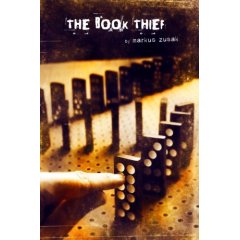
The Book Thief


The Book Thief by Markus Zusak
Young Adult Fiction
Finished on 10/9/06
Rating: A+ (10/10 Superb!)


Wow. Where do I begin?

This was simply the best book I’ve read all year. It may very well be the best book I have ever read. I will even venture to say it was better than To Kill A Mockingbird (one of my absolute favorite books). It was better than The Kite Runner. It was better than The Sparrow… and Atonement. Well, you get the idea.

I don’t know if I’ve ever felt such emotion from the printed word. It moved me beyond description. Every single page (and quite possibly every sentence) was a gem. I’ve been sitting here, thumbing through the book, re-reading highlighted passages and entire chapters. There are so many quotes I could share in this review, but I think they’re best read in the context of the story.

"Death" narrates the book and tells us of how he came to know the book thief. While a bit unconventional for a narrator, he is eloquent and, ironically, an ultimately benevolent and compassionate soul. I came to care as much for him as I did Liesel, Rosa, Hans, Max, and Rudy, each of whom is so distinctly drawn that I was left with a sense of deep love and tenderness for their individual roles in this story.

The Book Thief is the tale of a young girl, living with her new foster parents in Germany at the beginning of World War II. It’s a story about a Jewish man in hiding. And it’s story about German citizens refusing to follow along like sheep, standing their ground and showing love and compassion toward their fellow human beings.

This is a love story. Love of a family. Love of a stranger. Love of a playmate. Love of reading and books.

It’s a story about courage.

And it’s a story about death.

The Book Thief is an extremely emotional and draining narrative (how can anything about the Holocaust not be depressing?). I sobbed as the last pages drew closer. It's as moving as Schindler's List and The Pianist. But... I think it's worth the tears. It was just so damned good. I can’t remember the last time I was so affected by a book.

The Book Thief is classified as a Young Adult novel, but I believe it crosses over to contemporary fiction quite well. The young protagonist (Liesel) is reminiscent of Scout (To Kill a Mockingbird) and Griff (An Unfinished Life) and I doubt I’ll ever forget her or her story. The dialogue is marvelous and the pacing is consistently steady, with just enough tension to keep the pages turning (and not as predictable as I thought!). I wonder if this will ever be taught in high school English classes. It should be; it’s so powerful and, I would think, suitable for that age group. (It maybe even be good for junior high school students, although perhaps they're too young to really get much out of it.)

This is definitely one to read again, slowly savoring the lyrical prose now that the final outcome has been revealed. Unless something else knocks my socks off (The Thirteenth Tale, perhaps?), I’ve found my #1 read for 2006. Absolutely phenomenal and achingly beautiful.

October 14, 2006

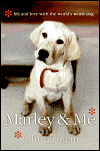
Marley & Me


Marley & Me by John Grogan
Nonfiction
Finished on 10/3/06
Rating: A- (8/10 Very good)


Dogs have given us their absolute all.
We are the center of their universe.
We are the focus of their love and faith and trust.
They serve us in return for scraps.
It is without a doubt the best deal man has ever made.
~Roger Caras

I was 26 years old when I got my first dog. Oh, sure, we had a couple of dogs while I was growing up, but they were really more my parents’ than mine. And to be quite honest, Sidney was really Rod’s dog. It wasn’t until we became empty-nesters and (quite coincidentally) Sid became an indoor dog that we became close pals. I had more time for him than I had in the past and I was in desperate need of something to nurture. I went from room-mother and soccer mom to head-groomer and dog-walker. Sidney was 12 and I was a year-and-a-half away from the big 4-0. It was a perfect fit.

I got a copy of Marley & Me from our library, but since I was trying to wrap up my classic challenge, Rod went ahead and read it first. I warned him that I’d heard it had a sad ending and it didn’t surprise me that he chose not to read the final chapters. I, on the other hand (being a glutton for punishment), sucked it up and read the whole book.

It took me a few chapters to get enthusiastic about Marley & Me. Something about the author’s style bothered me, at least initially, and I was afraid I was headed for another disappointing read. However, at some point Grogan stopped trying to sound like Dave Barry (and I stopped comparing his book to Fifty Acres and a Poodle) and I found myself nodding my head and chortling at his recollections of life with “the world’s worst dog.” I saw a lot of us and our Sidney in his stories.

Like the Grogans, we traded our postage-stamp-sized lot for three acres, a creek (crik to the locals) and gentle, rolling hills, moving from San Diego to Lincoln. It felt as if we’d moved into a Norman Rockwell painting. Never had we seen so many parks, all full of happy families riding bikes, flying kites or walking to the neighborhood DQ. Gone were the days of drive-by-shooting drills and gated communities. People left their cars and homes unlocked and a couple of grocery stores even let you sign for your groceries, happy--and trusting enough--to bill you at the end of the month.

We were thrilled and Sid was in heaven. Freedom! We let him roam during the day, happy he’d made friends with the neighbor’s dog, Molly, and smiled like proud parents as the two frolicked in the meadow, returning home utterly worn out and covered in burrs, pond scum and ticks.

But he paid a price for his new life as a country dog. Poor Sid. He hated thunder (and fireworks) and like Grogan, we eventually wound up drugging Sid every time a storm rolled through. This happens a lot in Nebraska, especially compared to San Diego, which rarely ever gets the big thunderstorms we see in the Midwest.

Sid was quite the retriever (on his own terms, mind you), entertaining us with unusual gifts from his daily excursions: a snapping turtle from the creek, a Runza bag with the remnants of someone’s partially-eaten lunch, a pair of pantyhose (don’t even want to know where he got those!), and the occasional golf ball (hopefully from one of the ditches alongside our road and not from the private golf course kitty-corner to our lot).

Sid loved to chase squirrels, sitting at the base of a tree for hours, completely unaware that the squirrel was long gone. He’d bark at rabbits, opossums, skunks, raccoons and stray cats as they’d wander up on our deck, enjoying the food and water my well-meaning hubby would leave out. He’d bark at Amy as she rode our shiny new John Deere mower, or at the two wild turkeys (named Lucy & Dezi -- Amy was a big I Love Lucy fan) that came to graze under the mulberry tree. Hell, he’d even bark at a solitary leaf blowing in the wind (we didn’t get a lot of falling leaves in San Diego). Quite the happy fellow. Until we told him we were moving to Texas. Land of scorpions, fire ants and heat. But that’s another story for another time.

And like any dog-owner, I have dozens and dozens of Sidney stories that I’d love to share (like the time we accidentally overdosed him on his tranquilizers or how his lip would curl into a smile causing him to sneeze and snort all over you or how Rod built a ramp for the porch steps so Sidney, as he aged, could continue to come in the front door with dignity), but this a book review and I should try to stay focused.

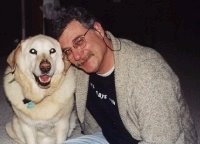
Sidney was part Chow, part yellow Lab and part human. I never fail to think of him when we have fried eggs and toast for breakfast. We always saved him some of the runny yolk and he licked that plate cleaner than any dishwasher ever could. He was my true companion and, until last year, I have never experienced a loss of a loved-one quite like I did when we had to have him put to sleep. He was almost 14 and he was the best damned dog I ever knew. Sniff.

Marley and Me is a book for all dog-lovers, whether they currently own a dog or have fond memories of a family pet that has passed away. Of course it’s a tear-jerker (Marley’s senior years were so much like Sid’s), but overall the book was entertaining and made me laugh (and made me grateful we didn’t wind up with a dog quite as high-maintenance as the Grogans). I think, most importantly though, it brought back some special memories of our sweet Sidney and for that I’m especially grateful.

Sidney's Photo Gallery


October 12, 2006

Favorite Classics


I know. I know. Enough already with the classics! I've written 11 posts/reviews focusing on classic literature and was ready to move on, but the book blogging community seems to be fixated on the subject. Over at A Reader's Journal, Booklogged is planning a Classic Challenge to start in January. Go here for more details. New challenges keep popping up everywhere I turn. I'm going to pass on Booklogged's, but I've begun to squirrel away some tomes for Bookfool's Chunkster Challenge (also beginning in the New Year). Below is a list of my favorite classics. If you're like me and love lists, you can go here for more titles. Or, you can check back here next week for a list of the classics I dislike the most. That should generate some chatter. ;)

***UPDATE*** Not sure how I forgot all about Kate Chopin's The Awakening, but I did. That is until Lisa mentioned it here. Good luck to everyone who participates in Booklogged's challenge!

1. To Kill A Mockingbird by Harper Lee

2. Dandelion Wine by Ray Bradbury

3. A Tree Grows in Brooklyn by Betty Smith

4. Their Eyes Were Watching God by Zora Neale Hurston

5. A Lantern in Her Hand by Bess Streeter Aldrich

6. Giants in the Earth by O.E. Rolvaag

7. The Good Earth by Pearl S. Buck

8. The Grapes of Wrath by John Steinbeck

9. My Antonia by Willa Cather

10. The Age of Innocence by Edith Wharton

11. Jane Eyre by Charlotte Bronte

12. The Bell Jar by Sylvia Plath

13. Bless Me Ultima by Rudolfo Anaya

Extras:

O Pioneers! by Willa Cather
Death Comes for the Archbishop by Willa Cather
Mrs. Dalloway by Virginia Woolf
A Tale of Two Cities by Charles Dickens
Great Expectations by Charles Dickens
Anna Karenina by Leo Tolstoy

October 11, 2006

Shelfari

Just read this from Seattle.pi.com:

"Now, a Seattle startup by the name of Shelfari is hoping to change the way people catalog and discuss books from their personal collections."

Hmmm. "Myspace meets Amazon.com?" Aren't we already doing this?? I feel like the book-blogging community is just that -- a community of like-minded folk who enjoy chatting about their books, adding titles to their never-ending TBR lists, all the while rejoicing in someone's good fortune (BAFAB or a R.I.P. Challenge prize), sympathizing with a personal loss, or sharing juicy details about the latest House episode.

Why does this new website irk me?

Anyone? Anyone? Class?

October 8, 2006

Classic Challenge Recap

From Merriam-Webster:

Main Entry: 2classic
Function: noun
1 : a literary work of ancient Greece or Rome
2 a : a work of enduring excellence; also : its author b : an authoritative source
3 : a typical or perfect example

Finished! I decided to devote only one month to my
Classic Challenge and have to say that I'm quite pleased with the final results.

# of books selected: 13
# of books finished: 7
# of books abandoned: 3
# of books untouched: 3

Favorite read: The Good Earth (followed by The Bell Jar and Brave New World)

Least favorite read: The Optimist's Daughter (followed by Death of a Salesman and Fahrenheit 451).

I hope to make this an annual event, as I truly enjoyed the experience.

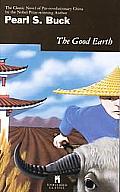
The Good Earth


The Good Earth by Pearl S. Buck
Classic Literature
Finished on 9/18/06
Rating: A- (8/10 Very good)


The sun beat down upon them, for it was early summer, and her face was soon dripping with her sweat. Wang Lung had his coat off and his back bare, but she worked with her thin garment covering her shoulders and it grew wet and clung to her like skin. Moving together in a perfect rhythm, without a word, hour after hour, he fell into a union with her which took the pain from his labor. He had no articulate thought of anything; there was only this perfect sympathy of movement of turning this earth of theirs over and over to the sun, this earth which formed their home and fed their bodies and made their gods. The earth lay rich and dark, and fell apart lightly under the points of their hoes. Sometimes they turned up a bit of brick, a splinter of wood. It was nothing. Some time, in some age, bodies of men and women had been buried there, houses had stood there, had fallen, and gone back into the earth. So would their house, some time, return into the earth, their bodies also. Each had his turn at this earth. They worked on, moving together – together – producing the fruit of this earth – speechless in their movement together.

It's been over two weeks since I finished this wonderful novel. I'm not sure why I've put off writing my review, especially since I enjoyed the read so well. I think it may have something to do with the simplicity of the narrative. I'm not sure what I can say about it that would entice another reader. Unlike Brave New World, which was so complex and multilayered, Buck's Pulitzer Prize winner (1932) is a fairly simple story about a simple Chinese peasant, scratching out a meager existence for himself and his family. It's a classic case of man vs. nature; an examination of the human condition; an epic story of one man’s life. A proud, honest, hardworking (and sometimes stubborn) man who tends to his small plot, slowly (and wisely) acquiring more and more land, ultimately rising to the status of a wealthy landowner with thousands of acres that he eventually rents out in his old age.

Buck is a skillful artist when it comes to drawing her main characters. Wang Lung and O-lan come to life, pulling the reader into their lives and struggles, occasionally with a gentle tug at one’s heartstrings. On the other hand, the remaining cast is nothing but a outline sketch of family members and neighbors. I didn’t care for any of them. I never felt like I knew them.

It didn’t take me long to start caring about Wang Lung and O-lan, silently applauding their good fortune while muttering under my breath when life to a turn for the worst. I liked Wang Lung. He worked hard and was honest, refusing to join his family when they were reduced to begging and thieving in order to survive. He had a great respect for his elders and strong sense of family loyalty. However, when he brought a second wife home, I lost some respect even though I know it was part of his cultural make-up. Even he seemed ashamed of his actions, which made me think he was behaving in a heartlessly selfish manner. He may have bought O-lan when she was a young slave, but I believe he came to love and admire her for her resourcefulness, independence and silent, yet proud, role as his wife.

A simple story? Maybe. Maybe not. There weren’t any car chases. No aliens. No futuristic technologies. No cute little anecdotes about dogs or children. But there were marauding bandits, concubines, an abundance of opium, floods, drought, locust plagues, war and death. As I read I found myself thinking about another couple from the great epic tale Giants in the Earth. Rolvaag’s Norwegian immigrants Per Hansa and Beret struggled with the challenges of living off the land, the constant battle between man and nature, very much like Wang and O-lan. More than once, I found myself thinking, "Thank goodness I was born when and where I was." I can't begin to imagine surviving such hardships simply to stay alive, feeding one's family, sheltering it from the harsh elements, all the while keeping one's sanity in the midst of extreme isolation. I'm thankful for indoor plumbing, modern medicine, plentiful food supplies, technology that allows me to keep in touch with friends and family, near and far. I'm afraid I would’ve been a terrible pioneer or peasant. I'm too fond of my creature comforts!