Showing posts with label World War II. Show all posts

July 18, 2026

The Alice Network


The Alice Network by Kate Quinn
Fiction
2017
Finished on July 13, 2026
Rating: 4/5 (Very Good)

Publisher's Blurb:

In an enthralling new historical novel from national bestselling author Kate Quinn, two women—a female spy recruited to the real-life Alice Network in France during World War I and an unconventional American socialite searching for her cousin in 1947—are brought together in a mesmerizing story of courage and redemption.

1947. In the chaotic aftermath of World War II, American college girl Charlie St. Clair is pregnant, unmarried, and on the verge of being thrown out of her very proper family. She's also nursing a desperate hope that her beloved cousin Rose, who disappeared in Nazi-occupied France during the war, might still be alive. So when Charlie's parents banish her to Europe to have her "little problem" taken care of, Charlie breaks free and heads to London, determined to find out what happened to the cousin she loves like a sister.

1915. A year into the Great War, Eve Gardiner burns to join the fight against the Germans and unexpectedly gets her chance when she's recruited to work as a spy. Sent into enemy-occupied France, she's trained by the mesmerizing Lili, code name Alice, the "queen of spies", who manages a vast network of secret agents right under the enemy's nose.

Thirty years later, haunted by the betrayal that ultimately tore apart the Alice Network, Eve spends her days drunk and secluded in her crumbling London house. Until a young American barges in uttering a name Eve hasn't heard in decades, and launches them both on a mission to find the truth...no matter where it leads.

After reading Kate Quinn's marvelous novel, The Rose Code, last September, I knew I wanted to read more of her historical fiction. I got a copy a couple of months ago and added it to my Summer Reading list. As with The Rose Code, Quinn's historical novel alternates between two time periods, slowly revealing the events of 1915 as one of her main characters shares those details with others in 1947. It took me some time to settle into the story, wishing Quinn didn't flip back and forth between characters and years with each new chapter. Eventually, I fell into the rhythm of the narrative, anxious for both Eve and Charlie, one searching for an enemy and the other for a missing relative. Based on the life of Louise de Bettignies, The Alice Network is a worthwhile read, although I didn't enjoy it as much as The Rose Code. With that said, I'd love to see a TV series based on this book!

June 30, 2026

The Safekeep


The Safekeep by Yael van der Wouden
Fiction
2024
Finished on June 28, 2026
Rating: 4/5 (Very Good)

Booker Prize Nominee for Shortlist (2024)
National Jewish Book Award for Debut Fiction (2024)
Women's Prize for Fiction (2025)

Publisher's Blurb:

An exhilarating, twisted tale of desire, suspicion, and obsession between two women staying in the same house in the Dutch countryside during the summer of 1961—a powerful exploration of the legacy of WWII and the darker parts of our collective past.

A house is a precious thing...

It is 1961 and the rural Dutch province of Overijssel is quiet. Bomb craters have been filled, buildings reconstructed, and the war is truly over. Living alone in her late mother’s country home, Isabel knows her life is as it should be—led by routine and discipline. But all is upended when her brother Louis brings his graceless new girlfriend Eva, leaving her at Isabel’s doorstep as a guest, to stay for the season.

Eva is Isabel’s antithesis: she sleeps late, walks loudly through the house, and touches things she shouldn’t. In response, Isabel develops a fury-fueled obsession, and when things start disappearing around the house—a spoon, a knife, a bowl—Isabel’s suspicions begin to spiral. In the sweltering peak of summer, Isabel’s paranoia gives way to infatuation—leading to a discovery that unravels all Isabel has ever known. The war might not be well and truly over after all, and neither Eva—nor the house in which they live—are what they seem.

Mysterious, sophisticated, sensual, and infused with intrigue, atmosphere, and sex, The Safekeep is a brilliantly plotted and provocative debut novel you won’t soon forget.

I finished this debut novel late last night and am glad I hadn't given up on it. The Safekeep is a quiet and unique tale, nothing like any novel I've read about post-World War II. The writing is lovely, but it was slow to draw me in, possibly due to the frenetic pacing of the book I read prior to this one. 

Isabel and Eva are complex, nuanced characters, both lost and broken in their individual lives, ultimately finding comfort with one another. It's a moving story of self-discovery and love, and yet the explicit revelation of Isabel's sexual awakening felt unnecessarily excessive, leaving nothing to the imagination. It didn't help to move the narrative forward, but rather became a distraction. The final chapters, however, rewarded me with an ultimately moving, and hopeful, conclusion. I look forward to reading more by the author in the future.

Recommend.

April 24, 2026

The Bletchley Riddle


The Bletchley Riddle by Ruta Sepetys and Steve Sheinkin
Fiction
2024
Narrated by Georgina Jane and Louis Hill
Finished on 4/21/2026
Rating: 4/5 (Very Good)

Publisher's Blurb:

This middle grade historical adventure follows two siblings at Bletchley Park, the home of WWII codebreakers, as they try to unravel a mystery surrounding their mother’s death.

Remember, you are bound by the Official Secrets Act…

Summer, 1940. Nineteen-year-old Jakob Novis and his quirky younger sister Lizzie share a love of riddles and puzzles. And now they’re living inside of one. The quarrelsome siblings find themselves amidst one of the greatest secrets of World War II—Britain’s eccentric codebreaking factory at Bletchley Park. As Jakob joins Bletchley’s top minds to crack the Nazi's Enigma cipher, fourteen-year-old Lizzie embarks on a mission to solve the mysterious disappearance of their mother.

The Battle of Britain rages and Hitler’s invasion creeps closer. And at the same time, baffling messages and codes arrive on their doorstep while a menacing inspector lurks outside the gates of the Bletchley mansion. Are the messages truly for them, or are they a trap? Could the riddles of Enigma and their mother's disappearance be somehow connected? Jakob and Lizzie must find a way to work together as they race to decipher clues which unravel a shocking puzzle that presents the ultimate challenge: How long must a secret be kept?

Having recently read The Eights (Joanna Miller) and The Rose Code (Kate Quinn), I decided to give The Bletchley Riddle a try after hearing good things about the book from others who have enjoyed novels about Bletchley Park. The narration of the audio edition is very well done, alternating readers between each of the two main characters. In spite of the fact that this is a YA novel, the storyline is neither childish or simplistic, and I was entertained from start to finish. I've read a couple of Sepetys books (Salt to the Sea and Between Shades of Gray) and this one doesn't disappoint.

September 14, 2025

The Rose Code


The Rose Code by Kate Quinn
Historical Fiction
2021
Finished on September 6, 2025
Rating: 4.5/5 (Very Good)

Publisher's Blurb:

The New York Times and USA Today bestselling author of The Huntress and The Alice Network returns with another heart-stopping World War II story of three female code breakers at Bletchley Park and the spy they must root out after the war is over.

1940. As England prepares to fight the Nazis, three very different women answer the call to mysterious country estate Bletchley Park, where the best minds in Britain train to break German military codes. Vivacious debutante Osla is the girl who has everything—beauty, wealth, and the dashing Prince Philip of Greece sending her roses—but she burns to prove herself as more than a society girl, and puts her fluent German to use as a translator of decoded enemy secrets. Imperious self-made Mab, product of East-End London poverty, works the legendary code-breaking machines as she conceals old wounds and looks for a socially advantageous husband. Both Osla and Mab are quick to see the potential in local village spinster Beth, whose shyness conceals a brilliant facility with puzzles, and soon Beth spreads her wings as one of the Park’s few female cryptanalysts. But war, loss, and the impossible pressure of secrecy will tear the three apart.

1947. As the royal wedding of Princess Elizabeth and Prince Philip whips post-war Britain into a fever, three friends-turned-enemies are reunited by a mysterious encrypted letter—the key to which lies buried in the long-ago betrayal that destroyed their friendship and left one of them confined to an asylum. A mysterious traitor has emerged from the shadows of their Bletchley Park past, and now Osla, Mab, and Beth must resurrect their old alliance and crack one last code together. But each petal they remove from the rose code brings danger—and their true enemy...

The Rose Code is a marvelous novel! I enjoyed each thread of the tale, never once feeling that the 600+ pages were too much, unable to put it down. I grew to care about the three main characters, and enjoyed the glimpse into the historical elements of Bletchley Park. The dual timelines are well-executed, and the characters fully fleshed out. I did have a tough time envisioning the British bombe machine, and an even harder time understanding how it worked, but found some videos that helped clarify how they functioned. 

In addition to the elements of World War II, the romantic stories were both tender and heartbreaking. The mystery thread kept me guessing, but the final scenes of the arrest were too mad cap, reminding me of the Laurel & Hardy screwball comedies. 

Two years ago, I tried to listen to The Huntress (also by Kate Quinn), but gave up after a couple of hours. I simply couldn't get interested. Now having read and loved The Rose Code, I wonder if I should try The Huntress in the print format. I do know that I want to read The Alice Network, so maybe I'll give that one a read first. Oh, and her latest, The Briar Club, is getting rave reviews, too. Guess I'll have to read that one, as well.

I love shows about World War II and think The Rose Code would make a great TV series. Now I'm inspired to re-watch The Imitation Game (starring Benedict Cumberbatch). Hmmm... I did a quick search to see if the book has been optioned for a film or limited TV series and found the following:
Black Bear Pictures is developing The Rose Code into a TV series. Black Bear Pictures previously developed the movie The Imitation Game, also about Bletchley Park codebreakers.

Yay!! 

March 28, 2025

Looking Back - Atonement

Looking Back... In an effort to transfer my book journal entries over to this blog, I'm going to attempt to post (in chronological order) an entry every Friday. I may or may not add extra commentary to what I jotted down in these journals.


Atonement by Ian McEwan
Fiction
2002
Finished on March 30, 2002
Rating: 5/5 (Brilliant!)

Publisher's Blurb:

On the hottest day of the summer of 1935, thirteen-year-old Briony Tallis sees her older sister Cecilia strip off her clothes and plunge into the fountain in the garden of their country house. Watching Cecilia is their housekeeper’s son Robbie Turner, a childhood friend who, along with Briony’s sister, has recently graduated from Cambridge.

By the end of that day the lives of all three will have been changed forever. Robbie and Cecilia will have crossed a boundary they had not dared to approach and will have become victims of the younger girl’s scheming imagination. And Briony will have committed a dreadful crime, the guilt for which will color her entire life.

In each of his novels Ian McEwan has brilliantly drawn his reader into the intimate lives and situations of his characters; but never before has he worked with so large a canvas. Atonement is Ian McEwan’s finest achievement. Brilliant and utterly enthralling in its depiction of childhood, love and war, England and class, Atonement is at its center a profound—and profoundly moving—exploration of shame and forgiveness, and the difficulty of absolution.

My Original Thoughts (2002):

First encounter with McEwan's works. Took a few chapters to get interested, but then I couldn't put it down. Beautiful, rich language. Use of color and light reminiscent of Willa Cather's prose. Witty. (13-year-old Briony's attempt to broaden her vocabulary in both her written and spoken word.) Alternating POVs reveal conflicting perspectives of a single event. Engrossing, touching, memorable characters. As the final chapter drew near, I slowed my pace, trying to savor each sentence. Was even able to stay fully immersed while on a flight to & from Nebraska. Set in 1935 England. A young girl's scheming imagination wreaks havoc on a family. Moves forward to Dunkirk 1941, then on to a reunion in 1999. Somewhat autobiographical in the references to writing?

My Current Thoughts:

I re-read Atonement in 2019 (reviewed here). Below is an excerpt from that review:

I received an ARC months before its publication date and was so excited to tell everyone about this wonderful book when it was finally released. I gave it a 5-star rating and it was my number one read of the year. I've had it on my shelf for 18 years, always hoping to make time to read it a second time, so after chatting with some friends about the books we've read and loved that others loathed, I decided the time had come. I had to see what I might had missed and why so many readers disliked this novel as much as they did.

It may come as a shock to many, but I am now one of those readers and it makes me sad to be so disappointed with a book after feeling so strongly about it for all those years. But it was all I could do to finish reading it and had I not previously read and loved it, I might have given up by the 50 page mark. Unlike my first reading, I did not find the story at all compelling or intense, but rather, I was bored with McEwan’s wordiness and impatient with the characters.

2019 Rating: 2/5 (Fair)

March 16, 2025

Beyond That, the Sea


Beyond That, the Sea by Laura Spence-Ash
Fiction
2023
Finished on March 12, 2025
Rating: 4.5/5 (Excellent)

Publisher's Blurb:

A sweeping, tenderhearted love story, Beyond That, the Sea follows two families living on opposite sides of the Atlantic Ocean and the young woman who will call them both her own.

As German bombs fall over London in 1940, working-class parents Millie and Reginald Thompson make an impossible choice: they decide to send their eleven-year-old daughter, Beatrix, to America, where they hope she’ll stay safe.

Scared and angry, Bea arrives in Boston to meet the Gregorys, who fold her into their world. She adjusts to their affluent lifestyle and grows close to both Gregory boys, one older and one younger, filling in the gap between them. Before long, before she even realizes it, life in America feels more natural to her than her quiet, spare world back in England.

As Bea comes into herself and relaxes into summers on the coast in Maine, the girl she had been begins to fade away, until, abruptly, she is called home to London when the war ends.

Desperate as she is not to leave the Gregorys behind, Bea dutifully retraces her trip across the Atlantic. As she returns to post-war London, the memory of her American family stays with her, never fully letting her go as she tries to move on, pursuing love and a life of her own.

As we follow Bea over time, navigating between her two worlds, Beyond That, the Sea emerges as a beautifully written, absorbing novel, full of grace and heartache, forgiveness and understanding, loss and love.

I loved this book! I've read dozens of novels set during World War II, but Laura Spence-Ash's debut is the first I've read about a British child taking refuge with a family in America. Told from eight perspectives, readers are privy to the inner thoughts and emotions of each main character. Usually, this many POVs would be clumsy and confusing, but the author's use of short, alternating chapters keeps the story flowing smoothly. Even with the short chapters, I was quickly drawn into the lives of each character, all of whom are fully drawn and believable. The linear narrative also aides in the seamlessly woven story of both families, spanning nearly forty years (1940-1977). 

I can't begin to imagine how heartbreaking it must have been for parents to send their young children off to either the countryside or to another country during the Blitz.
That is what's worrying Millie. How small life would seem when Beatrix got back. There would be no fancy parties or baseball game outings or trips to the symphony. She's happy, of course, that she seems so well cared for. She seems to have a nice group of friends. But that will make the return more difficult. She will no longer be a little girl. She no longer is a little girl. They sent her away so she could have a childhood. They hadn't realized, though, that their decision meant that her childhood would, instead, be taken away from them. Millie feels as though something has been stolen from her, never to be returned.
This novel would have been a 5-star read had there been more tension, and had the conclusion not been so predictable. I also dislike the author's dialogue format. Instead of a new paragraph for each person speaking, she embeds the conversation within a paragraph, often several sentences in length. Additionally, the words are in italics rather than quotations marks. There were times when it was hard for me to distinguish who was speaking. These quibbles aside, this is an excellent novel and one I look forward to reading again. I'm also eager to see what Laura Spence-Ash has to offer next. And I'd love to find more books (fiction or nonfiction) about the evacuation of British children during World War II.

I echo Alice Elliott Dark's sentiments:

"I was utterly captivated by this beautiful story from the first page to the last. The characters are so real, their feelings so well portrayed that I had to keep reminding myself that I don’t actually know them. But I do! And I will return to the book to experience the well-wrought details of these lives again. This is a new favorite novel, and I can only hope Laura Spence-Ash has more coming soon." Alice Elliott Dark, Author of Fellowship Point and In the Gloaming

July 11, 2024

Salt to the Sea


Salt to the Sea by Ruta Sepetys
Fiction - YA
2016
Finished on July 6, 2024
Rating: 4.5/5 (Very Good)

Publisher's Blurb:

In 1945, World War II is drawing to a close in East Prussia and thousands of refugees are on a desperate trek toward freedom, almost all of them with something to hide. Among them are Joana, Emilia, and Florian, whose paths converge en route to the ship that promises salvation, the Wilhelm Gustloff. Forced by circumstance to unite, the three find their strength, courage, and trust in each other tested with each step closer toward safety. Just when it seems freedom is within their grasp, tragedy strikes. Not country, nor culture, nor status matter as all ten thousand people aboard must fight for the same thing: survival.

A tribute to the people of Lithuania, Poland, and East Prussia, Ruta Sepetys unearths a shockingly little-known casualty of a gruesome war, and proves that humanity can prevail, even in the darkest of hours.

A winner from the backlist shelf! I read Sepetys' debut novel (Between Shades of Gray) over a decade ago, and while I appreciated that suspenseful and eye-opening story, I enjoyed Salt to Sea even more. Once I was able to recognize and remember background details of the central characters, I was hooked, eager to return to the book every night. Sepetys weaves the narrative with alternating perspectives, each chapter devoted to one of the four main characters. The additional supporting characters are given equal time within the chapters, and I came to care about each, apart from one (for obvious reasons, to those who have read the book).

I'm familiar with the Titanic and Lusitania disasters, but until now, have never heard of the 1945 Soviet submarine attack on the German cruise liner in the Baltic Sea. As with most great historical novels, I'm inspired to learn more, and would like to find a nonfiction account of the Wilhelm Gustloff tragedy. Death in the Baltic: The World War II Sinking of the Wilhelm Gustloff by Cathryn J. Prince sounds promising. 

The book is 418 pages in length, yet the text of the novel is only 378 pages. There are forty additional pages that include an impressive collection of ancillary items: Author's note, research and source material, acknowledgments, maps, discussion questions, and "in conversation" material from individuals who shared knowledge or direct experience of that period in history. With that said, the novel's chapters are two to three pages in length. Toward the end, several chapters contain a single sentence. My point is that this may appear to be a lengthy work, yet it is a compelling story that is easily read over a short period of time. For those readers who disdain young adult novels, Salt to the Sea is impressive and worthy of the numerous awards bestowed upon it.

Highly recommend.

May 1, 2024

Still Life


Still Life by Sarah Winman
Fiction - Historical
2021
Finished on April 29, 2024
Rating: 4.5/5 (Very Good)

Publisher's Blurb:

A captivating, bighearted, richly tapestried story of people brought together by love, war, art, flood, and the ghost of E. M. Forster, by the celebrated author of Tin Man.

Tuscany, 1944: As Allied troops advance and bombs sink villages, a young English soldier, Ulysses Temper, finds himself in the wine cellar of a deserted villa. There, he has a chance encounter with Evelyn Skinner, a middle-aged art historian intent on salvaging paintings from the ruins. In each other, Ulysses and Evelyn find a kindred spirit amidst the rubble of war-torn Italy, and paint a course of events that will shape Ulysses’s life for the next four decades.

Returning home to London, Ulysses reimmerses himself in his crew at The Stoat and Parot—a motley mix of pub crawlers and eccentrics—all the while carrying with him his Italian evocations. So, when an unexpected inheritance brings him back to where it all began, Ulysses knows better than to tempt he must return to the Tuscan hills.

With beautiful prose, extraordinary tenderness, and bursts of humor and light, Still Life is a sweeping portrait of unforgettable individuals who come together to make a family, and a deeply drawn celebration of beauty and love in all its forms.

Marvelous! I'm so glad I didn't give up on this outstanding novel. The first fifty pages didn't grab me, but after that, I was hooked. The touching relationships between a small group of friends prove that family is more than that in which we are born. I loved each and every one, including Claude, the parrot!

It took me a little over two weeks to read, but if we weren't traveling, I could have read it in a few short days, it was that engrossing. And yet, I found myself putting it down every dozen or so pages, willing myself to make it last. 456 pages and I wanted more!

On Art:
We like beauty, don't we? Something good on the eye cheers us. Does something to us on a cellular level, makes us feel alive and enriched. Beautiful art opens our eyes to the beauty of the world, Ulysses. It repositions our sight and judgment. Captures forever that which is fleeting. A meager stain in the corridors of history, that’s all we are. A little mark of scuff. One hundred and fifty years ago Napoleon breathed the same air as we do now. The battalion of time marches on. Art versus humanity is not the question, Ulysses. One doesn’t exist without the other. Art is the antidote. Is that enough to make it important? Well, yes, I think it is.
On Love:
What are we without love? 
Waiting, said Evelyn.
Humor:
Do I look as tipsy as I feel?
No point asking me, dear, said Dotty, I’ve been talking to two of you for the last hour.
I was captivated by Sarah Winman's beautiful prose, details of Italy (specifically Florence), and snappy dialogue, greedily adding her earlier works to my list of future purchases. I remember hearing good things about Tin Man, but never got around to buying it. If it's half as good as Still Life, I know I'll love it! This is one I hugged to my chest as I finished the final page, and I'll happily read a second time. Sure to appeal to readers who enjoy historical fiction, Renaissance art, Italy, and love...

Highly recommend!

Note: I rarely write my own synopsis of the books I review, instead relying on the publisher's blurb for those who wish to learn more about the plot and characters. The one above is spoiler-free, so I encourage you to give it a read. 

A parade of small stories, intimate connections and complex characters... Sentence after sentence, character by character, Still Life becomes poetry. ~ The New York Times Book Review

March 12, 2024

The Samurai's Garden - Updated


Fiction
1994 St. Martin's Griffin
First Reading: January 13, 2002
Second Reading: Mary 10, 2024
Original Rating: 5/5 (Outstanding!)
New Rating: 4/5 (Very Good)

Publisher's Blurb:

Critics nationwide have praised Gail Tsukiyama for her vivid characters and crystalline prose. They have acclaimed the exquisite beauty of her serene settings. But more than anything, readers have celebrated finding themselves in the hands of a strong storyteller with the wisdom and warm heart of an ancient soul.

On the eve of the Second World War, a young Chinese man is sent to his family's summer home in Japan to recover from tuberculosis. He will rest, swim in the salubrious sea, and paint in the brilliant shoreside light. It will be quiet and solitary. 

But he also meets four local residents--a beautiful Japanese girl and three older people. What then ensues is a tale that readers will find at once classical yet utterly unique. Young Stephen has his own adventure, but it is the unfolding story of Matsu, Sachi, and Kenzo that seizes your attention and will stay with you forever.

Tsukiyama, with lines as clean, simple, telling, and dazzling as the best of Oriental art, has created a small, moving masterpiece.

Update:

After posting about The Samurai's Garden last year, I was eager to give it another read, and it finally made its way to my nightstand this past month. I'd forgotten so much about the story and thoroughly enjoyed it this second time around. This novel would make such a lovely movie. 

My Original Thoughts (2002):

The perfect indication of a great book is one that you hug to your chest and whisper, "Great book!" upon completion. It's also the type of book you are tempted to read again the minute you've finished. This is one of those books! Beautifully written. Lyrical. Touching. Simply lovely. I didn't want it to end, so I read slowly, savoring each sentence. Closed the book with tears in my eyes and a lump in my throat. I want to read everything else that Tsukiyama has written. I'll give this as a gift to my book-loving friends and relatives. 

Honor, duty, loyalty. Unspoken love. Zen-like. A soothing, calm book. Beautifully "painted" images. 

My Current Thoughts:

I read this with two online book groups (The Book Spot and On the Porch Swing) and as I recall, everyone loved the book. I plan to read it again this summer while on our trip to Canada.

January 26, 2024

Looking Back - The Diary of Anne Frank: The Definitive Edition

Looking Back... In an effort to transfer my book journal entries over to this blog, I'm going to attempt to post (in chronological order) an entry every Friday. I may or may not add extra commentary to what I jotted down in these journals.


The Diary of Anne Frank (The Definitive Edition) by Anne Frank
Nonfiction
1947/1995
Finished on January 28, 2002
Rating: 4/5 (Very Good)

Publisher's Blurb:

The diary as Anne Frank wrote it: “The single most compelling personal account of the Holocaust ... remains astonishing and excruciating" (The New York Times Book Review).

In a modern translation, this definitive edition contains entries about Anne’s burgeoning sexuality and confrontations with her mother that were cut from previous editions. Anne Frank’s The Diary of a Young Girl is among the most enduring documents of the twentieth century. Since its publication in 1947, it has been a beloved and deeply admired monument to the indestructible nature of the human spirit, read by millions of people and translated into more than fifty-five languages. Doubleday, which published the first English translation of the diary in 1952, now offers a new translation that captures Anne’s youthful spirit and restores the original material omitted by Anne’s father, Otto—approximately thirty percent of the diary. The elder Frank excised details about Anne’s emerging sexuality, and about the often-stormy relations between Anne and her mother.

Anne Frank and her family, fleeing the horrors of Nazi occupation forces, hid in the back of an Amsterdam office building for two years. This is Anne’s record of that time. She was thirteen when the family went into the “Secret Annex,” and in these pages, she grows to be a young woman and proves to be an insightful observer of human nature as well. A timeless story discovered by each new generation, The Diary of a Young Girl stands without peer. For young readers and adults, it continues to bring to life this young woman, who for a time survived the worst horrors the modern world had seen—and who remained triumphantly and heartbreakingly human throughout her ordeal.

My Original Thoughts (2002):

I know I've read The Diary of Anne Frank in the past, but it wasn't the definitive edition; this one isn't quite as wholesome as the former! Anne is much more open and honest about feelings toward her parents and the other residents of the Secret Annex, including her romance with Peter. More sexuality is discussed, as well. Would love to have diaries written by Margot and Peter, which would be a great way to compare views of their time in hiding. Anne is wise beyond her years. Her writing seems so mature and insightful for such a young girl! 

Current Thoughts:

A timeless and important read. I wish I had been able to visit the museum in Amsterdam when we were there in 2015, but we didn't have enough time. 


July 7, 2023

Looking Back - The Samurai's Garden

Looking Back... In an effort to transfer my book journal entries over to this blog, I'm going to attempt to post (in chronological order) an entry every Friday. I may or may not add extra commentary to what I jotted down in these journals.


Fiction
1994 St. Martin's Griffin
Finished on January 13, 2002
Rating: 5/5 (Outstanding!)

Publisher's Blurb:

Critics nationwide have praised Gail Tsukiyama for her vivid characters and crystalline prose. They have acclaimed the exquisite beauty of her serene settings. But more than anything, readers have celebrated finding themselves in the hands of a strong storyteller with the wisdom and warm heart of an ancient soul.

On the eve of the Second World War, a young Chinese man is sent to his family's summer home in Japan to recover from tuberculosis. He will rest, swim in the salubrious sea, and paint in the brilliant shoreside light. It will be quiet and solitary. 

But as he meets four local residents--a beautiful Japanese girl and three older people. What then ensues is a tale that readers will find at once classical yet utterly unique. Young Stephen has his own adventure, but it is the unfolding story of Matsu, Sachi, and Kenzo that seizes your attention and will stay with you forever.

Tsukiyama, with lines as clean, simple, telling, and dazzling as the best of Oriental art, has created a small, moving masterpiece.

My Original Thoughts (2002):

Read with On the Porch Swing online book group. The perfect indication of a great book is one that you hug to your chest and whisper, "Great book!" upon completion. It's also the type of book you are tempted to read again the minute you've finished. This is one of those books! Beautifully written. Lyrical. Touching. Simply lovely. I didn't want it to end, so I read slowly, savoring each sentence. Closed the book with tears in my eyes and a lump in my throat. I want to read everything else that Tsukiyama has written. I'll give this as a gift to my book-loving friends and relatives. 

Honor, duty, loyalty. Unspoken love. Zen-like. A soothing, calm book. Beautifully "painted" images. 

My Current Thoughts:

I read this with two online book groups (The Book Spot and On the Porch Swing) and as I recall, everyone loved the book. I plan to read it again this summer while on our trip to Canada.


January 18, 2023

Coming Home

Fiction
2017 Thomas Dunne Books (first published in 1995)
Finished on January 15, 2023
Rating: 5/5 (Outstanding!)

Publisher's Blurb:

Against the backdrop of an elegant Cornwall mansion before World War II and a vast continent-spanning canvas during the turbulent war years, this involving story tells of an extraordinary young woman's coming of age, coming to grips with love and sadness, and in every sense of the term, coming home...

In 1935, Judith Dunbar is left behind at a British boarding school when her mother and baby sister go off to join her father in Singapore. At Saint Ursula's, her friendship with Loveday Carey-Lewis sweeps her into the privileged, madcap world of the British aristocracy, teaching her about values, friendship, and wealth. But it will be the drama of war, as it wrenches Judith from those she cares about most, that will teach her about courage...and about love.

Teeming with marvelous, memorable characters in a novel that is a true masterpiece, Rosamunde Pilcher's Coming Home is a book to be savored, reread, and cherished forever.

Since the late 1980s, I've read and reread most of Rosamunde Pilcher's novels, and several of her novellas. Coming Home has been on my shelves for many years, and I have started it on more than one occasion, but never got very far. The small print in the mass market made it difficult for me to read at night, so I eventually bought the trade paperback and vowed to try again. I began reading the book in December and it took me a little over three weeks to complete. I am now mourning the end of this great reading experience.

As always, I went into the book completely cold, with no knowledge of its timeline, which spans a full decade (1935-1945), taking place in the years prior to, during, and shortly after World War II. This is one of my favorite time periods for historical fiction, and Pilcher's attention to detail suggests well-researched knowledge and care for the accuracy of the war efforts. In addition to the usual historical points (the invasion of Poland, the Battle of Britain, air raids & blackout curtains, the evacuation of Dunkirk, etc.), we learn about the role of the WRNS, the POW camp in Changi (Singapore), and the construction of the Bangkok-Burma Railway (also known as the Death Railway), to name just a few.

In addition to this particular period, I am a big fan of epistolary works, and while this book isn't specifically an epistolary novel, it's filled with letters from Judith to her parents, assorted relatives, and close friends, giving the reader a more intimate view of Judith's thoughts and feelings toward those she loves. In addition to Judith's point-of-view, Pilcher shifts voice to other characters, allowing the reader further access to the relationships between friends and lovers. We watch Judith grow from a young girl of fourteen into a self-assured and independent young adult of twenty-four. (An aside: I always laugh when I read a Pilcher novel and an adult of fifty is considered, if not elderly, at least old. Ha!) 

Pilcher's characterizations and settings are so well done and descriptive that I felt like I not only knew her characters, caring deeply about their situations, but would also recognize the villages and various locations in which they reside. 

While some might consider Pilcher's novel a romance (and, at one time, she did write romance novels under the name Jane Fraser), I would argue that life is full of love and loss, and while Coming Home includes romantic themes, it also touches on more serious topics, such as sexual assault, PTSD, and the casualties and destruction of war. 

Published in 1995, politically incorrect labeling of an Asian's face coloring, and an off-hand comment about a summer tan, ("It will feel funny having yellow Chinese faces around you, instead of black Tamil faces" and "go home black as a little Indian," respectively) was jarring to read. Reflective of the times during the 1930s, perhaps Pilcher was attempting to portray society's attitudes to the world at large, but I found that it didn't enhance the narrative, and was unnecessary.

That solitary quibble aside, I loved this book. There were moments in which I had to will myself to not skip ahead and sneak a peek to see what was about to happen; the suspense was building, and I wanted to make sure all was alright with the involved characters. There were also moments in which I was certain of the outcome, only to be taken by surprise (and on an occasion, filled with relief). 

I first came across The Shell Seekers, Rosamunde Pilcher's beloved book (which is also set in Cornwall), in the late 1980s. This evocative novel became one of my all-time favorite reads. I reread it last year and it lived up to my original reaction. Having now read Coming Home, I must say that I loved it even more than The Shell Seekers. While not necessarily lyrical, the lush detail of domestic life, and the countryside setting of Cornwall, makes for one of those delightful stories that will stay with me for years to come. If you are put off by the size of this book, don't be. If it weren't for the busy holiday season, I could have read it much more quickly. My only regret is that it wasn't any longer; I would have been happy to read another thousand pages! 

Highly recommend.

August 25, 2022

The Tattooist of Auschwitz


Fiction
2018 Harper Paperbacks
Finished on August 21, 2022
Rating: 3.5/5 (Good)

Publisher's Blurb:

This beautiful, illuminating tale of hope and courage is based on interviews that were conducted with Holocaust survivor and Auschwitz-Birkenau tattooist Ludwig (Lale) Sokolov—an unforgettable love story in the midst of atrocity.

In April 1942, Lale Sokolov, a Slovakian Jew, is forcibly transported to the concentration camps at Auschwitz-Birkenau. When his captors discover that he speaks several languages, he is put to work as a Tätowierer (the German word for tattooist), tasked with permanently marking his fellow prisoners.

Imprisoned for over two and a half years, Lale witnesses horrific atrocities and barbarism—but also incredible acts of bravery and compassion. Risking his own life, he uses his privileged position to exchange jewels and money from murdered Jews for food to keep his fellow prisoners alive.

One day in July 1942, Lale, prisoner 32407, comforts a trembling young woman waiting in line to have the number 34902 tattooed onto her arm. Her name is Gita, and in that first encounter, Lale vows to somehow survive the camp and marry her.

A vivid, harrowing, and ultimately hopeful re-creation of Lale Sokolov's experiences as the man who tattooed the arms of thousands of prisoners with what would become one of the most potent symbols of the Holocaust, The Tattooist of Auschwitz is also a testament to the endurance of love and humanity under the darkest possible conditions.

Had I read the cover of the book, I would have known that The Tattooist of Auschwitz is based on a true story, but I didn't realize this until I reached the afterword and the author's note. I wonder if that information would have made a difference in my overall reaction to Morris' debut novel. It took me a while to get hooked, and I found the simplistic writing (particularly the dialogue) halting and awkward, but I was eventually drawn into Lale and Gita's story. I've read many novels set during World War II, including several set in the concentration camps, and while I liked learning about Lale's experience as the "Tatowierer," I didn't learn anything new about Auschwitz or the Holocaust. Lale and Gita's love story overshadows the horrors of the camp, which are given a cursory nod; it's the budding romance that takes center stage. 

There is controversy over the validity of the historical aspects in Heather Morris' novel; Gita's tattoo number, and the story about the use of penicillin on a prisoner, are just two examples. Click here and here to read more.

April 24, 2022

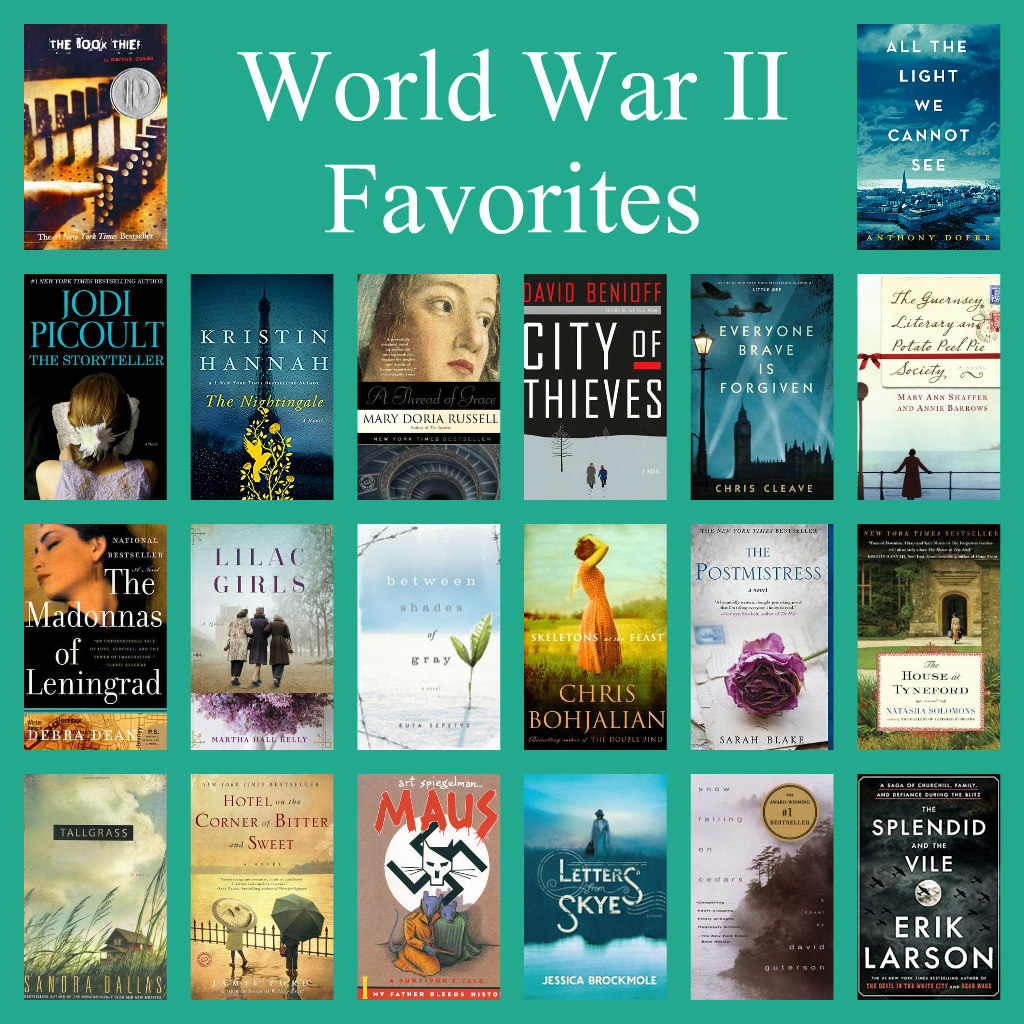
World War II Favorites


It's interesting how our reading tastes evolve as we become adults and grow older. If you had told me when I was in high school that I'd fall in love with historical fiction, particularly World War II novels, I would have scoffed. I had no interest in reading about history, which I equated to dull and dry "serious" books. I'm not sure which book swayed me to change my opinion, but this genre is now one of my favorites and one that has taught me so much about that era. 

You can find my reviews for the above novels* (plus one nonfiction favorite that I couldn't omit) by clicking on the links below. While I have several remaining unread WWII books on my shelf, I'd love to hear about some of your favorites.

The Book Thief by Markus Zusak (5/5)

All the Light We Cannot See by Anthony Doerr (5/5)

The Storyteller by Jodi Picoult (4.75/5)

The Nightingale by Kristin Hannah (4.5/5)

A Thread of Grace by Mary Doria Russell (pre-blogging)

City of Thieves by David Benioff (5/5)

Everyone Brave is Forgiven by Chris Cleave (4/5)

The Guernsey Literary and Potato Peel Pie Society by Mary Ann Shaffer and Annie Barrows (4.75/5)

The Madonnas of Leningrad by Debra Dean (4/5)

Lilac Girls by Martha Hall Kelly (3/5)

Between Shades of Gray by Ruta Sepetys (4/5)

Skeletons at the Feast by Chris Bohjalian (3.5/5)

The Postmistress by Sarah Blake (4.75/5)

The House at Tyneford by Natasha Solomons (4.5/5)

Tallgrass by Sandra Dallas (3.5/5)


Maus I by Art Spiegelman (3.5/5)

Letters from Skye by Jessica Brockmole (3.5/5)

Snow Falling on Cedars by David Gutterson (4.5/5)

The Splendid and the Vile by Erik Larson (nonfiction) (5/5)

*How could I forget to include Atonement by Ian McEwan??

November 22, 2021

The Splendid and the Vile


Nonfiction - History
2020 Crown Publishing
Finished on November 16, 2021
Rating: 5/5 (Excellent)

Publisher's Blurb:

The #1 New York Times bestselling author of Dead Wake and The Devil in the White City delivers a startlingly fresh portrait of Winston Churchill and London during the Blitz.

On Winston Churchill's first day as prime minister, Hitler invaded Holland and Belgium. Poland and Czechoslovakia had already fallen, and the Dunkirk evacuation was just two weeks away. For the next twelve months, Hitler would wage a relentless bombing campaign, killing 45,000 Britons (30,000 of them Londoners) and destroying two million homes. It was up to Churchill to hold the country together and persuade President Franklin Roosevelt that Britain was a worthy ally--that she was willing to fight to the end.

In The Splendid and the Vile, Erik Larson shows, in cinematic detail, how Churchill taught the British people "the art of being fearless." It is a story of political brinksmanship but also an intimate domestic drama, set against the backdrop of Churchill's prime-ministerial country house, Chequers, and his wartime residence, Ditchley, where Churchill and his entourage go when the moon is brightest and the bombing threat is highest. Drawing on a wealth of untapped sources, including recently declassified files, intelligence reports, and personal diaries only now available, Larson provides a new lens on London's darkest year through the day-to-day experience of Churchill and his family: his wife, Clementine; their daughters, Sarah, Diana, and the youngest, Mary, who chafes against her parents' wartime protectiveness; their son, Randolph, and his beautiful, unhappy wife, Pamela; her illicit lover, a dashing American emissary; and the cadre of close advisors who comprised Churchill's "Secret Circle," including his dangerously observant private secretary, John Colville; newspaper baron Lord Beaverbrook; and the Rasputin-like Federick Lindemann.

The Splendid and the Vile takes readers out of today's political dysfunction and back to a time of true leadership, when--in the face of unrelenting horror--Churchill's eloquence, strategic brilliance, and perseverance bound a country, and a family, together.

The Splendid and the Vile may be my favorite book of 2021! Until now, I don't believe I have ever read such a compelling book of history. I've been a longtime fan of World War II narratives, but mostly in the form of historical fiction. I requested an ARC of Erik Larson's most recent publication in late 2019 and was happy to receive a copy from the publisher specifically to give to my husband since he's read almost everything written about Winston Churchill. Truthfully, I wasn't even sure if I would read the book since I wasn't exactly enamoured with Larson's previous works. I gave up on The Devil in the White City (although, to be fair, I was in the middle of it in 2005 when tragedy struck our family and I never found the desire to pick it up again), gave Dead Wake (which I listened to on audio) a 2/5 rating, and Isaac's Storm (which I read for last year's Nonfiction November challenge) a 3/5 rating. But my husband assured me that Larson's newest book is very good and that I'd probably like it since it's a subject about which I enjoy reading. So I added it to my stack for this year's Nonfiction November challenge

Wanting to read as many books as possible for this challenge, I was tempted to start the month with some shorter memoirs that I'd chosen and leave what I perceived as a weighty tome for later in the month. However, I changed my mind, trying not to be put off by the 500+ pages of text. I shouldn't have worried; I simply could not put it down! I was drawn in from the prologue and found the entire text (including the sources and acknowledgments, which I pored over, gleaning more historical tidbits that weren't included in the text) engaging and informative. The narrow focus of a specific period during the war (Churchill's first year as prime minister, from May 10, 1940 to May 10, 1941) made it all the more compelling and I never felt any detail or description of events unnecessary.

I enjoyed reading not only about Churchill's role as prime minister during the Blitz, but also the individual stories and reflections about key events by members of his family and staff, derived from their personal diaries and letters. Additionally, there are accounts from Mass-Observation diarists, as well as ordinary British citizens, which further increases the intimacy of the narrative. 
The perspective from the ground was equally stunning. One young man, Colin Perry, eighteen, was on his bicycle when the first wave passed overhead. "It as the most amazing, impressive, riveting sight," he wrote later. "Directly above me were literally hundreds of planes, Germans! The sky was full of them." The fighters stuck close, he recalled, "like bees around their queen."
Larson also includes specific details and remarks by Virginia Woolf, Ian Fleming and Graham Greene, adding to this reader's enjoyment.

I couldn't help but be reminded of the terrorist attacks on the United States on September 11, 2001 as I read the following:
The day was warm and still, the sky blue above a rising haze. Temperatures by afternoon were in the nineties, odd for London. People thronged Hyde Park and lounged on chairs set out beside the Serpentine. Shoppers jammed the stores of Oxford Street and Piccadilly. The giant barrage of balloons overhead cast lumbering shadows on the streets below. After the August air raid when bombs first fell on London proper, the city had retreated back into a dream of invulnerability, punctuated now and then by false alerts whose once-terrifying novelty was muted by the failure of bombers to appear. The late-summer heat imparted an air of languid complacency. In the city's West End, theaters hosted twenty-four productions, among them the play Rebecca, adapted for the stage by Daphne du Maurier from her novel of the same name. Alfred Hitchcock's movie version, starring Laurence Olivier and Joan Fontaine, was also playing in London, as were the films The Thin Man and the long-running Gaslight.

It was a fine day to spend in the cool green of the countryside. 

and

The dust burst outward rapidly at first, like smoke from a cannon, then slowed and dissipated, sifting and settling, covering sidewalks, streets, windshields, double-decker buses, phone booths, bodies. Survivors exiting ruins were coated head to toe as if with gray flour. Harold Nicolson, in his diary, described seeing people engulfed in a "thick fog which settled down on everything, plastering their hair and eyebrows with thick dust." 

There is nothing quite like a great book to make one wish to read more about a particular subject. I plan to read Larson's earlier publication, In the Garden of Beasts, but I'm also interested in Roy Jenkin's Churchill, Martin Gilbert's The Finest Hour, John Lukacs's Five Days in London, May 1940, Doris Kearns Goodwins' No Ordinary Time (which I began many years ago, but set aside due to its length), and William Shirer's The Rise and Fall of the Third Reich (yes, another hefty read, I know!). 

I would also like to re-watch Darkest Hour, The Gathering Storm, Into the Storm, Winton Churchill's: Walking with Destiny, and Churchill's Secret. Any chance that Ken Burns and Erik Larson can get together and create a documentary based on this book? Please?