Showing posts with label 2024. Show all posts

January 5, 2025

2024 Year End Survey and Top Picks List


I thought my reading in 2023 was outstanding, but this past year was equally enjoyable. I didn't have as many 5-star reads in 2024 as I did in 2023, but the combination of 5 and 4.5 star ratings came out only one book shy of last year's totals. Remarkable!

Much like 2023, I surpassed my Goodreads goal of 60 books, and my numbers in November and December were better than anticipated. I also gave up on a lot of books. I might post a collage of those disappointments, eager to hear why others loved them, but doubt I'll be swayed to give them a second chance. I also sampled over two dozen books in December that have been on my shelves for years. They have gone in the donation box and it feels great to see some space in my bookcase!

Now for the fun stats of 2024!

Total Books Read: 63

Print Books: 50
Audiobooks: 13
ebooks: 0

Female Authors: 48
Male Authors: 15
New-To-Me Authors: 23

Fiction: 51
Nonfiction: 12

General Fiction: 29
Classics: 2
Poetry: 0
Historical Fiction: 5
Horror: 0
Science Fiction/Fantasy: 1
Time Travel: 0
Dystopia: 1
Mystery/Thrillers: 13
Westerns: 0
Epistolary: 1
Childrens: 1
Young Adult: 2
Memoir: 8
Travel/Food: 1
Nature/Science: 1
Essays: 0

Rereads: 7
Debuts: 9

Over 400 pages: 8
Over 500 pages: 3

ARCs: 12
Borrowed from Library: 11
From My Stacks: 40

Total Pages Read: 15,130
Pages not included from books I gave up on: 711!
Total Hours Listened: 163 hours and 8 minutes
Time not included from books I gave up on: 10 hours and 23 minutes

Ratings:

5 stars: 7
4.5 stars: 14
4 stars: 24
3.5 stars: 6
3 stars: 7
2 stars: 5

Top Picks of 2024 (5 stars):

Demon Copperhead by Barbara Kingsolver

In Memoriam by Alice Winn

Sandwich by Catherine Newman


Left on Tenth by Delia Ephron

Since We Fell by Dennis Lehane

Billy Summers by Stephen King


Honorable Mentions (4.5/5 stars):

Still Life by Sarah Winman

Holly by Stephen King


The Bird Hotel by Joyce Maynard

Small Things Like These by Claire Keegan

September by Rosamunde Pilcher

The Plot by Jean Hanff Korelitz

Salt to the Sea by Ruta Sepetys

The Weight of Silence by Heather Gudenkauf


The Comforts of Home by Susan Hill

The Golden Couple by Greer Hendricks and Sarah Pekkanen

Small Mercies by Dennis Lehane


Find my previous Year End Surveys and Top Pick lists here.

December 23, 2024

The Swimmers


The Swimmers by Julie Otsuka
Fiction
2022
Finished on December 20, 2024
Rating: 4/5 (Very Good)

Publisher's Blurb:

The swimmers are unknown to one another except through their private routines (slow lane, medium lane, fast lane) and the solace each takes in their morning or afternoon laps. But when a crack appears at the bottom of the pool, they are cast out into an unforgiving world without comfort or relief.

One of these swimmers is Alice, who is slowly losing her memory. For Alice, the pool was a final stand against the darkness of her encroaching dementia. Without the fellowship of other swimmers and the routine of her daily laps she is plunged into dislocation and chaos, swept into memories of her childhood and the Japanese American incarceration camp in which she spent the war. Alice’s estranged daughter, reentering her mother’s life too late, witnesses her stark and devastating decline. Written in spellbinding, incantatory prose, The Swimmers is a searing, intimate story of mothers and daughters, and the sorrows of implacable loss: the most commanding and unforgettable work yet from a modern master.

I was quite sure that I'd read one of Julie Otsuka's earlier novels, but if so, it must have been pre-blogging days since I can't find a review here or on Goodreads. I picked up a copy of The Swimmers while on one of our recent road trips and I'm glad I didn't let it sit on my shelves for too long. It's a quick read (under 200 pages) and despite the sad themes of estrangement, dementia, and loss, I was enjoyed the book and was deeply moved. 

The first part of the novel revolves around the group of swimmers and their daily routines, habits, and quirks at the pool. There was a time, many years ago, that I thought I could add lap swimming to my workout routine. I got a colorful Speedo swimsuit and some fancy goggles and began a short-lived venture into swimming at our gym. I'm not sure how many weeks (days?) I lasted, but I do remember that I found it very dull, and it was all I could do to swim for 30 minutes. I was a runner at the time, and I quickly returned to my daily runs outside while listening to my favorite music. I'm not sure my knees appreciate my choice of running over swimming, and now I do neither. But I digress.
Most days, at the pool, we are here to leave our troubles on land behind. Failed painters become elegant breaststrokers. Untenured professors slice, shark-like, through the water, with breathtaking speed. The newly divorced HR Manager grabs a faded red Styrofoam board and kicks with impunity. The downsized adman floats, otter-like, on his back, as he stares up at the clouds on the painted pale blue ceiling, thinking, for the first time all day long, of nothing. Let it go. Worriers stop worrying. Bereaved widows cease to grieve. Out-of-work actors unable to get traction above ground glide effortlessly down the fast lane, in their element, at last. I've arrived! And for a brief interlude we are at home in the world. Bad moods life, tics disappear, memories reawaken, migraines dissolve, and slowly, slowly, the chatter in our minds begins to subside as stroke after stroke, length after length, we swim.
The cadence of Otsuka's prose is snappy and at times, circular or repetitive, and I think I would have enjoyed listening to the audio edition of the book in order to hear the poetic delivery of the story. The middle section lost momentum, and I grew tired of the swimmers' anxious queries about the ongoing discovery of new cracks in the pool surface. However, the final section drew me back in, but oh how my heart ached for Alice, who suffers from frontotemporal dementia.
FTD. Some of the symptoms: gradual changes in personality, inappropriate behavior in public, apathy, weight gain, loss of inhibition, the desire to hoard.
Lisa Genova's brilliant work, Still Alice (reviewed here), put a face on Alzheimer's, and Julie Otsuka has done the same with dementia and the heartbreaking existence in a memory care facility. Otsuka's collective point-of-view, as well as her litany of traits and behaviors of the swimmers (and residents in the "home") requires patience from her readers, but overall, I thought the book was exceptionally good. It might hit too close to home for some, but the inclusion of humor provides some levity to an otherwise devastating narrative. Recommend with reservations.

December 21, 2024

Sipsworth


Sipsworth by Simon Van Booy
Fiction
2024
Finished on December 17, 2024
Rating: 4/5 (Very Good)

Publisher's Blurb:

Over the course of two weeks, in a small English town, a reclusive widow discovers an unexpected reason to live.

Following the loss of her husband and son, Helen Cartwright returns to the village of her childhood after living abroad for six decades. Her only wish is to die quickly and without fuss. She retreats into her home on Westminster Crescent, becoming a creature of routine and habit: "Each day was an impersonation of the one before with only a slight shuffle--as though even for death there is a queue."

Then, one cold winter night, a chance encounter with a mouse sets Helen on a surprising journey.

Sipsworth is a reminder that there can be second chances. No matter what we have planned for ourselves, sometimes life has plans of its own. With profound compassion, Simon Van Booy illuminates not only a deep friendship forged between two lonely creatures, but the reverberations of goodness that ripple out from that unique bond.

We live in a forest on the Oregon Coast. While we love to watch the birds outside our windows, we've recently stopped feeding them since the seed has been attracting rats! We wound up with a rat in our attic a few months ago, and after closing off the spot where we thought it was going in, we decided to put the bird feeders away...at least until next spring. This is all to say that I am not a fan of rodents. Unlike Van Booy's main character, I do not welcome mice (or rats) in this house. I'm happy that Helen found companionship with a furry four-legged creature, but if I wind up living alone in my old age, I'm more likely to get a dog.
Every day was an impersonation of the one before with only a slight shuffle--as though even for death there is a queue.
I've read some of Simon Van Booy's short stories, and while they didn't wow me, I was curious about Sipsworth, as I enjoy books about aging women. The novel is an easy read, and I enjoyed the opening chapters, but as I progressed in my reading, I felt the story was edging toward something overly sappy. I continued reading and with a surprising revelation about Helen, my attention returned. Those who believe in second chances and are looking for a feel-good read will delight in Van Booy's tender novel.

Recommend.

December 19, 2024

Small Things Like These


Small Things Like These by Claire Keegan
Fiction
2021
Finished on December 14, 2024
Rating: 4.5/5 (Very Good)

Publisher's Blurb:

It is 1985 in a small Irish town. During the weeks leading up to Christmas, Bill Furlong, a coal merchant and family man faces into his busiest season. Early one morning, while delivering an order to the local convent, Bill makes a discovery which forces him to confront both his past and the complicit silences of a town controlled by the church.

Already an international bestseller, Small Things Like These is a deeply affecting story of hope, quiet heroism, and empathy from one of our most critically lauded and iconic writers.

Once again, Claire Keegan has authored a spare story that will tug at your heartstrings, while making you believe in the good of humanity. Inspired by true accounts of the Magdalen Laundry scandal in Ireland, Keegan conveys the cruel acts of the Catholic nuns with lean, yet powerful, prose. Both Foster and Small Things Like These belong in everyone's permanent collection. 
It seemed both proper and at the same time deeply unfair that so much of life was left to chance.

A Note from the Author:

This is a work of fiction based in no part on any individual or individuals. Ireland’s last Magdalen laundry was not closed down until 1996. It is not known how many girls and women were concealed, incarcerated and forced to labour in these institutions. Ten thousand is the modest figure; thirty thousand is probably more accurate. Most of the records from the Magdalen laundries were destroyed, lost, or made inaccessible. Rarely was any of these girls’ or women’s work recognised or acknowledged in any way. Many girls and women lost their babies. Some lost their lives. Some or most lost the lives they could have had. It is not known how many thousands of infants died in these institutions or were adopted out from the mother-and-baby homes. Earlier this year, the Mother and Baby Home Commission Report found that nine thousand children died in just eighteen of the institutions investigated. In 2014, the historian Catherine Corless made public her shocking discovery that 796 babies died between 1925 and 1961 in the Tuam home, in County Galway. These institutions were run and financed by the Catholic Church in concert with the Irish State. No apology was issued by the Irish government over the Magdalen laundries until Taoiseach Enda Kenny did so in 2013.”

Joni Mitchell wrote "The Magdalene Laundries" after reading an article shortly after the discovery of 155 bodies of "fallen women" in a mass grave in Dublin. 

I was an unmarried girl
I'd just turned twenty-seven
When they sent me to the sisters
For the way men looked at me
Branded as a jezebel
I knew I was not bound for Heaven
I'd be cast in shame
Into the Magdalene laundries 
 
Most girls come here pregnant
Some by their own fathers
Bridget got that belly
By her parish priest
We're trying to get things white as snow
All of us woe-begotten-daughters
In the steaming stains
Of the Magdalene laundries
 
Prostitutes and destitutes
And temptresses like me
Fallen women
Sentenced into dreamless drudgery
Why do they call this heartless place
Our Lady of Charity?
Oh charity!
 
These bloodless brides of Jesus
If they had just once glimpsed their groom
Then they'd know and they'd drop the stones
Concealed behind their rosaries
They wilt the grass they walk upon
They leech the light out of a room
They'd like to drive us down the drain
At the Magdalene laundries
 
Peg O'Connell died today
She was a cheeky girl
A flirt
They just stuffed her in a hole!
Surely to God you'd think at least some bells should ring!
One day I'm going to die here too
And they'll plant me in the dirt
Like some lame bulb 
That never blooms come any spring
Not any spring
No, not any spring 
Not any spring

Bravo, Claire Keegan (and Joni)! Highly recommend.

Oprah has chosen Small Things Like These for her book club selection. You can see her interview Claire Keegan here. I don't care for the big Starbuck's sponsorship push, but I enjoyed hearing Keegan's thoughts about her novella.

December 17, 2024

In Memoriam


In Memoriam by Alice Winn
Fiction
2023
Finished on December 13, 2024
Rating: 5/5 (Excellent)

Publisher's Blurb:

It’s 1914, and World War I is ceaselessly churning through thousands of young men on both sides of the fight. The violence of the front feels far away to Henry Gaunt, Sidney Ellwood and the rest of their classmates, safely ensconced in their idyllic boarding school in the English countryside. News of the heroic deaths of their friends only makes the war more exciting.

Gaunt, half German, is busy fighting his own private battle–an all-consuming infatuation with his best friend, the glamorous, charming Ellwood–without a clue that Ellwood is pining for him in return. When Gaunt’s family asks him to enlist to forestall the anti-German sentiment they face, Gaunt does so immediately, relieved to escape his overwhelming feelings for Ellwood. To Gaunt’s horror, Ellwood rushes to join him at the front, and the rest of their classmates soon follow. Now death surrounds them in all its grim reality, often inches away, and no one knows who will be next.

An epic tale of both the devastating tragedies of war and the forbidden romance that blooms in its grip, In Memoriam is a breathtaking debut.

Impressive debut! I've read numerous books about World War II, but only a few set during the Great War. In Memoriam took my breath away, and I'm astonished that this gorgeous novel is the work of such a young author; she writes with the skill of a seasoned novelist.
“Don't be ridiculous. It (gas) was outlawed at the Hague Convention," I said.
I actually said that. I actually believed that the principles of our civilisation, our civilisation that has developed further than any other in the history of the world, giving us telephones and trains and flying, for God's sake, we can fly. I thought, surely such a civilisation, that prides itself on conquering the beast in man and seeks only to bend towards beauty and prosperity, surely, surely, surely, it would not shatter in such a vile and disgusting way. 
The Hague Convention sought to make war more humane. We had reached a point in history where we believed it was possible to make war humane.”
As I read Winn's war saga, I was reminded of John Boyne's tale of two soldiers in his remarkable novel, The Absolutist. Both stories examine not only the horrific effects of war on young men (many still in their early teens), but also of forbidden love during a period in history in which a soldier could not only be court-marshalled, but possibly executed for an illicit affair with another man. In addition to the budding romance between Gaunt and Ellwood, Winn draws her readers into the trenches at the front lines (including Loos and the Battle of the Somme, the latter of which was one of the bloodiest battles of the war), at times so brutally graphic that I'm sure I would turn my head if viewing the scenes on the big screen. And yet, the violence isn't gratuitous, and I came to care for all the boys, heartbroken with each new posting of death in The Preshutian Roll of Honour.
"Over the top, you cowardly bastards!” I cried, my voice breaking, because I did not want to do it, I didn’t, Elly, I knew those men, but what other choice had I? They were stupid with fear, and only more fear would move them.
and
It was dusk, on a Friday. The battered skeletons of trees tapered against the fresh starlight in No Man's Land. The sky offered curious glimpses of beauty, from time to time. The men wrote about it in their letters, describing sunsets in painstaking detail to their families, as if there was nothing to see at the front but crimson clouds and dusted rays of golden light.
With great tension, superb dialogue, and an unpredictable finale, Alice Winn has crafted an outstanding work of historical fiction that held me enthralled from beginning to end. My only disappointment is that there is no backlist of earlier novels to add to my TBR list. This is an author to watch for! 

I couldn't put it down. Highly recommend!

December 15, 2024

Lillian Boxfish Takes a Walk


Lillian Boxfish Takes a Walk by Kathleen Rooney
Fiction
2017
Finished on December 8, 2024
Rating: 3.5/5 (Good)

Any day you walk down a street and find nothing new but nothing missing counts as a good day in a city you love.

Publisher's Blurb:

It’s the last day of 1984, and 85-year-old Lillian Boxfish is about to take a walk.

As she traverses a grittier Manhattan, a city anxious after an attack by a still-at-large subway vigilante, she encounters bartenders, bodega clerks, chauffeurs, security guards, bohemians, criminals, children, parents, and parents-to-be—in surprising moments of generosity and grace. While she strolls, Lillian recalls a long and eventful life that included a brief reign as the highest-paid advertising woman in America—a career cut short by marriage, motherhood, divorce, and a breakdown.

A love letter to city life—however shiny or sleazy—Lillian Boxfish Takes a Walk by Kathleen Rooney paints a portrait of a remarkable woman across the canvas of a changing America: from the Jazz Age to the onset of the AIDS epidemic; the Great Depression to the birth of hip-hop.

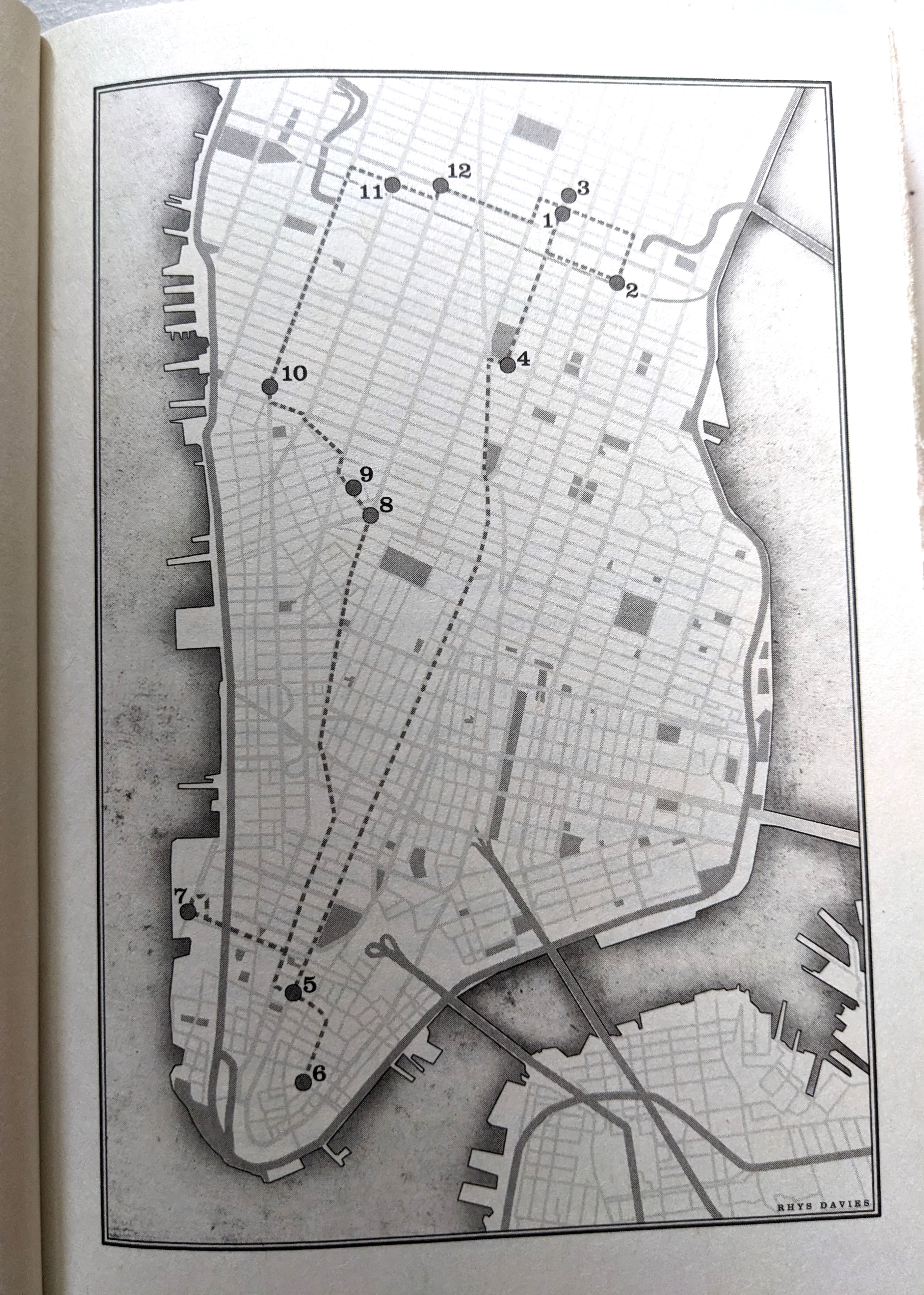
Lillian Boxfish Takes a Walk was slow to pull me in, but I didn't give up, and I wound up enjoying the story although it didn't wow me. I enjoy novels about women in their later years, but this story fell just shy of being one that I could love. One of my favorite things to do when visiting a new town or city is to wander up and down the streets, exploring neighborhoods and business districts. I've walked numerous miles in Victoria, Banff, Jasper, Port Townsend, Jackson, and London, to name a few. When my daughter and I were in NYC many years ago, we walked from our lovely hotel (The Peninsula) on 5th Avenue up to the Guggenheim Museum, then back down 5th all the way to Battery Park. Along the way, we admired St. Patrick's Cathedral, the New York Public Library, the Flatiron Building, and the World Trade Center. We took the ferry to the Statue of Liberty and then over to the Ellis Island National Museum of Immigration. After more than eight miles, we were exhausted and caught a cab back to our hotel. And thus, I was happy to discover a map of Lillian's route of her New Year's Eve walk in NYC, and couldn't help but notice that it was very similar to the one we took in 1996! 


Other than the premise of spending New Year's Eve walking across Manhattan, I doubt I'll remember very many details about this book. But, if I make it back to NYC, I'd love to retrace Lillian's steps.

December 13, 2024

Recitatif


Recitatif by Toni Morrison
Fiction
First published in 1983 (new edition in 2022)
Finished on December 8, 2024
Rating: 3.5/5 (Good)

Publisher's Blurb:

A beautiful, arresting short story by Toni Morrison—the only one she ever wrote—about race and the relationships that shape us through life, with an introduction by Zadie Smith.

Twyla and Roberta have known each other since they were eight years old and spent four months together as roommates in the St. Bonaventure shelter. Inseparable at the time, they lose touch as they grow older, only to find each other later at a diner, then at a grocery store, and again at a protest. Seemingly at opposite ends of every problem, and in disagreement each time they meet, the two women still cannot deny the deep bond their shared experience has forged between them.

Written in 1980 and anthologized in a number of collections, this is the first time Recitatif is being published as a stand-alone hardcover. In the story, Twyla's and Roberta's races remain ambiguous. We know that one is white and one is black, but which is which? And who is right about the race of the woman the girls tormented at the orphanage?

Morrison herself described this story as "an experiment in the removal of all racial codes from a narrative about two characters of different races for whom racial identity is crucial." Recitatif is a remarkable look into what keeps us together and what keeps us apart, and about how perceptions are made tangible by reality.

I took the advice of another reader and saved Zadie Smith's extensive introduction until I had finished reading Morrison's short story. Recitatif is a work that would be best read and discussed in a book group (or perhaps in a college literature class). The story is straightforward enough, but the underlying themes about race (and the perception of racial codes), as well as memory, are deep and thought-provoking. Smith's erudite analysis is helpful, although at times it was too cerebral. Again, one to discuss with others.

December 11, 2024

Be Ready When the Luck Happens


Be Ready When the Luck Happens: A Memoir by Ina Garten
Nonfiction - Memoir
2024
Read by Ina Garten
Finished on December 8, 2024
Rating: 4.5/5 (Excellent)

Publisher's Blurb:

In her long-awaited memoir, Ina Garten—aka the Barefoot Contessa, author of thirteen bestselling cookbooks, beloved Food Network personality, Instagram sensation, and cultural icon—shares her personal story with readers hungry for a seat at her table.

Here, for the first time, Ina Garten presents an intimate, entertaining, and inspiring account of her remarkable journey. Ina’s gift is to make everything look easy, yet all her accomplishments have been the result of hard work, audacious choices, and exquisite attention to detail. In her unmistakable voice (no one tells a story like Ina), she brings her past and her process to life in a high-spirited and no-holds-barred memoir that chronicles decades of personal challenges, adventures (and misadventures) and unexpected career twists, all delivered with her signature combination of playfulness and purpose.

From a difficult childhood to meeting the love of her life, Jeffrey, and marrying him while still in college, from a boring bureaucratic job in Washington, D.C., to answering an ad for a specialty food store in the Hamptons, from the owner of one Barefoot Contessa shop to author of bestselling cookbooks and celebrated television host, Ina has blazed her own trail and, in the meantime, taught millions of people how to cook and entertain. Now, she invites them to come closer to experience her story in vivid detail and to share the important life lessons she learned along the way: do what you love because if you love it you’ll be really good at it, swing for the fences, and always Be Ready When the Luck Happens.

From the opening track of the audiobook, I was immediately hooked on Be Ready When the Luck Happens. Ina Garten narrates her memoir with ease and enthusiasm, drawing me in as though we were sitting on her porch, enjoying a cup of coffee and a homemade treat warm from her oven. Her conversational tone is as inviting as her beautiful cookbooks (of which I own several) and I enjoyed my daily walks, learning more about her early career and relationship with her husband, Jeffrey. As one would expect, Ina's circle of friends and acquaintances are also well-known celebrities and yet I never felt she was dropping names while sharing anecdotes about their interactions. Her memoir is honest and genuine, and has inspired me to dig out her cookbooks for my weekly meal planning. Maybe I'll start with a sweet treat since it is the holiday season!

Highly recommend!

December 5, 2024

I Feel Bad About My Neck


I Feel Bad About My Neck by Nora Ephron
Nonfiction - Essays
2006
Finished on December 1, 2024
Rating: 4/5 (Very Good)

Publisher's Blurb:

With her disarming, intimate, completely accessible voice, and dry sense of humor, Nora Ephron shares with us her ups and downs in I Feel Bad About My Neck, a candid, hilarious look at women who are getting older and dealing with the tribulations of maintenance, menopause, empty nests, and life itself.

The woman who brought us When Harry Met Sally..., Sleepless in Seattle, You've Got Mail, and Bewitched, and the author of best sellers Heartburn, Scribble Scribble, and Crazy Salad, discusses everything--from how much she hates her purse to how much time she spends attempting to stop the clock: the hair dye, the treadmill, the lotions and creams that promise to slow the aging process but never do. Oh, and she can't stand the way her neck looks. But her dermatologist tells her there's no quick fix for that.

Ephron chronicles her life as an obsessed cook, passionate city dweller, and hapless parent. She recounts her anything-but-glamorous days as a White House intern during the JFK years ("I am probably the only young woman who ever worked in the Kennedy White House that the President did not make a pass at") and shares how she fell in and out of love with Bill Clinton - from a distance, of course. But mostly she speaks frankly and uproariously about life as a woman of a certain age.

Utterly courageous, wickedly funny, and unexpectedly moving in its truth telling, I Feel Bad About My Neck is a book of wisdom, advice, and laugh-out-loud moments, a scrumptious, irresistible treat.

It's been almost 18 years since I read Ephron's collection of humorous essays, but as soon as I finished listening to her sister's memoir (Left on Tenth), I decided to give this book a second reading. It was enjoyable, but maybe not quite as much as the first time around. I marked the same passages as noted in my original review, so click here to read that one.

November 30, 2024

The Wild Trees


The Wild Trees by Richard Preston
Nonfiction
2007
Finished on November 25, 2024
Rating: 3.5/5 (Good)

Those who dwell among the beauties and mysteries of the earth are never alone or weary of life. ~Rachel Carson

Publisher's Blurb:

Hidden away in foggy, uncharted rain forest valleys in Northern California are the largest and tallest organisms the world has ever sustained–the coast redwood trees, Sequoia sempervirens. Ninety-six percent of the ancient redwood forests have been destroyed by logging, but the untouched fragments that remain are among the great wonders of nature. The biggest redwoods have trunks up to thirty feet wide and can rise more than thirty-five stories above the ground, forming cathedral-like structures in the air. Until recently, redwoods were thought to be virtually impossible to ascend, and the canopy at the tops of these majestic trees was undiscovered. In The Wild Trees, Richard Preston unfolds the spellbinding story of Steve Sillett, Marie Antoine, and the tiny group of daring botanists and amateur naturalists that found a lost world above California, a world that is dangerous, hauntingly beautiful, and unexplored.

The canopy voyagers are young–just college students when they start their quest–and they share a passion for these trees, persevering in spite of sometimes crushing personal obstacles and failings. They take big risks, they ignore common wisdom (such as the notion that there’s nothing left to discover in North America), and they even make love in hammocks stretched between branches three hundred feet in the air.

The deep redwood canopy is a vertical Eden filled with mosses, lichens, spotted salamanders, hanging gardens of ferns, and thickets of huckleberry bushes, all growing out of massive trunk systems that have fused and formed flying buttresses, sometimes carved into blackened chambers, hollowed out by fire, called “fire caves.” Thick layers of soil sitting on limbs harbor animal and plant life that is unknown to science. Humans move through the deep canopy suspended on ropes, far out of sight of the ground, knowing that the price of a small mistake can be a plunge to one’s death.

Preston’s account of this amazing world, by turns terrifying, moving, and fascinating, is an adventure story told in novelistic detail by a master of nonfiction narrative. The author shares his protagonists’ passion for tall trees, and he mastered the techniques of tall-tree climbing to tell the story in The Wild Trees –the story of the fate of the world’s most splendid forests and of the imperiled biosphere itself.

I picked up a copy of The Wild Trees at Eureka Books a couple of years ago on one of our road trips down to Santa Rosa. Having previously read Damnation Spring (Ash Davidson's novel, which is set in the California Redwoods), I was curious about Preston's work of nonfiction about the same location. It's been years since I've read The Hot Zone and The Demon in the Freezer, two of his nonfiction narratives, but I remembered how both books were page-turners, so I grabbed a copy of The Wild Trees from the local interest display.

While not as engrossing as Preston's earlier books, The Wild Trees held my interest (mostly) and I learned not only a lot about the Coast Redwoods, but also about tree climbing techniques. There is a lot of detailed information on how Steve Sillett, Marie Antoine, and Preston himself climb these enormous trees. And they don't just climb straight up (using a variety of ropes and assorted tools), but they traverse from tree to tree (skywalking), branchwalk, canopy-trek, and even sleep in treeboats (hammocks). The last time I can remember climbing a tree was in fourth grade. We had a large mulberry tree in our front yard, which my best friend and I would climb and snack on the juicy berries while hiding from my younger brother. I would bet we weren't more than 8 feet off of the ground. I can't imagine climbing 350 feet, which is about the height of some of these ancient old growth redwoods.

As I mentioned in my review of Damnation Spring, I am well-acquainted with Northern California due to our many RV road trips down Highway 101 from our home on the Oregon coast. Preston mentions places we've either camped or enjoyed roadside lunches (Chetco River, Crescent City, Del Norte Coast Redwoods State Park, Redwood Creek, Prairie Creek, Avenue of the Giants, Founders Grove, Eel River, Humboldt Redwoods State Park, Eureka, etc.), which made it easy to envision where the old growth forests exist.


Things I learned (all info is based on 2007 publication date):
  • The coast redwood is the tallest species of tree on earth. The tallest redwoods today are between 350 and close to 380 feet in height--thirty-five to thirty-eight stories tall.*
  • Nobody knows the ages of any of the living giant coast redwoods, because nobody has ever drilled into one of them in order to count its annual growth rings. Drilling into an old redwood would not reveal its age, anyway, because the oldest redwoods seem to be hollow; they don't have growth rings left in their centers to be counted. Botanists suspect that the oldest living redwoods may be somewhere between two thousand and three thousand years old--they seem to be roughly the age of the Parthenon.

  • By the measure of overall size--the volume of wood--the largest species of living tree on earth is not the coast redwood but the giant sequoia, a type of cypress that is closely related to the coast redwood.  

  • There are very few birds in the redwood canopy. Redwoods produce poisons in their wood and needles that discourage insects from feeding on them, and consequently many species of birds that feed on insects go elsewhere to look for food.
Preston's book is chock-full of detail, whether it's about tree climbing or the multitude of organisms that live in the redwood canopy. From beginning to end, he introduces numerous students, naturalists, biologists, professors, and experts in the field of botany, so many that I created a list of "who's who" in order to keep track of key players. The writing gets bogged down in spots with the intricate details of not only climbing techniques, but personal information of these folks (dating, marriage, divorce, work life, etc.), making for an uneven read. I rarely skim a book, but I skipped over a few pages and didn't feel as if I missed anything critical in this wordy story. I do know that I will never not take advantage of looking up when in a grove of redwoods. They are magnificent trees. On the other hand, I also know that I have no desire to spend the night in a hammock at the top of any tree! I am curious to know how much the technology of drones has changed the way in which redwoods are measured and studied. I'll bet there are still those who prefer the old-school method of climbing these majestic trees.
"It helps us know how the forests work as a whole and how the trees work as organisms," she said. "Then we can help them out if they're having problems--and they are having problems. It occurs to me that I have a fairly cynical outlook on so many things in the world today--this insane world. But as long as we still have these trees, there's hope for us." 
*The tallest living tree is Hyperion, which is located in the Redwood National Park, and is 380.8 feet.

November 28, 2024

Left on Tenth: A Second Chance at Life


Left on Tenth: A Second Chance at Life by Delia Ephron
Nonfiction - Memoir
2022
Read by Delia Ephron
Finished on November 25, 2024
Rating: 5/5 (Excellent)

Publisher's Blurb:

The bestselling, beloved writer of romantic comedies like You've Got Mail tells her own late-in-life love story, complete with a tragic second act and joyous resolution.

Delia Ephron had struggled through several years of heartbreak. She’d lost her sister, Nora, and then her husband, Jerry, both to cancer. Several months after Jerry’s death, she decided to make one small change in her life—she shut down his landline, which crashed her internet. She ended up in Verizon hell.

She channeled her grief the best way she knew: by writing a New York Times op-ed. The piece caught the attention of Peter, a Bay Area psychiatrist, who emailed her to commiserate. Recently widowed himself, he reminded her that they had shared a few dates fifty-four years before, set up by Nora. Delia did not remember him, but after several weeks of exchanging emails and sixties folk songs, he flew east to see her. They were crazy, utterly, in love.

But this was not a rom-com: four months later she was diagnosed with AML, a fierce leukemia.

In Left on Tenth, Delia Ephron enchants as she seesaws us between tears and laughter, navigating the suicidal lows of enduring cutting-edge treatment and the giddy highs of a second chance at love. With Peter and her close girlfriends by her side, with startling clarity, warmth, and honesty about facing death, Ephron invites us to join her team of warriors and become believers ourselves.

Bravo! I have not read any of Delia Ephron's books, but I loved her films, You've Got Mail and Michael. I received an advance audio copy of Left on Tenth a couple of years ago and have finally made the time to give it a listen. Usually, I don't care for an author reading their own books, but Ephron's narration is outstanding. She drew me in to her life, and inner circle of friends and family, making me feel welcome, which in turn made me care about her struggle and recovery from leukemia. Delia's sister, Nora, died from complications of acute myeloid leukemia, the same type of cancer that Delia was fighting. Delia goes into great detail of her grueling treatment, but not once is it repetitive or boring. She shares sweet stories about her lovely new husband, Peter, and sprinkles humor throughout her memoir. I never felt that she was keeping her readers at arm's length, but rather created an intimate room for us to visit. I loved her conversational delivery, her authenticity, and her complete lack of pretension; if there was any name-dropping, it was never a distraction. 

On Friendship:
All these different friendships. Mine with Eugene is both business and personal. These bonds matter. They are little homes. Places of safety. I am taking stock now. Friendship. God, I love my friends.
On Grief:
 The silence in the apartment is loud.
On Love:
And one single thing about all this: We were both seventy-two and age meant nothing. We were getting as loopy, as obsessed with each other as anyone falling under the spell of romance.
On Dogs:
Dogs dig deep into your heart. They’re in the room, on the floor, in your lap, on the bed, pestering you for treats, chewing your sock, burrowing under sheets, making you laugh, following you about, eating the cheese you left on the table, tearing in wild happy circles after baths. They trust. They are innocence. They are unjudgmental observers of your every unguarded moment.
As much as I loved this audiobook, I would like to own a print edition for a second reading. Highly recommend!

I received a complimentary copy from Libro.fm. All thoughts and opinions are my own.

November 20, 2024

The Brave In-Between


Update: Amy Low passed away peacefully, surrounded by family, on Wednesday, November 27, 2024.

The Brave In-Between: Notes from the Last Room by Amy Low
Nonfiction - Memoir
2024
Finished on November 13, 2024
Rating: 4/5 (Very Good)

Publisher's Blurb:

Lessons and advice on navigating uncertainty while battling stage four cancer after divorce in midlife.

Amy Low resides in a room that is her last. Her medical team is clear-eyed with her: there is no cure for Stage IV metastatic colon cancer, and the odds of long-term survival are scant. Miraculously, she’s lived four years with her diagnosis, and that life between life has changed her.

Through the swirl of prolonged trauma and unbearable grief, a vantage point emerged—a window that showed her the way to relish life and be kinder to herself and others while living through the inevitable loss and heartbreak that crosses everyone’s paths. Instead of viewing joy and sorrow as opposites, she saw how both exist in harmony, full of mystery and surprise. Instead of seeing days as succeeding or failing, and physical selves as healthy or unwell, she’s learned to carry both achievements and afflictions in stride. And instead of bitterness and betrayal, forgiveness—toward her body, toward others, toward herself—became her wisest light.

Mapping her experiences to the words that St. Paul wrote in his own last room, The Brave In-Between is a sacred invitation to explore that space between triumph and tragedy. We all have a heart to marvel at miracles, a lightness to spot the absurdity, and an imagination to pause and extend empathy for others—even when tragedy strikes. Sometimes we just need a guide.

"Lessons and advice on navigating uncertainty while battling stage four cancer after divorce in midlife." Gee. Sounds like an entertaining book, doesn't it? I'm not sure why I'm drawn to stories about people battling diseases, but as I glance at my "memoir" shelf on Goodreads, there are a few. (Coincidentally, I was listening to another book, while reading this one, in which the author is dealing with the loss of her husband and leukemia.)

As with my previous read, You Could Make This a Beautiful Place, Amy Low's memoir resonates on many levels: divorce and co-parenting with an ex-spouse, Covid lockdown and Zoom, the upsetting election of 2016, etc. It's not simply a cancer story.

On hope:
Growing up in San Diego and rooting for the Padres, my brother and sister and I knew a little something about hope. We'd earned PhDs in hope. Most years, the Padres were out of contention by Mother's Day, but still we scrambled to get to games, pinning all of our dreams on Tony Gwynn* and remembering that miracles had a way of showing up despite it all. With a stirring in our hearts, we'd sit in the cheap seats, so high I thought we were closer to touching the moon than the field. What might happen?

Cancer is everywhere. I have friends and relatives currently battling this awful disease. I also know survivors. My younger brother was diagnosed with colon cancer at the age of 40. He is now 60 and cancer-free. So, to jump on my soap box--get your screenings, especially colonoscopies and mammograms. Cancer treatments have advanced, along with new technologies such as immunotherapy and target drugs. Early detection is critical!

Part medical narrative, part spirituality and philosophy, The Brave In-Between is both heartbreaking and uplifting. Recommend.

You can follow Amy Low on Instagram and Substack (Postcards from the Mountain).

*Sadly, Tony Gwynn died from complications of cancer of the salivary gland at the age of 54. 

November 19, 2024

You Could Make This Place Beautiful


You Could Make This Place Beautiful by Maggie Smith
Nonfiction - Memoir
2023
Finished on November 10, 2024
Rating: 5/5 (Outstanding)

It's easy to see the beginning of things, and harder to see the ends. ~Joan Didion

Publisher's Blurb:

In her memoir You Could Make This Place Beautiful, poet Maggie Smith explores the disintegration of her marriage and her renewed commitment to herself in lyrical vignettes that shine, hard and clear as jewels. The book begins with one woman’s personal, particular heartbreak, but its circles widen into a reckoning with contemporary womanhood, traditional gender roles, and the power dynamics that persist even in many progressive homes. With the spirit of self-inquiry and empathy she’s known for, Smith interweaves snapshots of a life with meditations on secrets, anger, forgiveness, and narrative itself. The power of these pieces is cumulative: page after page, they build into a larger interrogation of family, work, and patriarchy.

You Could Make This Place Beautiful, like the work of Deborah Levy, Rachel Cusk, and Gina Frangello, is an unflinching look at what it means to live and write our own lives. It is a story about a mother’s fierce and constant love for her children, and a woman’s love and regard for herself. Above all, this memoir is an argument for possibility. With a poet’s attention to language and an innovative approach to the genre, Smith reveals how, in the aftermath of loss, we can discover our power and make something new. Something beautiful.

I am out with lanterns, looking for myself. ~Emily Dickinson

I loved this book. However, it's brutally honest, and as Smith reveals the demise of her marriage, those who have faced similar scenarios may find it a difficult read. And yet, this new-to-me poet writes beautiful passages (and poems) centered on marriage, loss, motherhood, friendship and life without falling into a stereotypical navel-gazing rant. Some pages hold a single sentence or quote, others a brief paragraph, and a few need two to three pages to convey Smith's thoughts. It's this sort of layout that begs for "just one more page." It could have been twice as long, and it still wouldn't have been enough for this reader. 

I especially love her lyrical cadence in this passage:
There are so many windows, the house is lit naturally all day long, and you can follow the sunlight as it moves from the back of the house at sunrise to the front at sunset. There are so many windows, I couldn't bear to hang blinds or full curtain panels. With only cafe curtains covering the lower halves of the windows, my head can be seen floating from room to room at night from the street. There are so many windows, living in this house is like living in a glass display case, especially after dark. There are few places to hide.
She sounds like someone with whom I'd enjoy being friends:
I wonder what I would put in my own dating profile. Poet, writer, single mother of two, Gen Xer, lifelong Ohioan, city mouse, vegetarian. Loves books, live music, travel, dogs not cats, black coffee and black tattoos, dark beer and dark chocolate. Self-employed. Author of several books. Liberal, pro-choice, agnostic, monogamous. Aquarius. Gregarious introvert. Funny as hell. Occasionally melancholic. Good cook. Bed sleeper. Woman who, let's be real, probably won't trust you. Woman who will try.
About memoir:
"A memoir is about 'the art of memory,' and part of the art is in the curation. This isn't the story of a woman who fell in love again and therefore was healed and lived happily ever after. This is a story of a woman coming home to herself."
About poetry:
Poems and songs aren't the same, but they both rely on voice and form, rhythm and sound play, metaphor and image, repetition and surprise.

There were aspects of this book that resonated deeply with me, taking me back to a sad time in my life. But like Smith, I carry that young self inside me with the realization that I have grown from those difficult experiences.

How I picture it: We are all nesting dolls, carrying the earlier iterations of ourselves inside. We carry the past inside us. We take ourselves— all of our selves —wherever we go.
Inside forty-something me is the woman I was in my thirties, the woman I was in my twenties, the teenager I was, the child I was…
I still carry these versions of myself. It’s a kind of reincarnation without death: all these different lives we get to live in this one body, as ourselves.
I look forward to reading more by Maggie Smith. I've added Keep Moving: Notes on Loss, Creativity, and Change to my TBR list. I also subscribe to her Substack newsletters and follow her on Instagram. 

To read Maggie Smith is to embrace the achingly precious beauty of the present moment. ~TIME