***Update: 2007 Pulitzer Prize Winner for Fiction***
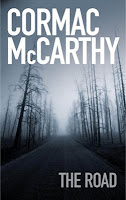
 The Road
 by Cormac McCarthyFictionFinished on 3/27/07Rating: 4/5 (Very Good)“I know not with what weapons World War III will be fought, but World War IV will be fought with sticks and stones.”~ Albert EinsteinBook Description:A searing, postapocalyptic [sic] novel destined to become Cormac McCarthy’s masterpiece.A father and his son walk alone through burned America. Nothing moves in the ravaged landscape save the ash on the wind. It is cold enough to crack stones, and when the snow falls it is gray. The sky is dark. Their destination is the coast, although they don’t know what, if anything, awaits them there. They have nothing; just a pistol to defend themselves against the lawless bands that stalk the road, the clothes they are wearing, a cart of scavenged food—and each other.The Road is the profoundly moving story of a journey. It boldly imagines a future in which no hope remains, but in which the father and his son, “each the other’s world entire,” are sustained by love. Awesome in the totality of its vision, it is an unflinching meditation on the worst and the best that we are capable of: ultimate destructiveness, desperate tenacity, and the tenderness that keeps two people alive in the face of total devastation.This is not a cheerful book. It is probably the grimmest book I’ve ever read. And one of the most difficult to review. When I finished reading the final page, I quickly decided I didn’t like the book. It was overwhelmingly bleak and depressing (and far too plausible). Yet, in the days following, my thoughts returned to the story, sifting through the psychological detritus that continued to linger, debating structure and style with my husband (who read and loved the novel), and ultimately changing my view and final rating. As we discussed the book, I told my husband that part of my initial distaste was simply due to its depressing nature. However, The Book Thief was also sad and depressing and bleak, and yet it’s one of my favorite books. I’m not sure why I’ve changed my opinion, but I’ve come to the conclusion that The Road is a beautifully crafted story, rich in texture and depth, and one that deserves a second reading. Perhaps I was too preoccupied trying to sort out all the missing plot points (What caused the nuclear war? Which coastline were they traveling toward? What are their names?!), none of which are of great importance after all, as the story represents every man, every child, and every nation.This is a fairly short novel, easily read in a day or two. The dialogue is quite sparse, as though the boy and his father were conserving all their strength just to put one foot in front of the other, not expending any extra energy toward conversation. Perhaps the brevity of their discussions is symbolic of the stark, barren environment. Or, maybe, after traveling together for several years in such desolate surroundings, it was no longer necessary to communicate in a sophisticated language. While anthropologists and linguists believe that language has evolved from primitive grunts and gestures into a powerful and sophisticated tool, McCarthy presents a bleak vision in which that evolution has now been reversed: The journey down the ruined road mirrors -- and is mirrored by -- the characters' linguistic descent; it's a narrative lacking in complex dialogue, one in which mumbles, nods, and one-word utterances are all that is needed and perhaps all that the characters can manage. McCarthy forces us to consider the painful likelihood that, when the world finally blinks out, the last remaining man will simply grunt and moan as the end comes, because that is the only response of which he is capable.I don't have any quotes to include here (the narrative is so tight, every passage is a spoiler), but I'd like to share the following review by one of my favorite authors, Dennis Lehane:Cormac McCarthy sets his new novel, The Road, in a post-apocalyptic blight of gray skies that drizzle ash, a world in which all matter of wildlife is extinct, starvation is not only prevalent but nearly all-encompassing, and marauding bands of cannibals roam the environment with pieces of human flesh stuck between their teeth. If this sounds oppressive and dispiriting, it is. McCarthy may have just set to paper the definitive vision of the world after nuclear war, and in this recent age of relentless saber-rattling by the global powers, it's not much of a leap to feel his vision could be not far off the mark nor, sadly, right around the corner. Stealing across this horrific (and that's the only word for it) landscape are an unnamed man and his emaciated son, a boy probably around the age of ten. It is the love the father feels for his son, a love as deep and acute as his grief, that could surprise readers of McCarthy's previous work. McCarthy's Gnostic impressions of mankind have left very little place for love. In fact that greatest love affair in any of his novels, I would argue, occurs between the Billy Parham and the wolf in The Crossing. But here the love of a desperate father for his sickly son transcends all else. McCarthy has always written about the battle between light and darkness; the darkness usually comprises 99.9% of the world, while any illumination is the weak shaft thrown by a penlight running low on batteries. In The Road, those batteries are almost out--the entire world is, quite literally, dying--so the final affirmation of hope in the novel's closing pages is all the more shocking and maybe all the more enduring as the boy takes all of his father's (and McCarthy's) rage at the hopeless folly of man and lays it down, lifting up, in its place, the oddest of all things: faith.This is a book I’d like to own and read again. I guess that B&N employee discount will come in handy after all.


 by Khaled Hosseini
 quickly became a favorite with book groups worldwide, several communities (including mine) chose it for their annual "One Book" program. It made my Top Ten list for 2004 and I'm anxious to see the film, which comes out in November.
 , The Book Thief by Markus Zusak, and Anne Frank: The Diary of a Young Girl
 and Pearl S. Buck's The Good Earth. These are all beautifully evocative narratives, and while each taught me about the culture and history of the countries described, they are also a stark reminder of how very fortunate I am to be a woman in America in the 21st century.


 In spite of the late freeze we had earlier this month, our crab apple survived (not so sure about our Star Magnolia and Japanese Maple) and is now in full bloom. I love the rich pink color. It's too bad the blossoms fall off fairly quickly, but with spring comes wind and rain (we're currently under a tornado watch). Our front porch is littered with tiny pink petals (and yellow pollen).


 Birdsong
 by Sebastian Faulks
 by Ted Kooser


 by Joanne Harris
 ). All the other characters (primary and supporting) were flat and unremarkable.
 after only a few chapters. Nothing has impressed me quite like Chocolate. Having said that, my curiosity was piqued when I discovered the enticing descriptions for Harris' two cookbooks: My French Kitchen: A Book of 120 Treasured Recipes
 and The French Market: More Recipes From a French Kitchen
 ) by Harris is due for publication on May 10th. It sounds intriguing!


