October 3, 2010

Loving Frank


Loving Frank by Nancy Horan
Historical Fiction
Debut
2007 Ballantine Books
Finished on 9/20/10
Rating: 4.5/5 (Terrific!)


Product Description

I have been standing on the side of life, watching it float by. I want to swim in the river. I want to feel the current.

So writes Mamah Borthwick Cheney in her diary as she struggles to justify her clandestine love affair with Frank Lloyd Wright. Four years earlier, in 1903, Mamah and her husband, Edwin, had commissioned the renowned architect to design a new home for them. During the construction of the house, a powerful attraction developed between Mamah and Frank, and in time the lovers, each married with children, embarked on a course that would shock Chicago society and forever change their lives.

In this ambitious debut novel, fact and fiction blend together brilliantly. While scholars have largely relegated Mamah to a footnote in the life of America’s greatest architect, author Nancy Horan gives full weight to their dramatic love story and illuminates Cheney’s profound influence on Wright.

Drawing on years of research, Horan weaves little-known facts into a compelling narrative, vividly portraying the conflicts and struggles of a woman forced to choose between the roles of mother, wife, lover, and intellectual. Horan’s Mamah is a woman seeking to find her own place, her own creative calling in the world. Mamah’s is an unforgettable journey marked by choices that reshape her notions of love and responsibility, leading inexorably ultimately lead to this novel’s stunning conclusion.

Elegantly written and remarkably rich in detail, Loving Frank is a fitting tribute to a courageous woman, a national icon, and their timeless love story.

Hmmm, I not so sure about using the word courageous to describe Mamah in the above blurb. We're talking about a woman who basically abandoned her two young children for her lover. And that act was the hot topic of discussion at my book club two weeks ago. How could a mother behave so selfishly? Yes, we understood her unhappiness in her marriage and yes, we understood the difficulty of obtaining a divorce, but we could not understand how she could move to Europe, leaving her children behind to live with her estranged husband, burdening her sister to care for them when they so desperately missed her. Was she courageous to seek her own happiness over that of two small children? The consensus of our group was that it was a purely selfish act that none of us could fathom.

That said, we loved the book. Horan draws the reader in from the opening paragraphs and, other than a brief lull in the middle of the narrative, maintains the pace with believable dialogue and tension, causing this reader to quickly finish the final chapters with just a few hours to spare before the women arrived for book club.

Prior to reading Loving Frank, I knew nothing about Wright, other than having a general familiarity with a few of his architectural works. And I certainly knew nothing about Mamah Borthwick Cheney until the release of Horan's novel. So, the historical details of their affair and life together at Taliesin were quite revealing.


On her walk home, the snow stopped. She paused on the sidewalk to look at her house. Tiny iridescent squares in the stained-glass windows glinted back the late-afternoon sun. She remembered standing in this very spot three years ago, during an open house she and Ed had given after they'd moved in. Women had been sitting along the terrace wall, gazing out toward the street, calling out to their children, their faces lit like a row of moons. It had struck Mamah then that her low-slung house looked as small as a raft beside the steamerlike Victorian next door. But what a spectacular raft, with the "Maple Leaf Rag" drifting out of its front doors, and people draped along its edges.

Edwin had noticed her standing on the sidewalk and come to put his arm around her. "We got ourselves a good times house, didn't we?" he'd said. His face was beaming that day, so full of pride and the excitement of a new beginning. For Mamah, though, the housewarming had felt like the end of something extraordinary.


On Marriage and Motherhood:

For as long as Mamah could remember, she had felt a longing inside her for something she could not name. She had shoveled everything into that empty place—books, club committees, suffrage work, classes—but nothing filled it.

In college, and for a good period afterward in Port Huron, she'd had big ambitions. She had wanted to be a writer of substance, or maybe a translator of great works. But the years passed. She was nearing thirty when Edwin finally won her over. By the time she married him, she'd put those dreams to rest.

Back in Oak Park, living as a wife, she had done what all the women did: had children. She had truly wanted children—that was the main reason she'd married Ed. But there was a nanny now, and she had reverted to her old habit of retreating into herself, holing up to read and study. When she came out for a burst of socializing, everyone seemed pleased to see her. "Strong-minded" was a word she heard from time to time about herself. It meant brainy. But she heard "lovely," too.

On Writing:

She took her time translating Love and Ethics. She toyed with phrases, consulted her dictionary, framed and reframed sentences. She wanted to honor the work by getting it right. And when she did, when she poured the German translation of Ellen's wisdom through the filter of her own soul, when it distilled into elegant, persuasive English sentences right there on the paper, something very much like ecstasy came over her.


(top three photos from www.savewright.org)


On Taliesin:

Taliesin had come a long way since Mamah had arrived that first August day. There were windows in—large clear panes, with no stained glass because there was no need to block out the views. There was plaster on the walls. Rough-cut oak beams thrust out from interior walls of stacked limestone.

How different from the house on East Avenue, she thought. In Oak Park, the kind of building Frank had put up, despite being called a "prairie house," turned inward toward the hearth and family life and turned its back on the street, because there was no real prairie beyond the door, only other houses.

Here, Taliesin opened its arms to what was outside—the sun and sky and green hills and black earth. Far more than the house on East Avenue, this house promised good times. It was truly for her, with its terraces and courtyard and gardens so like the Italian villas she had loved. Yet it wasn't an Italian villa. It had elements of the prairie house but it was not one. Taliesin was original, unlike anything else she had ever been in—a truly organic house that was of the hill.

Final thoughts: A sure winner for any book club seeking a thought-provoking, albeit scandalous topic. A word of caution, though. Don't Google "Mamah Borthwick Cheney" if you don't want to spoil the conclusion of this novel. I'm glad I went into it completely unaware of the final outcome for this famous couple. Now to read T.C. Boyle's The Women!

Go here to listen to Nancy Horan discuss the relationship between Frank Lloyd Wright and Mamah Borthwick Cheney.

September 29, 2010

While You've Been Blogging...

I've been hitting the local bike trails on my trusty Trek.

Click on photos to enlarge.


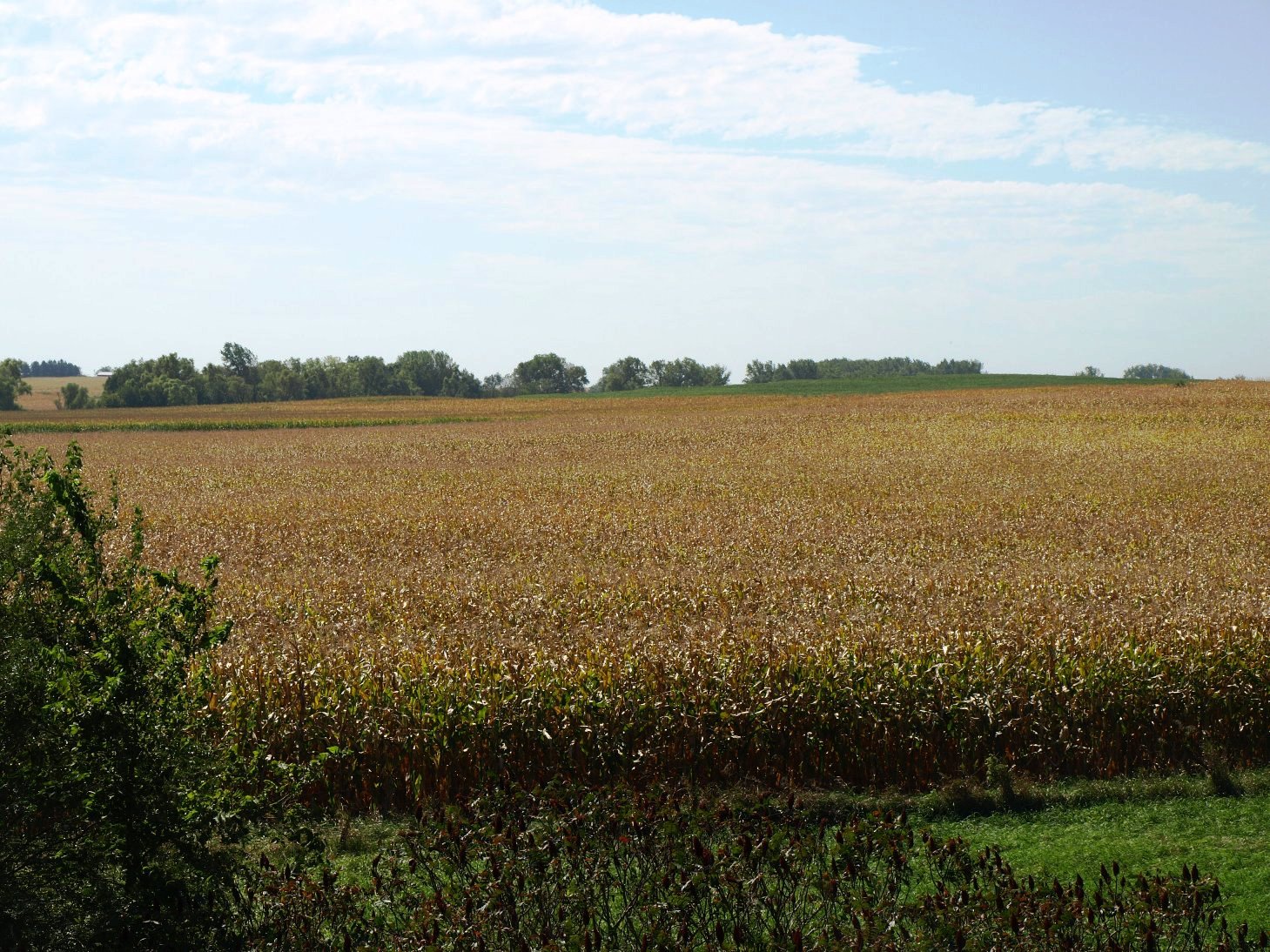
Yep. That would be corn.


Halfway mark.
Time to turn around and head back home.


Game day. Go Huskers!


In one month, I've logged 240 miles in less than 16.5 hours.
I hope to ride until the snow falls.

September 26, 2010

The Girl Who Played With Fire


The Girl Who Played with Fire by Stieg Larsson
Mystery/Thriller
2009 Random House Audio, Unabridged Edition
18 1/2 hours/ 15 compact discs
Read by Simon Vance
Finished on 9/13/10
Rating: 4.5/5 (Terrific!)


Product Description

Mikael Blomkvist, crusading journalist and publisher of the magazine Millennium, has decided to run a story that will expose an extensive sex trafficking operation between Eastern Europe and Sweden, implicating well-known and highly placed members of Swedish society, business, and government.

But he has no idea just how explosive the story will be until, on the eve of publication, the two investigating reporters are murdered. And even more shocking for Blomkvist: the fingerprints found on the murder weapon belong to Lisbeth Salander—the troubled, wise-beyond-her-years genius hacker who came to his aid in The Girl with the Dragon Tattoo, and who now becomes the focus and fierce heart of The Girl Who Played with Fire.

As Blomkvist, alone in his belief in Salander’s innocence, plunges into an investigation of the slayings, Salander herself is drawn into a murderous hunt in which she is the prey, and which compels her to revisit her dark past in an effort to settle with it once and for all.

Wow. For those of you who struggled with the opening chapters of The Girl With the Dragon Tattoo, you can rest assured that the second installment in the late Stieg Larsson's trilogy does not disappoint. I enjoyed The Girl With the Dragon Tattoo, but I loved The Girl Who Played with Fire. I felt the latter was less confusing and more evenly paced and I was immediately drawn in to the narrative, eager to discover more about Lisbeth Salander and her dark past. What an interesting character, so complex and so seriously flawed that one might think she exhibits sociopathic traits; yet, I found her completely sympathetic and likeable.


And, unlike the first in this series, I had no trouble with the Swedish names and locations thanks to Simon Vance's superb reading. Listening to an audio book is so helpful when it comes to a book set in a foreign country. The repetition of hearing the pronunciation of city names, as well as those of the characters, makes for a much more enjoyable reading experience. (Although I did need to glance at the book as I got toward the end, since a few of the names are very similar and I was having trouble keeping track of who the good guys were.)


And speaking of the ending, the final chapter had me holding my breath with trepidation and as the last words were read, I was stunned by the silence. My first reaction (after getting over the initial shock of the cliff-hanger) was relief in the knowledge that Larsson had written the third book prior to his death. My second thought was to hope that he didn't leave his readers with a similar cliff-hanger at the end of The Girl Who Kicked the Hornet's Nest.

Final thoughts: The Girl Who Played with Fire is a riveting sequel. I can hardly wait to read the final book in this series.

I'd Know You Anywhere


I'd Know You Anywhere by Laura Lippman
Mystery/Thriller
2010 William Morrow
Finished 9/4/10
Rating: 2.5/5 (Fair)


Product Description

The acclaimed New York Times bestselling author returns with a new stand-alone novel—a powerful and utterly riveting tale that skillfully moves between past and present to explore the lasting effects of crime on a victim's life....I'd Know You Anywhere.

Eliza Benedict cherishes her peaceful, ordinary suburban life with her successful husband and children, thirteen-year-old Iso and eight-year-old Albie. But her tranquility is shattered when she receives a letter from the last person she ever expects—or wants—to hear from: Walter Bowman. There was your photo, in a magazine. Of course, you are older now. Still, I'd know you anywhere.

In the summer of 1985, when she was fifteen, Eliza was kidnapped by Walter and held hostage for almost six weeks. He had killed at least one girl and Eliza always suspected he had other victims as well. Now on death row in Virginia for the rape and murder of his final victim, Walter seems to be making a heartfelt act of contrition as his execution nears. Though Eliza wants nothing to do with him, she's never forgotten that Walter was most unpredictable when ignored. Desperate to shelter her children from this undisclosed trauma in her past, she cautiously makes contact with Walter. She's always wondered why Walter let her live, and perhaps now he'll tell her—and share the truth about his other victims.

Yet as Walter presses her for more and deeper contact, it becomes clear that he is after something greater than forgiveness. He wants Eliza to remember what really happened that long-ago summer. He wants her to save his life. And Eliza, who has worked hard for her comfortable, cocooned life, will do anything to protect it—even if it means finally facing the events of that horrifying summer and the terrible truth she's kept buried inside.

An edgy, utterly gripping tale of psychological manipulation that will leave readers racing to the final page, I'd Know You Anywhere is a virtuoso performance from acclaimed, award-winning author Laura Lippman that is sure to be her biggest hit yet.

Vaguely familiar with the author's name, I picked up the ARC of this thriller at work a couple of months ago, deciding it was time to give her a try. I'd never read anything by Lippman, but knew she'd written What the Dead Know, about which I recall hearing good things. I love a great mystery that has me marking pages with sticky-notes, working through the complicated clues and red herrings, racing to uncover the villain before he or she is revealed by the author. I love an edge-of-your-seat thriller that keeps me reading late into the night, scaring me just enough to make my pulse race, yet not so much that I need to sleep with a light on! So basically, I was expecting a read along the lines of Cody McFadyen, Stieg Larsson or Tana French. Unfortunately, I was pretty disappointed when Lippman's stand-alone novel failed to hold my interest for more than a few pages every evening. What should have only taken a week (tops!) to finish wound up dragging on for almost an entire month. The storyline was just compelling enough to keep me from quitting, but the grand finale was anticlimactic and characters easily forgotten.
Final thoughts: Meh. Three weeks to read and three weeks to review. Not a good sign, but you never know. What the Dead Know may turn out to be just what I'm looking for in a thriller.

September 21, 2010

Wordless Wednesday

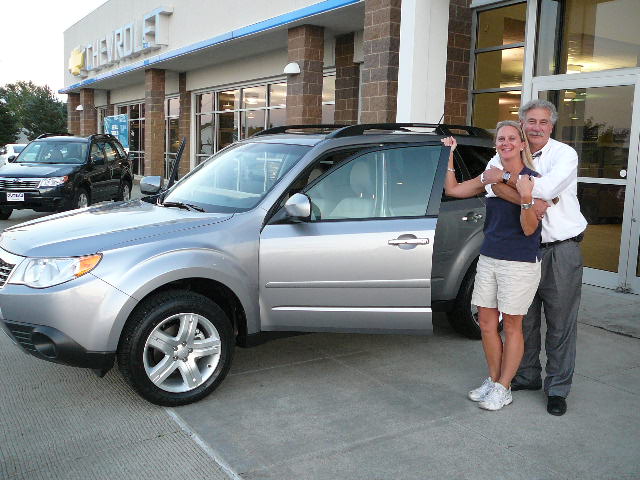
My new car!
2010 Subaru Forester

September 19, 2010

Fly Away Home


Fly Away Home by Jennifer Weiner
Fiction
2010 Atria
eBook
Finished 8/8/10
Rating: 3.5/5 (Good)


Product Description

Sometimes all you can do is fly away home . . .

When Sylvie Serfer met Richard Woodruff in law school, she had wild curls, wide hips, and lots of opinions. Decades later, Sylvie has remade herself as the ideal politician’s wife—her hair dyed and straightened, her hippie-chick wardrobe replaced by tailored knit suits. At fifty-seven, she ruefully acknowledges that her job is staying twenty pounds thinner than she was in her twenties and tending to her husband, the senator.

Lizzie, the Woodruffs’ younger daughter, is at twenty-four a recovering addict, whose mantra HALT (Hungry? Angry? Lonely? Tired?) helps her keep her life under control. Still, trouble always seems to find her. Her older sister, Diana, an emergency room physician, has everything Lizzie failed to achieve—a husband, a young son, the perfect home—and yet she’s trapped in a loveless marriage. With temptation waiting in one of the ER’s exam rooms, she finds herself craving more.

After Richard’s extramarital affair makes headlines, the three women are drawn into the painful glare of the national spotlight. Once the press conference is over, each is forced to reconsider her life, who she is and who she is meant to be.

Written with an irresistible blend of heartbreak and hilarity, Fly Away Home is an unforgettable story of a mother and two daughters who after a lifetime of distance finally learn to find refuge in one another.

This was my very first eBook and I have to say I loved the entire experience. I was able to quickly download the book to my iPad while sitting on a plane in Virginia Beach. I'd been reading Mr. Rosenblum Dreams in English and it simply wasn't holding my interest. I had other books in my carry-on, but didn't have time to get out of my seat since we were about to push back from the gate. I was so impressed by the ease and speed with which I was able to download the book and even more impressed with the iPad reader. I love the layout and the ease of turning "pages." Quickly sucked into the narrative from the opening pages, I completely forgot that I wasn't reading a "real" book. So much so that I caught myself reaching up toward the top right corner, ready to turn the page! And, I know I wasn't, but it sure felt like I was reading faster than usual. Maybe that had more to do with the nature of the book and not the manner in which it was read. Nonetheless, it was a great experience and I look forward to reading more eBooks.

Fly Away Home was just what I wanted for the trip home from our vacation. It was light and easy to get into, yet not so simplistic that I wound up focusing on the aircraft noises or felt all the bumps and drops during the all-too-typical encounters with turbulence. I've only read one other book by Weiner (back in my pre-book blogging days) and as I recall, it was also light and entertaining. And yet as I reflect on the novel, I have to admit that the characters were somewhat flat and unmemorable. Maybe I'm just itching for another great read like The Help, The Story of Edgar Sawtelle or World Without End. Fly Away Home fits the bill for a light summer beach read, but I'm ready for something more complex, peopled with rich, fully-drawn characters who will stay with me long after I've read the final lines.

Final thoughts: Worthwhile, but grab a copy at your local library.

September 16, 2010

Mr. Rosenblum Dreams in English


Mr. Rosenblum Dreams in English by Natasha Solomons
Fiction
2010 Reagan Arthur Book
Finished on 7/26/10
Rating: 2.5/5 (Average)


Product Description:

At the outset of World War II, Jack and Sadie Rosenblum and their baby daughter escape Berlin, bound for London. They are greeted with a pamphlet instructing immigrants how to act like "the English." Jack follows it to the letter—Savile Row suits, the BBC, a Bently—as he and his family settle into a prosperous new life.

But one key item—membership in a golf club—remains elusive. In postwar England, no golf club will admit Jack Rosenblum. He hatches a wild idea: to build his own. As Jack sets off on a quixotic adventure in the Dorset countryside, Sadie quietly mourns the family and life they left behind.

Despite ancient customs, British snobbery, mythical wildlife, and a shrinking bank account, Jack and Sadie persevere in this triumphant, tender, sweetly comic love story about a couple making a new life—and making their wildest dreams come true.

Set during one of my favorite time periods in one of my favorite locations, this novel had my name all over it. And yet (just like La's Orchestra Saves the World), it failed to impress me. I read it on and off during my flights to Virginia Beach, as well as sitting poolside at our hotel, but I never came to care about Jack or Sadie. Jack's proud, yet naive tenacity started to wear on me around the halfway point. Yes, it's a sweet story, but I wanted something a little deeper and not quite so hokey.

On golf:

He contemplated why he was so drawn to the game of golf—what had compelled him to pack up his life, gather his petulant wife and move to this place? Yes, he wanted to be an Englishman but there had to be something more, a reason for his obsession with the game. Perhaps he liked golf because it had rules—within those little laws lay a logical order. If you played the game and obeyed the rules, then win or lose you were safe. The game contained and held you safely within its structures. For the hours of your round, you could live in this perfected world of flowers and silver pools, and exist according to the boundaries of the game. Golf was a great list of rules, all by itself.

On food:

Sadie's mother was a great cook and had ordered her life entirely around meals, keeping time via the contents of her larder. Mutti knew it was tomorrow when the big loaf of bread she baked yesterday was going hard. It was summer when Sadie brought her the first plate of rose petals ready to be iced in order to bejewel her lemon rose cake and autumn was gooseberry fool, or a big round summer pudding, oozing with blackberries, strawberries and the last of the blackcurrants. For Mutti there were no hours of the day, only meals: breakfast, lunch, tea and supper. Things were either before breakfast, after lunch or between tea and supper. A time like three o'clock meant nothing—it was instead the space shortly before apple strudel and freshly boiled peppermint tea. Then there were the recipes themselves that fitted into neat categories: the conventional ones like "dishes so that you can tell it is summer," "meals for times that are cold and wintery," but there were others like "biscuits for when one is sad," or "buns for heartbreak."

Solomons is a screenwriter and the movie rights have already been sold to the makers of Four Weddings and a Funeral. This may be one of those rare cases in which the film is better than the book. Or not.

Final thoughts: Grab a copy at the library.

How's that for brevity? ;)

September 15, 2010

Wordless Wednesday

Stormy Weather in Lincoln, Nebraska
September 13, 2010

(Photo credit to Ami Johnson)


I wish I could take credit for this photograph! It was shot by a co-worker of a friend. Be sure to click on image for larger viewing.

September 3, 2010

On the Road


On the Road by Jack Keroauc
Fiction
Penguin Audio, Unabridged Edition 2007
Read by Will Patton
Quit on 7/20/10
Rating: DNF


Product Description

On the Road chronicles Kerouac's years traveling the North American continent-from East Coast to West Coast to Mexico-with his friend Neal Cassady, "a sideburned hero of the snowy West."

From Amazon:

Though Jack Kerouac began thinking about the novel that was to become On the Road as early as 1947, it was not until three weeks in April 1951, in an apartment on West Twentieth Street in Manhattan, that he wrote the first full draft that was satisfactory to him. Typed out as one long, single-spaced paragraph on eight long sheets of tracing paper that he later taped together to form a 120-foot scroll, this document is among the most significant, celebrated, and provocative artifacts in contemporary American literary history. It represents the first full expression of Kerouac's revolutionary aesthetic, the identifiable point at which his thematic vision and narrative voice came together in a sustained burst of creative energy. It was also part of a wider vital experimentation in the American literary, musical, and visual arts in the post-World War II period.

It was not until more than six years later, and several new drafts, that Viking published, in 1957, the novel known to us today. On the occasion of the fiftieth anniversary of On the Road, Viking will publish the 1951 scroll in a standard book format. The differences between the two versions are principally ones of significant detail and altered emphasis. The scroll is slightly longer and has a heightened linguistic virtuosity and a more sexually frenetic tone. It also uses the real names of Kerouac's friends instead of the fictional names he later invented for them. The transcription of the scroll was done by Howard Cunnell who, along with Joshua Kupetz, George Mouratidis, and Penny Vlagopoulos, provides a critical introduction that explains the fascinating compositional and publication history of On the Road and anchors the text in its historical, political, and social context.

Until last month, I had never read any of Kerouac's works, so I was pleased when my book club chose On the Road for our July selection. Not a huge fan of the "classics," I decided to opt for the audio version. I wish I could say I was pleasantly surprised with this literary classic, but after four discs, I had to call it quits. I found Patton's nonstop reading of Kerouac's prose exhausting (and a bit annoying) to listen to for more than 10-15 minutes at a time.

The only people for me are the mad ones, the ones who are mad to live, mad to talk, mad to be saved, desirous of everything at the same time, the ones who never yawn or say a commonplace thing, but burn, burn, burn, like fabulous yellow Roman candles exploding like spiders across the stars, and in the middle, you see the blue center-light pop, and everybody goes ahh...

Truman Capote famously said about Kerouac's work, "That's not writing, it's typing".

Final thoughts: If you're looking for a "road-trip" adventure story, read John Steinbeck's Travels with Charley. Excellent book!

About the audio version:

The year 2007 marked the 50th anniversary of this modern classic, and an audio interpretation is a marvelous way to experience Kerouac's free-flowing prose. Will Patton, noted for his performance of books by James Lee Burke, is a fine match for this text. ON THE ROAD is a winding, meandering journey, and Patton's performance as narrator provides the map. His voice brings the vitality of Kerouac's sense of spontaneity into being. Patton creates distinct voices for the two main characters, speaking for Kerouac in the guise of the observant Sal Paradise and for his friend Neal Cassady in the guise of the pleasure-seeking Dean Moriarty. Patton is appropriately quiet or exuberant, optimistic or cautious, and an ideal guide into the experience that is ON THE ROAD.

In other news, Viggo Mortensen will be playing Old Bull Lee in the upcoming re-make of On the Road. Click here for more info.

August 28, 2010

The Story of Edgar Sawtelle


The Story of Edgar Sawtelle by David Wroblewski

Fiction
2008 Recorded Books, LLC; Unabridged CD edition
Reader: Richard Poe
Finished on 7/14/10
Rating: 5/5 (Outstanding!)


Product Description:

Born mute, speaking only in sign, Edgar Sawtelle leads an idyllic life with his parents on their farm in remote northern Wisconsin. For generations, the Sawtelles have raised and trained a fictional breed of dog whose thoughtful companionship is epitomized by Almondine, Edgar's lifelong friend and ally. But with the unexpected return of Claude, Edgar's paternal uncle, turmoil consumes the Sawtelles' once peaceful home. When Edgar's father dies suddenly, Claude insinuates himself into the life of the farm—and into Edgar's mother's affections.

Grief-stricken and bewildered, Edgar tries to prove Claude played a role in his father's death, but his plan backfires—spectacularly. Forced to flee into the vast wilderness lying beyond the farm, Edgar comes of age in the wild, fighting for his survival and that of the three yearling dogs who follow him. But his need to face his father's murderer and his devotion to the Sawtelle dogs turn Edgar ever homeward.

David Wroblewski is a master storyteller, and his breathtaking scenes—the elemental north woods, the sweep of seasons, an iconic American barn, a fateful vision rendered in the falling rain—create a riveting family saga, a brilliant exploration of the limits of language, and a compulsively readable modern classic.

I loved this book! I loved it so much that after listening to the audio, I was compelled to buy a copy for future readings. The writing is beyond lyrical; it's exquisite! The characters (human and canine) touched my heart, and Edgar and Almondine have joined the ranks of all-time favorite characters, keeping company with Scout, Owen, Leisel & Rudy, and Perry. I actually found myself thinking of Owen Meany a lot during this book; probably due to the manner in which he speaks...and the manner in which Edgar is unable to do so.

I found myself completely absorbed in the story, sitting in my parked car (both in my driveway or the parking lot at work) long after my car engine had cooled, unable to pull myself away from the narrative. The pacing is even, the suspense and foreshadowing perfectly tuned. Richard Poe is an exceptional reader and his performance of this heartfelt coming-of-age novel is to be applauded.

On man's (or boy's) best friend:

This will be his earliest memory.

Red light, morning light. High ceiling canted overhead. Lazy click of toenails on wood. Between the honey-colored slats of the crib a whiskery muzzle slides forward until its cheeks pull back and a row of dainty front teeth bare themselves in a ridiculous grin.


The nose quivers. The velvet snout dimples.


All the house is quiet. Be still. Stay still.


Fine, dark muzzle fur. Black nose, leather of lacework creases, comma of nostrils flexing with each breath. A breeze shushes up the field and pillows the curtains inward. The apple tree near the kitchen window caresses the house with a tick-tickety-tick-tick. As slowly as he can, he exhales, feigning sleep, but despite himself his breath hitches. At once, the muzzle knows he is awake. It snorts. Angles right and left. Withdraws. Outside the crib, Almondine's forequarters appear. Her head is reared back, her ears cocked forward.


A cherry-brindled eye peers back at him.


Whoosh of her tail.


Be still. Stay still.


The muzzle comes hunting again, tunnels beneath his blanket, below the farmers and pigs and chicks and cows dyed into that cotton world. His hand rises on fingers and spider-walks across the surprised farmyard residents to challenge the intruder. It becomes a bird, hovering before their eyes. Thumb and index finger squeeze the crinkled black nose. The pink of her tongue darts out but the bird flies away before Almondine can lick it. Her tail is switching harder now. Her body sways, her breath envelops him. He tugs the blackest whisker on her chin and this time her tongue catches the palm of his hand ever so slightly. He pitches to his side, rubs his hand across the blanket, blows a breath in her face. Her ears flick back. She stomps a foot. He blows again and she withdraws and bows and woofs, low in her chest, quiet and deep, the boom of an uncontainable heartbeat. Hearing it, he forgets and presses his face against the rails to see her, all of her, take her inside him with his eyes, and before he can move, she smears her tongue across his nose and forehead! He claps a hand to his face but it's too late—she's away, spinning, biting her tail, dancing in the moted sunlight that spills through the window glass.


and

Wandering through the kennel, holding a book: Winnie-the-Pooh. He opens a whelping pen, sits. The puppies surge through the underbrush of loose straw, kicking up fine white dust as they come along. He captures them between his legs and reads to them, hands in motion before their upturned muzzles. The mother comes over and they peep like chicks when they see her. One by one she carries them back to the whelping box; they hang black and bean-shaped from her mouth. When she has finished, she stands over them, looking at Edgar in reproach.

They
wanted to hear, he signs at her, but the mother won't settle with her pups until he leaves.

Winnie-the-Pooh is a good story for puppies. If only she would let him tell it.

I'm not sure what I expected when I first picked up this debut novel, but I was more than pleasantly surprised by Wroblewski's beautiful prose:

Inside was a calamity of plywood and mossy bedsprings and vast spider webs hanging like spinnakers between the timbers.

On trained dogs:

And the dogs, in turn, discovered that if they waited after he'd asked them to stay and disappeared into a cabin, he would always return. Together they practiced new skills he devised. They had long understood what was being asked of them during a stay, whether in the training in the yard or in town; now he asked if they would stay in a forest glade when they were hungry and the flickers pounded the ground, thumping up millipedes, or squirrels harassed them, or a rock sailed over their heads and rattled the dead leaves. Several times each day he found a likely spot shielded by sumac or bracken fern, and he placed them in guard over something small—a stick he'd been carrying that morning, say, or a bit of rag. Then he walked off into the forest, careful not to push them past the breaking point since he had no way to correct them. Later, he tied a length of fishing line to the guarded thing and asked them to move only when it moved, keeping it surrounded. When they got that right, he'd sail back into their midst signing, release! and throw himself at them to roll and tickle, toss the thing for them to catch, see to each of them in whatever way he'd learned was the greatest delight for that dog.

He learned, too, the limits of their patience, different for each of them. In a stay, Baboo was as immovable as the hills, and likely to fall asleep. Essay, ever alert, was the most tempted of any of them by the skitter of a rock pitched through the ferns. And Tinder, equally likely to stick or bolt, who twice jumped up when Essay broke her stay and licked her muzzle and coaxed her back into a sit.


I've yet to read Where the Red Fern Grows or Old Yeller, but recently I've become drawn to novels about dogs. I loved Garth Stein's The Art of Racing in the Rain and now The Story of Edgar Sawtelle has found its way into my heart. Looks like I'm in good company, too:

Praise from Stephen King:

I flat-out loved The Story of Edgar Sawtelle, and spent twelve happy evenings immersed in the world David Wroblewski has created. As I neared the end, I kept finding excuses to put the book aside for a little, not because I didn't like it, but because I liked it too much; I didn't want it to end. Dog-lovers in particular will find themselves riveted by this story, because the canine world has never been explored with such imagination and emotional resonance. Yet in the end, this isn't a novel about dogs or heartland America--although it is a deeply American work of literature. It's a novel about the human heart, and the mysteries that live there, understood but impossible to articulate. Yet in the person of Edgar Sawtelle, a mute boy who takes three of his dogs on a brave and dangerous odyssey, Wroblewski does articulate them, and splendidly. I closed the book with that regret readers feel only after experiencing the best stories: It's over, you think, and I won't read another one this good for a long, long time.

In truth, there's never been a book quite like The Story of Edgar Sawtelle. I thought of Hamlet when I was reading it, and Watership Down, and The Night of the Hunter, and The Life of Pi--but halfway through, I put all comparisons aside and let it just be itself.

I'm pretty sure this book is going to be a bestseller, but unlike some, it deserves to be. It's also going to be the subject of a great many reading groups, and when the members take up
Edgar, I think they will be apt to stick to the book and forget the neighborhood gossip.

Wonderful, mysterious, long and satisfying: readers who pick up this novel are going to enter a richer world. I envy them the trip. I don't re-read many books, because life is too short. I will be re-reading this one.

Final thoughts: Do not be put off by the size of this book. You will not want it to end!

Did I say I loved it?!

Be sure to visit Wroblewski's website, particularly his tangent page. He's included some wonderful video clips!