Showing posts with label Biography. Show all posts

September 20, 2025

The Ride of Her Life


The Ride of Her Life: The True Story of a Woman, Her Horse, and Their Last-Chance Journey Across America by Elizabeth Letts
Nonfiction
2021
Finished on September 14, 2025
Rating: 3.5/5

Publisher's Blurb:

The triumphant true story of a woman who rode her horse across America in the 1950s, fulfilling her dying wish to see the Pacific Ocean, from the #1 New York Times bestselling author of The Perfect Horse and The Eighty-Dollar Champion.

“The gift Elizabeth Letts has is that she makes you feel you are the one taking this trip. This is a book we can enjoy always but especially need now.”—Elizabeth Berg, author of The Story of Arthur Truluv

In 1954, sixty-three-year-old Maine farmer Annie Wilkins embarked on an impossible journey. She had no money and no family, she had just lost her farm, and her doctor had given her only two years to live. But Annie wanted to see the Pacific Ocean before she died. She ignored her doctor’s advice to move into the county charity home. Instead, she bought a cast-off brown gelding named Tarzan, donned men’s dungarees, and headed south in mid-November, hoping to beat the snow. Annie had little idea what to expect beyond her rural crossroads; she didn’t even have a map. But she did have her ex-racehorse, her faithful mutt, and her own unfailing belief that Americans would treat a stranger with kindness.

Annie, Tarzan, and her dog, Depeche Toi, rode straight into a world transformed by the rapid construction of modern highways. Between 1954 and 1956, the three travelers pushed through blizzards, forded rivers, climbed mountains, and clung to the narrow shoulder as cars whipped by them at terrifying speeds. Annie rode more than four thousand miles, through America’s big cities and small towns. Along the way, she met ordinary people and celebrities—from Andrew Wyeth (who sketched Tarzan) to Art Linkletter and Groucho Marx. She received many offers—a permanent home at a riding stable in New Jersey, a job at a gas station in rural Kentucky, even a marriage proposal from a Wyoming rancher. In a decade when car ownership nearly tripled, when television’s influence was expanding fast, when homeowners began locking their doors, Annie and her four-footed companions inspired an outpouring of neighborliness in a rapidly changing world.

Until now, I hadn't read anything by Elizabeth Letts, but I recognized her name and the title of her popular book, The Eighty-Dollar Champion, from my days as a bookseller at Barnes & Noble. I love to travel, so when my book group chose The Ride of Her Life, my curiosity was piqued, wondering how in the world a sixty-three-year-old woman (with a serious health condition) could possibly ride a horse from Maine to California. It took me far too long to get engrossed (and I admit to counting the remaining pages, which is never a good sign), but I eventually found myself looking forward to returning to the story. I'm glad I persevered. I decided if Annie Wilkins could keep going, so could I.

If you've been following me here (or on Instagram) for even a short time, you know that I love to travel. However, I'm not sure what it is about reading travel stories, at least those about traveling around the United States, that fails to impress me. I've read Travels with Charley by John Steinbeck, The Longest Road by Philip Caputo, Blue Highways by William Least Heat-Moon, and The Oregon Trail by Rinker Buck. None of these resonated with me as I would have thought, and I find it interesting that I gave each of these the same low rating of 2 stars! Curiously, the travel stories that have entertained me are those set in France, specifically Paris. 

What I liked about this particular book wasn't necessarily the details or route Annie and her menagerie traveled, but the tidbits of historical trivia Letts weaves into her narrative, creating a richer reading experience. (Coincidentally, my husband utilizes the same parenthetical style in his nautical books.) I learned that Lincoln Logs were created by Frank Lloyd Wright's son. I also discovered that AAA (American Automotive Association) issued the first road map for drivers (a map of Vermont), and that Duncan Hines was a former traveling salesman who put together restaurant and lodging guides for travelers. There's also a bit of a "Forest Gump" tone to Annie's adventures, with her crossing paths with Andrew Wyeth, Casey Jones' widow, and Art Linkletter, as she makes her way across the country.

I was reminded of Cheryl Strayed's memoir, Wild, and how ill-prepared she was to hike the Pacific Crest Trail. Like Strayed (who had no experience in backpacking), Annie never looked at a map of the entire United States, relying solely on gas station maps for the surrounding areas, piecing together her route bit by bit. She certainly didn't take the most logical route from one coast to other! It's a wonder Strayed and Wilkins survived their journeys.

At the time of her departure for California, Annie was sixty-three-years-old. Not only am I the same age as she was, but we share the same birthday. I was a little miffed that she was referred to as an old lady, but it was 1954, and 60 is now the new 50, right?

I mentioned that Letts' writing style reminded me that of my husband's. The following can also be compared to one of Rod's books, Sailing by Starlight, in which Marv Creamer sailed around the world without any instruments. No sextant, no compass, no chart-plotter, no GPS, no radar. Not even a stopwatch. But Annie's lack of tools was less to prove a point and due more to nonexistent technologies and simply being unaware of what might help her on her journey:
In November 1954, Annie took her dog and got on a horse and started riding. Destination: California. From a modern perspective, her journey seems almost bewildering--imagine trying to navigate without the benefit of GPS, to travel with no cellphone, no credit or debit card, not even a bank account to draw from. In fact, when she first set off, Annie didn't even have the kinds of tools that were available in 1954: road maps, a flashlight and batteries, a waterproof raincoat. Annie headed south, a Quixote in the company of her Rocinante, a run-down ex-racehorse, and her Sancho Panza, a little mutt. Society had called these people by different names: vagabonds and drifters, pilgrims, hoboes, and hippies. She called herself a tramp.
The Ride of Her Life took longer to grab me than I like, and it began to feel repetitious toward the end, but it's a heartwarming and uplifting story, which I appreciate during these distressing times in our country. I'm not a horse person, but Tarzan (and his little buddy, Depeche Toi) stole my heart. 
Annie had spent the past year on less-traveled roads and in small towns. From her own perspective on horseback, the country she had traveled across had seemed vast, yet still welcoming and friendly, a pace where neighbors greeted each other in local diners and a visiting stranger would attract friendly notice. Annie still traveled at the speed of hoofbeats, but the world she had encountered, one of roadside diners on quiet byways, would soon become more obsolete than she could have imagined.
By the way, the overall reaction at yesterday's book group meeting was resounding praise for the book. With my lackluster 3.5 rating,I was definitely in the minority.

February 26, 2019

Looking Back - Tuesdays with Morrie

Addendum:

Finished on February 17, 2019

New Rating: 4/5 (Very Good)

After posting this "Looking Back" entry, I decided it was finally time to re-read Albom's book. I began reading and was quickly drawn into the narrative, remembering bits and pieces, but not so much that I was bored or impatient with the writing. It was as fresh and inspiring as the first time I read it in 1998. It's a quick read, easily finished in a day, but I took my time, both savoring Morrie's aphorisms and Mitch's thoughts and reactions to his friend's decline.
The last class of my old professor's life took place once a week in his house, by a window in the study where he could watch a small hibiscus plant shed its pink leaves. The class met on Tuesdays. It began after breakfast. The subject was The Meaning of Life. It was taught from experience.
No grades were given, but there were oral exams each week. You were expected to respond to questions, and you were expected to pose questions of your own. You were also required to perform physical tasks now and then, such as lifting the professor's head to a comfortable spot on the pillow or placing his glasses on the bridge of his nose. Kissing him good-bye earned you extra credit. 
No books were required, yet many topics were covered, including love, work, community, family, aging, forgiveness, and, finally, death. The last lecture was brief, only a few words.
On Death & Dying:
How can you ever be prepared to die?
"Do what the Buddhists do. Every day, have a little bird on your shoulder that asks, 'Is today the day? Am I ready? Am I doing all I need to do? Am I being the person I want to be?'"
I thoroughly enjoyed this experience of re-reading Mitch Albom's book. I did find that I was preparing myself for the heartbreaking finale and was surprised that I didn't shed a single tear. Since reading this back in 1998, I have lost three very close family members, so maybe I am now better equipped to handle the tragic details of death and dying. Or maybe knowing the outcome softened the blow.


Looking Back... In an effort to transfer my book journal entries over to this blog, I'm going to attempt to post (in chronological order) an entry every Friday. I may or may not add extra commentary to what I jotted down in these journals.


Tuesdays with Morrie: An Old Man, a Young Man and Life's Greatest Lesson by Mitch Albom
Nonfiction
1997 Doubleday
Finished in March 1998
Rating: 5/5 (Excellent)

Publisher's Blurb:

Maybe it was a grandparent, or a teacher or a colleague. Someone older, patient and wise, who understood you when you were young and searching, and gave you sound advice to help you make your way through it. 

For Mitch Albom, that person was Morrie Schwartz, his college professor from nearly twenty years ago.

Maybe, like Mitch, you lost track of this mentor as you made your way, and the insights faded. Wouldn't you like to see that person again, ask the bigger questions that still haunt you, receive wisdom for your busy life today the way you once did when you were younger? 

Mitch Albom had that second chance. He rediscovered Morrie in the last months of the older man's life. Knowing he was dying Morrie visited with Mitch in his study every Tuesday, just as they used to back in college. Their rekindled relationship turned into one final 'class': lessons in how to live.

Tuesdays with Morrie is a magical chronicle of their time together, through which Mitch shares Morrie's last gift with the world. 

My Original Notes (1998):

Awesome book. Moving without being maudlin. Introspective. Wonderful words of wisdom from a tremendously brave old man. Courageous. Inspirational. A great gift book. I cried like a baby when I finished. Sobbed! 

My Current Thoughts:

I remember when I read this book and how the ending gutted me. I've had it on my shelf for over 20 years and have never read it a second time. I did later read Albom's popular novel, The Five People You Meet in Heaven, and didn't care for it at all, so I wonder if I'll still like this biography about Morrie. Guess it's worth a try.

January 30, 2018

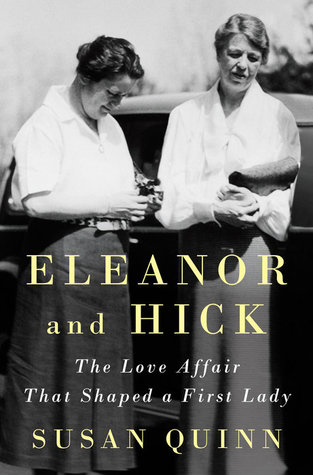
Eleanor and Hick


Eleanor and Hick: The Love Affair that Shaped a First Lady by Susan Quinn
Biography
2016 Penguin Audio
Read by Kimberly Farr
13 hours and 44 minutes
Finished on February 25, 2017
Rating: 3/5 (Good)

Publisher's Blurb:

A warm, intimate account of the love between Eleanor Roosevelt and reporter Lorena Hickok - a relationship that, over more than three decades, transformed both women's lives and empowered them to play significant roles in one of the most tumultuous periods in American history.

In 1932, as her husband assumed the presidency, Eleanor Roosevelt entered the claustrophobic, duty-bound existence of the first lady with dread. By that time she had put her deep disappointment in her marriage behind her and developed an independent life - now threatened by the public role she would be forced to play. A lifeline came to her in the form of a feisty campaign reporter for the Associated Press: Lorena Hickok. Over the next 30 years, until Eleanor's death, the two women carried on an extraordinary relationship: They were, at different points, lovers, confidantes, professional advisors, and caring friends.

They couldn't have been more different. Eleanor had been raised in one of the nation's most powerful political families and was introduced to society as a debutante before marrying her distant cousin, Franklin. Hick, as she was known, had grown up poor in rural South Dakota and worked as a servant girl after she escaped an abusive home, eventually becoming one of the most respected reporters at the AP. Her admiration drew the buttoned-up Eleanor out of her shell, and the two quickly fell in love. For the next 13 years, Hick had her own room at the White House, next door to the first lady.

These fiercely compassionate women inspired each other to right the wrongs of the turbulent era in which they lived. During the Depression Hick reported from the nation's poorest areas for the WPA, and Eleanor used these reports to lobby her husband for New Deal programs. Hick encouraged Eleanor to turn their frequent letters into her popular and long-lasting syndicated column "My Day" and to befriend the female journalists who became her champions. When Eleanor's tenure as first lady ended with FDR's death, Hick pushed her to continue to use her popularity for good - advice Eleanor took by leading the UN's postwar Human Rights Commission. At every turn the bond these women shared was grounded in their determination to better their troubled world.

Deeply researched and told with great warmth, Eleanor and Hick is a vivid portrait of love and a revealing look at how an unlikely romance influenced some of the most consequential years in American history.

I've always been fascinated with Eleanor Roosevelt's life story and thought this new biography might give a little more personal (and honest) insight into her life, as well as that of Lorena Hickok. My husband and I watched The Roosevelts: An Intimate History (a wonderful Ken Burns' documentary) and after reading Quinn's biography on Eleanor, I'm inclined to watch the program a second time. My mind wandered a little bit while listening to this audio book, and overall I liked it, but it probably would have been better to read the print edition.

June 25, 2009

Maus I

Maus I: A Survivor's Tale: My Father Bleeds History by Art Spiegelman
Nonfiction - Graphic Memoir
1986 Pantheon
Winner of the 1992 Pulitzer Prize
Finished on 6/13/09
Rating: 3.5/5 (Good)


Publisher's Blurb:

Maus is the story of Vladek Spiegelman, a Jewish survivor of Hitler's Europe, and his son, a cartoonist who tries to come to terms with his father, his father's terrifying story, and History itself. Its form, the cartoon (the Nazis are cats, the Jews mice), succeeds perfectly in shocking us out of any lingering sense of familiarity with the events described, approaching, as it does, the unspeakable through the diminutive. It is, as the New York Times Book Review has commented, "a remarkable feat of documentary detail and novelistic vividness...an unfolding literary event."

Moving back and forth from Poland to Rego Park, New York, Maus tells two powerful stories: The first is Spiegelman's father's account of how he and his wife survived Hitler's Europe, a harrowing tale filled with countless brushes with death, improbable escapes, and the terror of confinement and betrayal. The second is the author's tortured relationship with his aging father as they try to lead a normal life of minor arguments and passing visits against a backdrop of history too large to pacify. At all levels, this is the ultimate survivor's tale--and that, too, of the children who somehow survive even the survivors.

Part I of Maus takes Spiegelman's parents to the gates of Auschwitz and him to the edge of despair. Put aside all your preconceptions. These cats and mice are not Tom and Jerry, but something quite different. This is a new kind of literature.

It's been years since I first heard about this book and I'm glad I finally got around to getting a copy to read. I've never read a graphic novel (although that's a misnomer for this work, as it's not fiction but rather a memoir), so I wasn't sure what to expect. Would the cartoons distract me? Would they minimize the horrors of the Holocaust? Surprisingly, I found I didn't spend too much time looking at the drawings and wondered if this was common or if a true graphic novel demands more attention to the artwork. And I certainly didn't think this form of narrative did anything to minimize the severity of the story. If anything, its impact might actually have been enhanced, rather than minimized, by the fact that it's such a horrible story told in a medium normally reserved for more innocent, child-like pursuits.

Maus
is a deeply moving story, especially knowing it's Spiegelman's father's true history. In spite of the subject matter, I enjoyed this compelling book (as well as one can enjoy such a tragic tale) and I look forward to reading Maus II: A Survivor's Tale: And Here My Troubles Began.
Go here to listen to an excellent NPR interview with Art Spiegelman.