Showing posts with label History. Show all posts

September 11, 2026

The Only Plane In the Sky

I published this review in 2020. Today is the 25th anniversary of 9/11 and I have decided to repost it in memory of all those who lost their lives, as well as everyone affected by this terribly attack on our country. May we never forget. 


The Only Plane in the Sky: An Oral History of 9/11 by Garrett M. Graff
Nonfiction - History
2019 Avid Reader Press
Finished on January 11, 2020
Rating: 5/5 (Excellent)

Publisher's Blurb:

The first comprehensive oral history of September 11, 2001—a panoramic narrative woven from the voices of Americans on the front lines of an unprecedented national trauma.

Over the past eighteen years, monumental literature has been published about 9/11, from Lawrence Wright’s The Looming Tower, which traced the rise of al-Qaeda, to The 9/11 Commission Report, the government’s definitive factual retrospective of the attacks. But one perspective has been missing up to this point—a 360-degree account of the day told through the voices of the people who experienced it.


Now, in The Only Plane in the Sky, award-winning journalist and bestselling historian Garrett Graff tells the story of the day as it was lived—in the words of those who lived it. Drawing on never-before-published transcripts, recently declassified documents, original interviews, and oral histories from nearly five hundred government officials, first responders, witnesses, survivors, friends, and family members, Graff paints the most vivid and human portrait of the September 11 attacks yet.


Beginning in the predawn hours of airports in the Northeast, we meet the ticket agents who unknowingly usher terrorists onto their flights, and the flight attendants inside the hijacked planes. In New York City, first responders confront a scene of unimaginable horror at the Twin Towers. From a secret bunker underneath the White House, officials watch for incoming planes on radar. Aboard the small number of unarmed fighter jets in the air, pilots make a pact to fly into a hijacked airliner if necessary to bring it down. In the skies above Pennsylvania, civilians aboard United Flight 93 make the ultimate sacrifice in their place. Then, as the day moves forward and flights are grounded nationwide, Air Force One circles the country alone, its passengers isolated and afraid.


More than simply a collection of eyewitness testimonies, The Only Plane in the Sky is the historic narrative of how ordinary people grappled with extraordinary events in real time: the father and son working in the North Tower, caught on different ends of the impact zone; the firefighter searching for his wife who works at the World Trade Center; the operator of in-flight telephone calls who promises to share a passenger’s last words with his family; the beloved FDNY chaplain who bravely performs last rites for the dying, losing his own life when the Towers collapse; and the generals at the Pentagon who break down and weep when they are barred from rushing into the burning building to try to rescue their colleagues.


At once a powerful tribute to the courage of everyday Americans and an essential addition to the literature of 9/11, The Only Plane in the Sky weaves together the unforgettable personal experiences of the men and women who found themselves caught at the center of an unprecedented human drama. The result is a unique, profound, and searing exploration of humanity on a day that changed the course of history, and all of our lives.


I have so many thoughts about this book. As I began, I discovered I couldn't stop reading, very much like that September morning 18 years ago when I couldn't stop watching the news. It brought back vivid memories of where I was, who I was with, and how the shocking events of the attacks unfolded before my eyes as I watched the news reports in disbelief and horror. Like Garrett Graff's excellent compilation of interviews and transcripts, I simply could not pull my gaze from the scenes. I was afraid there would be more attacks and I felt compelled to know what was happening at every moment. At that time, my teenage daughter and I were living in Texas and my husband was working in Nebraska, so I was even more anxious, not being together as a family to face whatever might come.

From the first pages of this outstanding narrative, I was quickly engrossed, reading far into the night, which was not particularly a good thing since my dreams were full of images of that terrible day. I noticed that as I read, I was holding my breath, literally on the edge of my seat, despite the fact that I knew the terrible outcome as I turned each page. Yet, the intimacy of the oral histories revealed so much more than I saw on the TV broadcasts.

I had considered listening to the audio version of this book, but I'm glad that I decided to go with the print. Each chapter is arranged in a format of individual accounts, noting the name, place of employment, or relationship to a family member involved in the attacks. Without those visual references, I would have lost track of who was who; the print version made it easy to flip back and forth, refreshing my memory of the specific individual describing a particular anecdote. I also think the audio book (and hear all of those stories, which are read by a full cast of actors) would gut me. 

Here are just a few passages that gave me pause:
For those at the tip of Lower Manhattan, the only viable evacuation route turned out to be the water. A makeshift, unorganized armada of more than 130 ferries, pleasure yachts, sightseeing vessels, Coast Guard and police vessels, fireboats, and tugboats gathered--many without being asked--at Battery Park and nearby piers. By the end of the day, they had collectively evacuated somewhere between 300,000 and 500,000 people from Manhattan--a maritime rescue larger than the World War II evacuation from Dunkirk.
and
James Luongo, inspector, NYPD: At one point, there had to be 200 construction workers walking down West Street. I said, "Who's in charge?" They said, "Nobody's in charge. We're here to help." I'll never forget those men--big burly guys, coming down. So much of that day, so much of that day was just New Yorkers. People who can help people. A lot of credit goes to the fire department. A lot of credit goes to the police department and emergency response people. But that's what we get paid for. The amount of New Yorkers--just everyday New Yorkers--who stepped up to the plate that day was incredible.
and
Ileana Mayorga, management specialist, Volunteer Arlington: At 1:00 the phone started ringing, people who wanted to come and help. I put the names of all these people in an Excel sheet and what it is that they wanted to do. They wanted to help dig out the people at the Pentagon. They wanted to secure the area themselves. They wanted to enlist to go and fight. I had a man who called and he said, "I am 80 years old. I still fit in my pilot uniform from World War II. I can still see. I can still hear. I have kept up with my training as a pilot. Tell whoever you can tell that I'm ready to report for duty." That broke my heart, this 80-year-old man saying that.
and
Ileana Mayorga: It was completely amazing, the feeling of support, of unity. I felt so proud that my community, the Hispanic community, were calling. Suddenly the phones were ringing and saying, "This is the country that we chose to come to. Nobody will destroy our country." They would say, "I'm not legal in the United States. Do you think they will accept me to do volunteer work?"
and
As the morning of September 11th passed, a stunned, wounded nation found itself enveloped in a quiet--businesses and schools closed, traffic thinned, the normal air traffic overhead fell silent. Many Americans, both ordinary civilians and government officials, were glued to the television, soaking in the news, overcome with emotion.
and
At Ground Zero, an impromptu bucket brigade had begun work, trying to sift through the acres of burning wreckage in hopes of finding survivors and recovering the dead. The fires at Ground Zero would burn for another 99 days, until they were finally extinguished for good on December 19.
and
Paul McFadden [firefighter, Rescue 2, FDNY]: When everything settled, I lost 46 friends. The were either my friends or they were sons of my friends. 
I've read two other books that deal with the horrors of 9/11. The first is The Usual Rules by Joyce Maynard (reviewed here). The second is a memoir by Abigail Carter called The Alchemy of Loss: A Young Widow's Transformation (reviewed here). Both are excellent and The Only Plane in the Sky has inspired me to pull them from my shelves for a second reading.

Click here to listen to the Garrett Graff explain his research process and motivation for creating this comprehensive and important oral history of 9/11.

We must never forget.

November 22, 2021

The Splendid and the Vile


Nonfiction - History
2020 Crown Publishing
Finished on November 16, 2021
Rating: 5/5 (Excellent)

Publisher's Blurb:

The #1 New York Times bestselling author of Dead Wake and The Devil in the White City delivers a startlingly fresh portrait of Winston Churchill and London during the Blitz.

On Winston Churchill's first day as prime minister, Hitler invaded Holland and Belgium. Poland and Czechoslovakia had already fallen, and the Dunkirk evacuation was just two weeks away. For the next twelve months, Hitler would wage a relentless bombing campaign, killing 45,000 Britons (30,000 of them Londoners) and destroying two million homes. It was up to Churchill to hold the country together and persuade President Franklin Roosevelt that Britain was a worthy ally--that she was willing to fight to the end.

In The Splendid and the Vile, Erik Larson shows, in cinematic detail, how Churchill taught the British people "the art of being fearless." It is a story of political brinksmanship but also an intimate domestic drama, set against the backdrop of Churchill's prime-ministerial country house, Chequers, and his wartime residence, Ditchley, where Churchill and his entourage go when the moon is brightest and the bombing threat is highest. Drawing on a wealth of untapped sources, including recently declassified files, intelligence reports, and personal diaries only now available, Larson provides a new lens on London's darkest year through the day-to-day experience of Churchill and his family: his wife, Clementine; their daughters, Sarah, Diana, and the youngest, Mary, who chafes against her parents' wartime protectiveness; their son, Randolph, and his beautiful, unhappy wife, Pamela; her illicit lover, a dashing American emissary; and the cadre of close advisors who comprised Churchill's "Secret Circle," including his dangerously observant private secretary, John Colville; newspaper baron Lord Beaverbrook; and the Rasputin-like Federick Lindemann.

The Splendid and the Vile takes readers out of today's political dysfunction and back to a time of true leadership, when--in the face of unrelenting horror--Churchill's eloquence, strategic brilliance, and perseverance bound a country, and a family, together.

The Splendid and the Vile may be my favorite book of 2021! Until now, I don't believe I have ever read such a compelling book of history. I've been a longtime fan of World War II narratives, but mostly in the form of historical fiction. I requested an ARC of Erik Larson's most recent publication in late 2019 and was happy to receive a copy from the publisher specifically to give to my husband since he's read almost everything written about Winston Churchill. Truthfully, I wasn't even sure if I would read the book since I wasn't exactly enamoured with Larson's previous works. I gave up on The Devil in the White City (although, to be fair, I was in the middle of it in 2005 when tragedy struck our family and I never found the desire to pick it up again), gave Dead Wake (which I listened to on audio) a 2/5 rating, and Isaac's Storm (which I read for last year's Nonfiction November challenge) a 3/5 rating. But my husband assured me that Larson's newest book is very good and that I'd probably like it since it's a subject about which I enjoy reading. So I added it to my stack for this year's Nonfiction November challenge. 

Wanting to read as many books as possible for this challenge, I was tempted to start the month with some shorter memoirs that I'd chosen and leave what I perceived as a weighty tome for later in the month. However, I changed my mind, trying not to be put off by the 500+ pages of text. I shouldn't have worried; I simply could not put it down! I was drawn in from the prologue and found the entire text (including the sources and acknowledgments, which I pored over, gleaning more historical tidbits that weren't included in the text) engaging and informative. The narrow focus of a specific period during the war (Churchill's first year as prime minister, from May 10, 1940 to May 10, 1941) made it all the more compelling and I never felt any detail or description of events unnecessary.

I enjoyed reading not only about Churchill's role as prime minister during the Blitz, but also the individual stories and reflections about key events by members of his family and staff, derived from their personal diaries and letters. Additionally, there are accounts from Mass-Observation diarists, as well as ordinary British citizens, which further increases the intimacy of the narrative. 
The perspective from the ground was equally stunning. One young man, Colin Perry, eighteen, was on his bicycle when the first wave passed overhead. "It as the most amazing, impressive, riveting sight," he wrote later. "Directly above me were literally hundreds of planes, Germans! The sky was full of them." The fighters stuck close, he recalled, "like bees around their queen."
Larson also includes specific details and remarks by Virginia Woolf, Ian Fleming and Graham Greene, adding to this reader's enjoyment.

I couldn't help but be reminded of the terrorist attacks on the United States on September 11, 2001 as I read the following:
The day was warm and still, the sky blue above a rising haze. Temperatures by afternoon were in the nineties, odd for London. People thronged Hyde Park and lounged on chairs set out beside the Serpentine. Shoppers jammed the stores of Oxford Street and Piccadilly. The giant barrage of balloons overhead cast lumbering shadows on the streets below. After the August air raid when bombs first fell on London proper, the city had retreated back into a dream of invulnerability, punctuated now and then by false alerts whose once-terrifying novelty was muted by the failure of bombers to appear. The late-summer heat imparted an air of languid complacency. In the city's West End, theaters hosted twenty-four productions, among them the play Rebecca, adapted for the stage by Daphne du Maurier from her novel of the same name. Alfred Hitchcock's movie version, starring Laurence Olivier and Joan Fontaine, was also playing in London, as were the films The Thin Man and the long-running Gaslight.

It was a fine day to spend in the cool green of the countryside. 

and

The dust burst outward rapidly at first, like smoke from a cannon, then slowed and dissipated, sifting and settling, covering sidewalks, streets, windshields, double-decker buses, phone booths, bodies. Survivors exiting ruins were coated head to toe as if with gray flour. Harold Nicolson, in his diary, described seeing people engulfed in a "thick fog which settled down on everything, plastering their hair and eyebrows with thick dust." 

There is nothing quite like a great book to make one wish to read more about a particular subject. I plan to read Larson's earlier publication, In the Garden of Beasts, but I'm also interested in Roy Jenkin's Churchill, Martin Gilbert's The Finest Hour, John Lukacs's Five Days in London, May 1940, Doris Kearns Goodwins' No Ordinary Time (which I began many years ago, but set aside due to its length), and William Shirer's The Rise and Fall of the Third Reich (yes, another hefty read, I know!). 

I would also like to re-watch Darkest Hour, The Gathering Storm, Into the Storm, Winton Churchill's: Walking with Destiny, and Churchill's Secret. Any chance that Ken Burns and Erik Larson can get together and create a documentary based on this book? Please?

December 22, 2020

Isaac's Storm


Nonfiction/Science
2000 Vintage Books (first published in 1999)
Finished on December 19, 2020
Rating: 3/5 (Good)

Publisher's Blurb:

September 8, 1900, began innocently in the seaside town of Galveston, Texas. Even Isaac Cline, resident meteorologist for the U.S. Weather Bureau failed to grasp the true meaning of the strange deep-sea swells and peculiar winds that greeted the city that morning. Mere hours later, Galveston found itself submerged in a monster hurricane that completely destroyed the town and killed over six thousand people in what remains the greatest natural disaster in American history--and Isaac Cline found himself the victim of a devastating personal tragedy.

Using Cline's own telegrams, letters, and reports, the testimony of scores of survivors, and our latest understanding of the science of hurricanes, Erik Larson builds a chronicle of one man's heroic struggle and fatal miscalculation in the face of a storm of unimaginable magnitude. Riveting, powerful, and unbearably suspenseful, Isaac's Storm is the story of what can happen when human arrogance meets the great uncontrollable force of nature.

My husband read Isaac's Storm many years ago and said it was a very good read, so I added it to my nonfiction TBR collection where it lingered for a couple of decades. I finally pulled it from that shelf and added it to my stack for the Nonfiction November reading challenge (which I extended into December). This was not my first encounter with Erik Larson's writing (I listened to Dead Wake in 2015) and while I appreciate his extensive research, it took me well over 100 pages to get interested in this book. That is just about the time when he starts describing the actual hurricane and the horrific affect it had on the community of Galveston. At that point, I was spellbound and couldn't stop reading.

I've lived where earthquakes, tornadoes and blizzards are commonplace, but I have never lived where the threat of a hurricane is a way of life. After reading Larson's account of the Galveston hurricane, I hope to never have to worry about that particular weather event! I'm also thankful for the advances in weather forecasting, although even with that modern technology, people still continue to lose their homes, businesses, and quite often, their lives as a result of the destructive nature of hurricanes. I can guarantee that I wouldn't be one of those individuals who chooses to remain with their house! 

Passages of Note:
Waves form by absorbing energy from the wind. The longer the "fetch," or the expanse of the sea over which the wind can blow without obstruction, the taller a wave gets. The taller it gets, the more efficiently it absorbs additional energy. Generally, its maximum height will equal half the speed of the wind. Thus a wind of 150 miles an hour can produce waves up to 75 feet tall. Other conditions, such as the chance superimposition of two are more waves, can cause waves to grow even bigger. The tallest wave on record was 112 feet, but occurred amid steady winds of only 75 miles an hour. 
and
As soon as they reached the Texas coast, however, they changed shape again. Whenever a deep-sea swell enters shallow water its leading edge slows. Water piles up behind it. The wave grows again. It is this effect that makes earthquake-spawned tsunamis so deceptive and so deadly. A tsunami travels across the ocean as a small hump of water but at speeds as high as five hundred miles an hour. When it reaches land, it explodes.
and
At 7:30 P.M., the wind shifted again, this time from the east to south. And again it accelerated. It moved through the city like a mailman delivering dynamite. Sustained winds must have reached 150 miles an hour, gusts perhaps 200 or more.

The sea followed.

Galveston became Atlantis.

While I didn't love Isaac's Storm, I'm glad I finally got around to reading it and learning not only about the history of this particular Galveston hurricane, but also a little bit about meteorology. 

December 7, 2020

Once Upon a Town


Nonfiction/History
2002 Harper Collins Publishers
Finished on December 4, 2020
Rating: 3/5 (Good)

Publisher's Blurb:

In search of "the best America there ever was," bestselling author and award-winning journalist Bob Greene finds it in a small Nebraska town few people pass through today—a town where Greene discovers the echoes of the most touching love story imaginable: a love story between a country and its sons.

During World War II, American soldiers from every city and walk of life rolled through North Platte, Nebraska, on troop trains en route to their ultimate destinations in Europe and the Pacific. The tiny town, wanting to offer the servicemen warmth and support, transformed its modest railroad depot into the North Platte Canteen. Every day of the year, every day of the war, the Canteen—staffed and funded entirely by local volunteers—was open from five a.m. until the last troop train of the day pulled away after midnight. Astonishingly, this remote plains community of only 12,000 people provided welcoming words, friendship, and baskets of food and treats to more than six million GIs by the time the war ended.

In this poignant and heartwarming eyewitness history, based on interviews with North Platte residents and the soldiers who once passed through, Bob Greene tells a classic, lost-in-the-mists-of-time American story of a grateful country honoring its brave and dedicated sons.

In 1992, we moved from San Diego to Lincoln, Nebraska and lived there for nearly 25 years (minus a few years when we had a job-related move to Texas). We occasionally traveled along I-80 for getaways in Colorado and South Dakota, as well as soccer tournaments in nearby towns, but other than a quick stop to fill up on gas, I don't recall ever going to North Platte. The gas stations are located right off the interstate, so we didn't drive the the extra mile or two into the town for a meal or any exploring. It wasn't until I heard about Bob Greene's book that I learned about the role this small town played in the lives of so many servicemen during World War II. 

I've had a copy of Once Upon a Town on my shelves for far too many years and I finally pulled it down and added it to my stack for this year's Nonfiction November challenge. I'm glad I made the time to read about the wonderful community of volunteers and the lasting affect they had on thousands of soldiers by their kindness and generosity. It's a good read, albeit a little repetitive in nature. By the middle of the book, I felt I'd learned all that the author had to share and I was ready to be finished. There are only so many anecdotes and interviews, and Greene came to rely (over and over again) on his own numerous observations as filler. This is the sort of book that is probably better suited as a lengthy magazine article rather than a full-blown book. I'm not sorry I read it, but maybe in the hands of a writer like Bill Bryson or Erik Larson, I would have enjoyed it better. 

November 28, 2020

Under a Wing


Nonfiction - Memoir
1998 Delta
Finished on November 26, 2020
Rating: 2/5 (Fair)

Publisher's Blurb:

"We Lindberghs still know ourselves best as a tribe: close-knit, self-enclosed, and self-defining, always prepared to be besieged by invisible forces upwelling from the past...."

The world knew Charles Lindbergh as a daring aviator, Pulitzer Prize-winning author, and controversial isolationist in World War II. His wife, Anne Morrow Lindbergh, was a bestselling author. To their five children they were Father, never Daddy, and Mother. Charles, a stern yet loving father, was surprisingly affectionate and playful; Anne provided a great, gentling love. With remarkable candor, their youngest daughter provides a rare, intimate look at her legendary family...the pervasive impact of her brother's kidnapping and death...the complexity of her parents' long, loving marriage...the night her life and her mother's converged, as Reeve's own infant son died suddenly. With grace and insight, Reeve Lindbergh appraises her remarkable parents, her unusual childhood, and the troubling questions that remain. At once an eloquent reminiscence and a slice of American history, Under a Wing is, at its core, a heartfelt tribute to an extraordinary family.

I read Reeve Lindbergh's collection of essays, Forward From Here, a couple of years ago and it was a bit of a disappointment. I've had Under a Wing on my shelves for many years and decided to read it for this year's Nonfiction November challenge. Sadly, it was another letdown. I almost quit after the first 100 pages, but decided to skim the last half of the book. I've always been a little curious about the Lindberghs and had hoped to learn more about the family from Reeve's perspective, but quite honestly, I found her memoir dull and repetitive. My recommendation for those interested in the Lindbergh family is to read The Aviator's Wife by Melanie Benjamin, which I thought it was terrific. Reeve's books, however, were unsatisfying.

Click on the links to read my earlier reviews.

July 14, 2020

The Warmth of Other Suns by Isabel Wilkerson


The Warmth of Other Suns: The Epic Story of America's Great Migration by Isabel Wilkerson
Nonfiction - History
2011 Brilliance Audio
Read by Robin Miles
Finished on July 6, 2020
Rating: 3/5 (Good)

Publisher's Blurb:

From 1915 to 1970, this exodus of almost six million people changed the face of America. Wilkerson compares this epic migration to the migrations of other peoples in history. She interviewed more than a thousand people, and gained access to new data and official records, to write this definitive and vividly dramatic account of how these American journeys unfolded, altering our cities, our country, and ourselves.

With stunning historical detail, Wilkerson tells this story through the lives of three unique individuals: Ida Mae Gladney, who in 1937 left sharecropping and prejudice in Mississippi for Chicago, where she achieved quiet blue-collar success and, in old age, voted for Barack Obama when he ran for an Illinois Senate seat; sharp and quick-tempered George Starling, who in 1945 fled Florida for Harlem, where he endangered his job fighting for civil rights, saw his family fall, and finally found peace in God; and Robert Foster, who left Louisiana in 1953 to pursue a medical career, the personal physician to Ray Charles as part of a glitteringly successful medical career, which allowed him to purchase a grand home where he often threw exuberant parties.

Wilkerson brilliantly captures their first treacherous and exhausting cross-country trips by car and train and their new lives in colonies that grew into ghettos, as well as how they changed these cities with southern food, faith, and culture and improved them with discipline, drive, and hard work. Both a riveting microcosm and a major assessment, The Warmth of Other Suns is a bold, remarkable, and riveting work, a superb account of an “unrecognized immigration” within our own land. Through the breadth of its narrative, the beauty of the writing, the depth of its research, and the fullness of the people and lives portrayed herein, this book is destined to become a classic.

I've had my eye on The Warmth of Other Suns for several years and finally decided to download the audiobook from Libro.fm. I was well aware that the print edition is very long, but I wasn't quite prepared to spend an entire month listening to this nonfiction work. It was just under 23 hours of listening time. Eek!

Wilkerson's research is extensive and I liked learning about the lives of the three main individuals represented in the book, but it took me quite a while to get used to the rhythm of the narrative. Each of three people (and their families) migrate to different areas of the country, experiencing unique and similar instances of racial injustice and acceptance. These biographies are interwoven during each time period and there were times when I wasn't sure if the narrative was focusing on George or Robert's life.

I wish I could say that I loved this book, and perhaps I would have enjoyed it more had I read the print copy, but that was not my experience. I appreciate the lessons learned about this time in our country's history, but I found the writing repetitive and was easily distracted as I listened. I am obviously in the minority, if one is to look at all the 5-star ratings on Goodreads. Robin Miles does a fine job with the audiobook narration, but my recommendation is to read the print edition.

August 16, 2019

Looking Back - Wild Swans

Looking Back... In an effort to transfer my book journal entries over to this blog, I'm going to attempt to post (in chronological order) an entry every Friday. I may or may not add extra commentary to what I jotted down in these journals.


Wild Swans by Jung Chang
Nonfiction - Memoir
2003 Simon Schuster (first published in 1991)
Read in November 1998
Rating: 3/5 (Good)

Publisher's Blurb:


The story of three generations in twentieth-century China that blends the intimacy of memoir and the panoramic sweep of eyewitness history—a bestselling classic in thirty languages with more than ten million copies sold around the world, now with a new introduction from the author.

An engrossing record of Mao’s impact on China, an unusual window on the female experience in the modern world, and an inspiring tale of courage and love, Jung Chang describes the extraordinary lives and experiences of her family members: her grandmother, a warlord’s concubine; her mother’s struggles as a young idealistic Communist; and her parents’ experience as members of the Communist elite and their ordeal during the Cultural Revolution. Chang was a Red Guard briefly at the age of fourteen, then worked as a peasant, a “barefoot doctor,” a steelworker, and an electrician. As the story of each generation unfolds, Chang captures in gripping, moving—and ultimately uplifting—detail the cycles of violent drama visited on her own family and millions of others caught in the whirlwind of history.

My Original Notes (1998):

Starts off slow, then the pace picks up, but almost drags toward the end. I learned a lot about Communism in China, but what a depressing book. Such brutality!

My Current Thoughts:

I think I might have read this with an online book group. I remember how it got bogged down toward the end and I almost didn't bother finishing. It's not a book I remember too well.

January 30, 2018

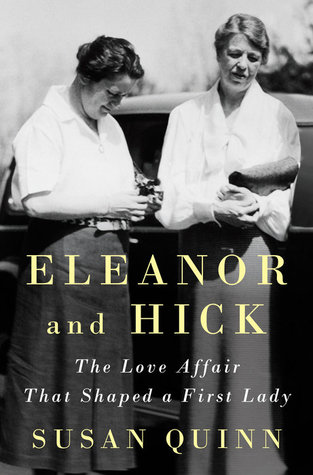
Eleanor and Hick


Eleanor and Hick: The Love Affair that Shaped a First Lady by Susan Quinn
Biography
2016 Penguin Audio
Read by Kimberly Farr
13 hours and 44 minutes
Finished on February 25, 2017
Rating: 3/5 (Good)

Publisher's Blurb:

A warm, intimate account of the love between Eleanor Roosevelt and reporter Lorena Hickok - a relationship that, over more than three decades, transformed both women's lives and empowered them to play significant roles in one of the most tumultuous periods in American history.

In 1932, as her husband assumed the presidency, Eleanor Roosevelt entered the claustrophobic, duty-bound existence of the first lady with dread. By that time she had put her deep disappointment in her marriage behind her and developed an independent life - now threatened by the public role she would be forced to play. A lifeline came to her in the form of a feisty campaign reporter for the Associated Press: Lorena Hickok. Over the next 30 years, until Eleanor's death, the two women carried on an extraordinary relationship: They were, at different points, lovers, confidantes, professional advisors, and caring friends.

They couldn't have been more different. Eleanor had been raised in one of the nation's most powerful political families and was introduced to society as a debutante before marrying her distant cousin, Franklin. Hick, as she was known, had grown up poor in rural South Dakota and worked as a servant girl after she escaped an abusive home, eventually becoming one of the most respected reporters at the AP. Her admiration drew the buttoned-up Eleanor out of her shell, and the two quickly fell in love. For the next 13 years, Hick had her own room at the White House, next door to the first lady.

These fiercely compassionate women inspired each other to right the wrongs of the turbulent era in which they lived. During the Depression Hick reported from the nation's poorest areas for the WPA, and Eleanor used these reports to lobby her husband for New Deal programs. Hick encouraged Eleanor to turn their frequent letters into her popular and long-lasting syndicated column "My Day" and to befriend the female journalists who became her champions. When Eleanor's tenure as first lady ended with FDR's death, Hick pushed her to continue to use her popularity for good - advice Eleanor took by leading the UN's postwar Human Rights Commission. At every turn the bond these women shared was grounded in their determination to better their troubled world.

Deeply researched and told with great warmth, Eleanor and Hick is a vivid portrait of love and a revealing look at how an unlikely romance influenced some of the most consequential years in American history.

I've always been fascinated with Eleanor Roosevelt's life story and thought this new biography might give a little more personal (and honest) insight into her life, as well as that of Lorena Hickok. My husband and I watched The Roosevelts: An Intimate History (a wonderful Ken Burns' documentary) and after reading Quinn's biography on Eleanor, I'm inclined to watch the program a second time. My mind wandered a little bit while listening to this audio book, and overall I liked it, but it probably would have been better to read the print edition.

January 6, 2016

Dead Wake


Dead Wake by Erik Larson
Nonfiction
2015 Penguin Random House Audio Publishing Group
Read by Scott Brick
Finished on June 18, 2015
Rating: 2/5 (Meh)


Publisher's Blurb:

From the bestselling author and master of narrative nonfiction comes the enthralling story of the sinking of the Lusitania

On May 1, 1915, with WWI entering its tenth month, a luxury ocean liner as richly appointed as an English country house sailed out of New York, bound for Liverpool, carrying a record number of children and infants. The passengers were surprisingly at ease, even though Germany had declared the seas around Britain to be a war zone. For months, German U-boats had brought terror to the North Atlantic. But the Lusitania was one of the era's great transatlantic "Greyhounds"—the fastest liner then in service—and her captain, William Thomas Turner, placed tremendous faith in the gentlemanly strictures of warfare that for a century had kept civilian ships safe from attack.

Germany, however, was determined to change the rules of the game, and Walther Schwieger, the captain of Unterseeboot-20, was happy to oblige. Meanwhile, an ultra-secret British intelligence unit tracked Schwieger's U-boat, but told no one. As U-20 and the Lusitania made their way toward Liverpool, an array of forces both grand and achingly small—hubris, a chance fog, a closely guarded secret, and more—all converged to produce one of the great disasters of history.

It is a story that many of us think we know but don't, and Erik Larson tells it thrillingly, switching between hunter and hunted while painting a larger portrait of America at the height of the Progressive Era. Full of glamour and suspense, Dead Wake brings to life a cast of evocative characters, from famed Boston bookseller Charles Lauriat to pioneering female architect Theodate Pope to President Woodrow Wilson, a man lost to grief, dreading the widening war but also captivated by the prospect of new love.

Gripping and important, Dead Wake captures the sheer drama and emotional power of a disaster whose intimate details and true meaning have long been obscured by history.

My husband loved Dead Wake, as have many of my friends, so I had high hopes when I began listening to the audio book, which is read by Scott Brick. I've enjoyed Brick's narration of other books (The Passage and The Twelve), but this time I was disappointed. I'm not sure if it was his delivery or the writing which fell short, but I found my mind wandering on more than one occasion. I did learn a bit about this historical event, but I feel that the details of Larson's account of the final voyage of the Lusitania were more superfluous than compelling. One reviewer stated the following, to which I most heartily agree:
If anything I would have preferred that he edited out some of all the details presented. I don't need to know a passenger's ticket number or that Mr. X wore a pink vest or the dimensions of a book brought on board. I believe Larson was trying to recreate the atmosphere on the boat, and he certainly did, but the details were excessive.

Final Thoughts:

In a word, lackluster. Print vs. audio? Perhaps the former is the way to go with this one. Or better yet, wait for the movie. I'm sure there will be one in the near future.

June 26, 2011

Unbroken


Unbroken: A World War II Story of Survival, Resilience, and Redemption by Laura Hillenbrand
Nonfiction
2010 Random House Audio; Unabridged Edition
Reader: Edward Herrmann
Finished 5/17/11
Rating: 3.5/5 (Good)


Product Description

On a May afternoon in 1943, an Army Air Forces bomber crashed into the Pacific Ocean and disappeared, leaving only a spray of debris and a slick of oil, gasoline, and blood. Then, on the ocean surface, a face appeared. It was that of a young lieutenant, the plane’s bombardier, who was struggling to a life raft and pulling himself aboard. So began one of the most extraordinary odysseys of the Second World War.

The lieutenant’s name was Louis Zamperini. In boyhood, he’d been a cunning and incorrigible delinquent, breaking into houses, brawling, and fleeing his home to ride the rails. As a teenager, he had channeled his defiance into running, discovering a prodigious talent that had carried him to the Berlin Olympics and within sight of the four-minute mile. But when war had come, the athlete had become an airman, embarking on a journey that led to his doomed flight, a tiny raft, and a drift into the unknown.

Ahead of Zamperini lay thousands of miles of open ocean, leaping sharks, a foundering raft, thirst and starvation, enemy aircraft, and, beyond, a trial even greater. Driven to the limits of endurance, Zamperini would answer desperation with ingenuity; suffering with hope, resolve, and humor; brutality with rebellion. His fate, whether triumph or tragedy, would be suspended on the fraying wire of his will.

In her long-awaited new book, Laura Hillenbrand writes with the same rich and vivid narrative voice she displayed in Seabiscuit. Telling an unforgettable story of a man’s journey into extremity, Unbroken is a testament to the resilience of the human mind, body, and spirit.

I tend to read more fiction than nonfiction, but after hearing such high praise for Hillenbrand’s latest book, I decided to give it a try. Listening to the audio version worked out well, since I tend to read history books with a highlighter in hand, studying the book rather than simply reading for enjoyment. I have no complaints about the reader (Edward Herrmann), but there were several instances in which I felt the story was beginning to sound repetitious and drawn out. I began to get impatient for Zamperini’s rescue from the POW camps and, had I been reading the book rather than listening to the audio version, I’m not sure if I would have bothered to finish. And yet one sentence has remained with me since I finished listening to the book. After relating his entire saga to a journalist, Louie said, “If I knew I had to go through those experiences again” he finally said, “I’d kill myself.” And who could blame him? War alone must be the most terrifying for those fighting for their countries. But then to be lost at sea for 47 days, fighting off sharks and watching as the enemy approaches, strafing the raft with gunfire, followed by capture and a horrific experience in a Japanese POW camp, in which starvation, beatings and torture (under the watch of the sadistic Corp. Mutsuhiro Watanabe) were routine experiences, it’s a wonder he and his fellow POWs didn’t commit suicide. I’m pretty sure at that point, I would’ve been beyond broken!

I read Seabiscuit back in 2002 and while I enjoyed parts of it, I wasn’t terribly impressed, giving it a somewhat average rating of 6/10. Judging from the reviews for both Seabiscuit and Unbroken, I’m in the minority.

May 3, 2009

The Midwife


The Midwife: A Memoir of Birth, Joy, and Hard Times by Jennifer Worth
Medical History/Memoir
2009 Penguin
Finished on 4/28/09
Rating: 4/5 (Very Good)


Product Description

An unforgettable story of the joy of motherhood, the bravery of a community, and the hope of one extraordinary woman

At the age of twenty-two, Jennifer Worth leaves her comfortable home to move into a convent and become a midwife in post war London’s East End slums. The colorful characters she meets while delivering babies all over London—from the plucky, warm-hearted nuns with whom she lives to the woman with twenty-four children who can’t speak English to the prostitutes and dockers of the city’s seedier side—illuminate a fascinating time in history. Beautifully written and utterly moving, The Midwife will touch the hearts of anyone who is, and everyone who has, a mother.

About the author

Jennifer Worth trained as a nurse at the Royal Berkshire Hospital in Reading, England. She then moved to London to train as a midwife. She later became a staff nurse at the Royal London Hospital, Whitechapel, and then ward sister at the Elizabeth Garrett Anderson Hospital in Euston. Music had always been her passion and in 1973 Jennifer left nursing in order to study music intensively. She gained the Licentiate of the London College of Music in 1974 and was awarded a fellowship ten years later. Mother of two daughters and grandmother of two; Jennifer lives in Hertfordshire with her husband Philip Worth.

I generally don't read a lot of nonfiction, but I sure do love memoirs, so I was happy to accept a review copy of The Midwife. I had a little bit of difficulty getting started, stumbling a bit through the introduction, but after that it was smooth sailing. The author has an engaging style and I was quickly transported to the streets of East London.

This is one of those books that must cause a bit of confusion for bookstore buyers and merchandisers. The subtitle indicates that it's a memoir. However, Barnes & Noble has it shelved in the medical history section. I'm not sure it's either. I think it falls more into the area of British history, as many of the anecdotes have more to do with life in London after World War II than with the art and science of delivering babies. Regardless of its classification, it's a lovely story of a young woman living amongst a group of kind-hearted nuns, learning the ropes of midwifery.

On the joy of a delivery:

I am about ready to leave. It has been a long day and night, but a profound sense of fulfilment and satisfaction lighten my step and lift my heart. Muriel and baby are both asleep as I creep out of the room. The good people downstairs offer me more tea, which again I decline as gracefully as I can, saying that breakfast will be waiting for me at Nonnatus House. I give instructions to call us if there seems to be any cause for worry, but say that I will be back again around lunch time, and again in the evening.

I entered the house in the rain and the dark. There had been a fever of excitement and anticipation, and the anxiety of a woman in labour, on the brink of bringing forth new life. I leave a calm, sleeping household, with the new soul in the midst, and step out into the morning sunlight.

I cycled through the dark deserted streets, the silent docks, past the locked gates, the empty ports. Now I cycle through bright early morning, the sun just rising over the river, the gates open or opening, men streaming through the streets, calling to each other; engines beginning to sound, the cranes to move; lorries turning in through the huge gates; the sounds of a ship as it moved. A dockyard is not really a glamorous places, but to a young girl with only three hours sleep on twenty-four hours work, after the quiet thrill of a safe delivery of a healthy baby, it is intoxicating. I don't even feel tired.

From large families (one delivery is of a woman's 25th child!) to rickets to interracial births to the horrors of the "workhouse," Worth entertains and enlightens her readers with anecdotes that help balance the story's grim poverty and hardships with stories imbued with her keen sense of humor:

A convent is essentially a female establishment. However, of necessity, the male of the species cannot be excluded entirely. Fred was the boiler-man and odd-jobber of Nonnatus House. He was typical of the Cockney of his day and age. Stunted growth, short bowed legs, powerful hairy arms, pugnacious, obstinate, resourceful; all these attributes were combined with endless chat and irrepressible good humour. His most striking characteristic was a spectacular squint. One eye was permanently directed north-east, whilst the other roved in a south-westerly direction. If you added to this the single yellow tooth jutting from his upper jaw, which he generally held over his lower lip and sucked, you would not say he was a beautiful specimen of manhood.

I noticed an occasional repetition to some of the stories, making me wonder if each chapter originated as an essay or column, later to be woven together in the form of a book. This is very minor quibble, as it really didn't distract from my enjoyment of the narrative.

The Midwife is much more than simply a memoir about a young woman's experiences in her new role as a midwife. It's a warm, engaging examination of life in a convent, life in London's post-war slums, and the friendships that grow between the nuns, midwives and mothers-to-be. If you enjoy any sort of medical narrative or historical memoirs (such as Frank McCourt's Angela's Ashes), you'll fall in love with Worth's richly evocative story. I certainly did.

Be sure to watch this wonderful video (from BookVideos.tv) of Jennifer Worth discussing her memoir. There are some marvelous black and white photographs included throughout the clip.

November 4, 2008

Yes We Did!


From our President-Elect

To Me! :)

Lesley --

I'm about to head to Grant Park to talk to everyone gathered there, but I wanted to write to you first.

We just made history.

And I don't want you to forget how we did it.

You made history every single day during this campaign -- every day you knocked on doors, made a donation, or talked to your family, friends, and neighbors about why you believe it's time for change.

I want to thank all of you who gave your time, talent, and passion to this campaign.

We have a lot of work to do to get our country back on track, and I'll be in touch soon about what comes next.

But I want to be very clear about one thing...

All of this happened because of you.

Thank you,

Barack