Showing posts with label Black Lives Matter. Show all posts

March 6, 2021

The Underground Railroad


Fiction
2016 Random House Audio
Read by Bahni Turpin
Finished on March 1, 2021
Rating: 2/5 (Fair)

Publisher's Blurb:

Cora is a slave on a cotton plantation in Georgia. Life is hell for all the slaves, but especially bad for Cora; an outcast even among her fellow Africans, she is coming into womanhood—where even greater pain awaits. When Caesar, a recent arrival from Virginia, tells her about the Underground Railroad, they decide to take a terrifying risk and escape. Matters do not go as planned—Cora kills a young white boy who tries to capture her. Though they manage to find a station and head north, they are being hunted.

In Whitehead’s ingenious conception, the Underground Railroad is no mere metaphor—engineers and conductors operate a secret network of tracks and tunnels beneath the Southern soil. Cora and Caesar’s first stop is South Carolina, in a city that initially seems like a haven. But the city’s placid surface masks an insidious scheme designed for its black denizens. And even worse: Ridgeway, the relentless slave catcher, is close on their heels. Forced to flee again, Cora embarks on a harrowing flight, state by state, seeking true freedom. 

Like the protagonist of Gulliver’s Travels, Cora encounters different worlds at each stage of her journey—hers is an odyssey through time as well as space. As Whitehead brilliantly re-creates the unique terrors for black people in the pre–Civil War era, his narrative seamlessly weaves the saga of America from the brutal importation of Africans to the unfulfilled promises of the present day. The Underground Railroad is at once a kinetic adventure tale of one woman’s ferocious will to escape the horrors of bondage and a shattering, powerful meditation on the history we all share.

I have now read two novels written by Colson Whitehead and I don't think I'll read any more. My book group chose The Underground Railroad for our March discussion and I decided to listen to the audio since it's read by the wonderful Bahni Turpin. Turpin's narration is fine, but I never felt like I knew Cora or any of the other characters, for that matter. It took me a long time to get interested in Cora's story, but once I did there would suddenly be the introduction of new characters or locations, which was jarring and confusing. I was never fully engrossed in the book and often found my mind wandering as I walked while listening to the audio. 

Judging from the high ratings by my friends on Goodreads, I am undoubtedly in the minority, although a few readers have shared my thoughts, claiming the book lacks emotion, is distant and impersonal. Will I watch the ten-episode limited series when it hits Amazon Prime on May 14th? Possibly. Maybe this will be one of those rare instances when the movie is better than the book.

Click here for my review of The Nickel Boys by Colson Whitehead.

August 24, 2020

Red at the Bone


Fiction
2019 Penguin Audio
Narrated by: Jacqueline Woodson, Quincy Tyler Bernstine, Peter Francis James, Shayna Small, and Bahni Turpin
Finished on August 19, 2020
Rating: 3/5 (Good)

Publisher's Blurb:

Moving forward and backward in time, Jacqueline Woodson's taut and powerful new novel uncovers the role that history and community have played in the experiences, decisions, and relationships of these families, and in the life of the new child.

As the book opens in 2001, it is the evening of sixteen-year-old Melody's coming of age ceremony in her grandparents' Brooklyn brownstone. Watched lovingly by her relatives and friends, making her entrance to the music of Prince, she wears a special custom-made dress. But the event is not without poignancy. Sixteen years earlier, that very dress was measured and sewn for a different wearer: Melody's mother, for her own ceremony-- a celebration that ultimately never took place.

Unfurling the history of Melody's parents and grandparents to show how they all arrived at this moment, Woodson considers not just their ambitions and successes but also the costs, the tolls they've paid for striving to overcome expectations and escape the pull of history. As it explores sexual desire and identity, ambition, gentrification, education, class and status, and the life-altering facts of parenthood, Red at the Bone most strikingly looks at the ways in which young people must so often make long-lasting decisions about their lives--even before they have begun to figure out who they are and what they want to be.

I wound up listening to this novel at the same time I was reading Woodson's powerful memoir, Brown Girl Dreaming. Red at the Bone is a quick read, but I didn't care for it nearly as much as the memoir and I'm already sensing that the story and characters will soon be forgotten. I normally enjoy a novel read by several narrators, but this particular production made it more difficult to connect to anyone character and I regret not reading the the print version.

August 22, 2020

Brown Girl Dreaming


Memoir/Poetry
2014 Puffin Books
Finished on August 19, 2020
Rating: 4/5 (Very Good)

Publisher's Blurb:

Jacqueline Woodson, one of today's finest writers, tells the moving story of her childhood in mesmerizing verse.

Raised in South Carolina and New York, Woodson always felt halfway home in each place. In vivid poems, she shares what it was like to grow up as an African American in the 1960s and 1970s, living with the remnants of Jim Crow and her growing awareness of the Civil Rights movement. Touching and powerful, each poem is both accessible and emotionally charged, each line a glimpse into a child’s soul as she searches for her place in the world. Woodson’s eloquent poetry also reflects the joy of finding her voice through writing stories, despite the fact that she struggled with reading as a child. Her love of stories inspired her and stayed with her, creating the first sparks of the gifted writer she was to become.

I wound up reading Brown Girl Dreaming at the same time I listened to the audio edition of Woodson's novel, Red at the Bone. I'm not sure anything I say about either book will do them justice, so bear with me.

Brown Girl Dreaming is both a beautiful memoir and an engaging history lesson, expressed entirely in free verse. I have only read one other book written in this literary style (The Hunchback of Neiman Marcus) and while it may initially feel awkward, it isn't long before the story begins to flow and the reader becomes enveloped in the lush prose.

south carolina at war

Because we have a right, my grandfather tells us--
we are sitting at his feet and the story tonight is

why people are marching all over the South--

to walk and sit and dream wherever we want.

First they brought us here.
Then we worked for free. Then it was 1863,
and we were supposed to be free but we weren't.

And that's why people are so mad.

And it's true, we can't turn on the radio
without hearing about the marching.

We can't go to downtown Greenville without
seeing the teenagers walking into stores, sitting
where brown people still aren't allowed to sit
and getting carried out, their bodies limp,
their faces calm.

This is the way brown people have to fight,
my grandfather says.
You can't just put your fist up. You have to insist
on something
gently. Walk toward a thing
slowly.

But be ready to die,
my grandfather say,
for what is right.

Be ready to die, my grandfather says,
for everything you believe in.

And none of us can imagine death
but we try to imagine it anyway.

Even my mother joins the fight.
When she thinks our grandmother
isn't watching she sneaks out
to meet the cousins downtown, but just as
she's stepping through the door,
her good dress and gloves on, my grandmother says,
Now don't go getting arrested.

And Mama sounds like a little girl when she says,
I won't.

More than a hundred years, my grandfather says,
and we're still fighting for the free life
we're supposed to be living.

So there's a war going on in South Carolina
and even as we play
and plant and preach and sleep, we are a part of it.

Because you're colored, my grandfather says.
And just as good and bright and beautiful and free
as anybody.
And nobody colored in the South is stopping,
my grandfather says,
until everybody knows what's true.
Woodson's memoir is categorized for young readers (ages 10 and up) and yet it is just as astute and perceptive as most of the adult memoirs I've read over the years. A little over 300 pages, Brown Girl Dreaming can easily be read in a single day, but I chose to read a little at a time, going back to reread a page or two, savoring the story of Woodson's childhood.
what i believe

I believe in God and evolution.
I believe in the Bible and the Qur'an.
I believe in Christmas and the New World.
I believe that there is good in each of us
no matter who we are or what we believe in.
I believe in the words of my grandfather.
I believe in the city and the South
the past and the present.
I believe in Black people and White people coming
 together. 
I believe in nonviolence and "Power to the People."
I believe in my little brother's pale skin and my own
 dark brown.
I believe in my sister's brilliance and the too-easy
 books I love to read.
I believe in my mother on a bus and Black people
 refusing to ride.
I believe in good friends and good food.

I believe in johnny pumps and jump ropes,
Malcolm and Martin, Buckeyes and Birmingham,
writing and listening, bad words and good words -
I believe in Brooklyn!

I believe in one day and someday and this
 perfect moment called Now.
Highly recommend! The timely memoir is worthy of the numerous awards and accolades received and is one that I will read again and again. I'm especially eager to listen to the audiobook, which is narrated by the author. 
The triumph of Brown Girl Dreaming is not just in how well Woodson tells us the story of her life, but in how elegantly she writes words that make us want to hold those carefully crafted poems close, apply them to our lives, reach into the mirror she holds up and makes the words and the worlds she explores our own. This is a book full of poems that cry out to be learned by heart. These are poems that will, for years to come, be stored in our bloodstream. ~ The New York Times Book Review

August 10, 2020

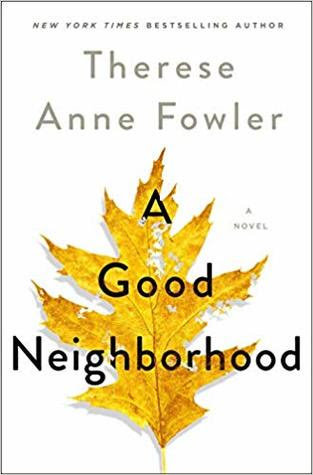
A Good Neighborhood


A Good Neighborhood by Therese Anne Fowler
Fiction
2020 St. Martin's Press
Finished on August 4, 2020
Rating: 3/5 (Good)

Publisher's Blurb:

In Oak Knoll, a verdant, tight-knit North Carolina neighborhood, professor of forestry and ecology Valerie Alston-Holt is raising her bright and talented biracial son. Xavier is headed to college in the fall, and after years of single parenting, Valerie is facing the prospect of an empty nest. All is well until the Whitmans move in next door - an apparently traditional family with new money, ambition, and a secretly troubled teenaged daughter.

Thanks to his thriving local business, Brad Whitman is something of a celebrity around town, and he's made a small fortune on his customer service and charm, while his wife, Julia, escaped her trailer park upbringing for the security of marriage and homemaking. Their new house is more than she ever imagined for herself, and who wouldn't want to live in Oak Knoll? With little in common except a property line, these two very different families quickly find themselves at odds: first, over an historic oak tree in Valerie's yard, and soon after, the blossoming romance between their two teenagers.

Told from multiple points of view, A Good Neighborhood asks big questions about life in America today―What does it mean to be a good neighbor? How do we live alongside each other when we don't see eye to eye?―as it explores the effects of class, race, and heartrending star-crossed love in a story that’s as provocative as it is powerful.

I haven't read Fowler's previous novels (A Well-Behaved Woman and Z: A Novel of Zelda Fitzgerald), but the premise of A Good Neighborhood appealed to me and I was pleased to win an ARC from the publisher earlier this year. I was quickly pulled into the narrative and enjoyed the thought-provoking story, although I didn't care for the first person plural POV, which felt gimmicky and kept me from caring about most of the characters. 
Before we depict the first encounter between our story's other central players, we need to show the wider setting in which this slow tragedy unfolded. As our resident English professor would remind us, place, especially in stories of the South, is as much a character as any human, and inseparable from--in this case even necessary to--the plot.
There is quite a bit of foreshadowing, which helped move this Greek-like tragedy along, but there were no surprises and it was all fairly predictable. My initial reaction after the intense finale, was to give the book a high rating, but after thinking about the plot and character development, I've dropped it down to an average rating. Nonetheless, this is a timely book, touching on the injustices of race and class, and would make a good selection for a book club discussion, especially if combined with Bryan Stevenson's Just Mercy.

July 14, 2020

The Warmth of Other Suns by Isabel Wilkerson


The Warmth of Other Suns: The Epic Story of America's Great Migration by Isabel Wilkerson
Nonfiction - History
2011 Brilliance Audio
Read by Robin Miles
Finished on July 6, 2020
Rating: 3/5 (Good)

Publisher's Blurb:

From 1915 to 1970, this exodus of almost six million people changed the face of America. Wilkerson compares this epic migration to the migrations of other peoples in history. She interviewed more than a thousand people, and gained access to new data and official records, to write this definitive and vividly dramatic account of how these American journeys unfolded, altering our cities, our country, and ourselves.

With stunning historical detail, Wilkerson tells this story through the lives of three unique individuals: Ida Mae Gladney, who in 1937 left sharecropping and prejudice in Mississippi for Chicago, where she achieved quiet blue-collar success and, in old age, voted for Barack Obama when he ran for an Illinois Senate seat; sharp and quick-tempered George Starling, who in 1945 fled Florida for Harlem, where he endangered his job fighting for civil rights, saw his family fall, and finally found peace in God; and Robert Foster, who left Louisiana in 1953 to pursue a medical career, the personal physician to Ray Charles as part of a glitteringly successful medical career, which allowed him to purchase a grand home where he often threw exuberant parties.

Wilkerson brilliantly captures their first treacherous and exhausting cross-country trips by car and train and their new lives in colonies that grew into ghettos, as well as how they changed these cities with southern food, faith, and culture and improved them with discipline, drive, and hard work. Both a riveting microcosm and a major assessment, The Warmth of Other Suns is a bold, remarkable, and riveting work, a superb account of an “unrecognized immigration” within our own land. Through the breadth of its narrative, the beauty of the writing, the depth of its research, and the fullness of the people and lives portrayed herein, this book is destined to become a classic.

I've had my eye on The Warmth of Other Suns for several years and finally decided to download the audiobook from Libro.fm. I was well aware that the print edition is very long, but I wasn't quite prepared to spend an entire month listening to this nonfiction work. It was just under 23 hours of listening time. Eek!

Wilkerson's research is extensive and I liked learning about the lives of the three main individuals represented in the book, but it took me quite a while to get used to the rhythm of the narrative. Each of three people (and their families) migrate to different areas of the country, experiencing unique and similar instances of racial injustice and acceptance. These biographies are interwoven during each time period and there were times when I wasn't sure if the narrative was focusing on George or Robert's life.

I wish I could say that I loved this book, and perhaps I would have enjoyed it more had I read the print copy, but that was not my experience. I appreciate the lessons learned about this time in our country's history, but I found the writing repetitive and was easily distracted as I listened. I am obviously in the minority, if one is to look at all the 5-star ratings on Goodreads. Robin Miles does a fine job with the audiobook narration, but my recommendation is to read the print edition.

June 17, 2020

The Nickel Boys


The Nickel Boys by Colson Whitehead
Fiction
2019 Doubleday
Finished on June 15, 2020
Rating: 3/5 (Good)

Publisher's Blurb:

Winner of the 2020 Pulitzer Prize for Fiction.

As the Civil Rights movement begins to reach the black enclave of Frenchtown in segregated Tallahassee, Elwood Curtis takes the words of Dr. Martin Luther King to heart: He is “as good as anyone.” Abandoned by his parents, but kept on the straight and narrow by his grandmother, Elwood is a high school senior about to start classes at a local college. But for a black boy in the Jim Crow South of the early 1960s, one innocent mistake is enough to destroy the future. Elwood is sentenced to a juvenile reformatory called the Nickel Academy, whose mission statement says it provides “physical, intellectual and moral training” so the delinquent boys in their charge can become “honorable and honest men.”

In reality, the Nickel Academy is a grotesque chamber of horrors. Stunned to find himself in such a vicious environment, Elwood tries to hold onto Dr. King’s ringing assertion “Throw us in jail and we will still love you.” His friend Turner thinks Elwood is worse than naive, that the world is crooked, and that the only way to survive is to scheme and avoid trouble.

The tension between Elwood’s ideals and Turner’s skepticism leads to a decision with repercussions that will echo down the decades. Formed in the crucible of the evils Jim Crow wrought, the boys’ fates will be determined by what they endured at the Nickel Academy.

The book is based on the real story of a reform school in Florida that operated for one hundred and eleven years and warped the lives of thousands of children.

I received a copy of The Nickel Boys for my birthday and decided to add it to my stack of books for this year's 20 Books of Summer reading challenge. Colson Whitehead's previous novel, The Underground Railroad, has been on my radar since it was first published, but I hadn't heard much about this newer release, which is based on the real story of the Dozier School in Florida. 

The hardcover edition is just over 200 pages and a fast reader could finish it in one sitting. I'm not terribly quick, but the first half was so compelling, I zipped through the book in two days. Whitehead's detailed descriptions of the brutal treatment of the boys (both Black and white) in his fictionalized juvenile reformatory are not for the faint of heart. I felt a great sense of foreboding as I read, and noticed that I was holding my breath as I turned the pages. The second half of the book jumps back and forth between past and present, which I found somewhat disruptive and confusing, but once I finished the book, I understood Whitehead's reasoning for that format and applaud him for the startling conclusion. This is a tough, but important book, and while I'm not sorry I read it, it's not one that I enjoyed.

June 6, 2020