Showing posts with label 1/5. Show all posts

January 21, 2022

Looking Back - Love Medicine

Looking Back... In an effort to transfer my book journal entries over to this blog, I'm going to attempt to post (in chronological order) an entry every Friday. I may or may not add extra commentary to what I jotted down in these journals.


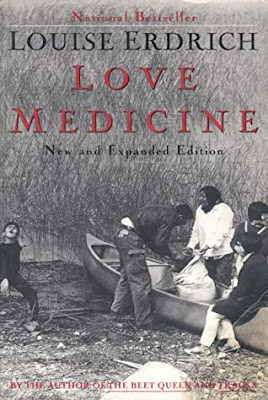
Love Medicine by Louise Erdrich
Fiction
2001 Harper Perennial (first published in 1984)
Read in January 2001
Rating: 1/5 (Meh)

Publisher's Blurb:

The first book in Louise Erdrich's highly acclaimed "Native American" trilogy that includes "The Beet Queen," "Tracks," and "The Bingo Palace," re-sequenced and expanded to include never-before-published chapters.

Set on and around a North Dakota Ojibwe reservation, Love Medicine is the epic story about the intertwined fates of two families: the Kashpaws and the Lamartines.

With astonishing virtuosity, each chapter draws on a range of voices to limn its tales. Black humor mingles with magic, injustice bleeds into betrayal, and through it all, bonds of love and family marry the elements into a tightly woven whole that pulses with the drama of life.

Filled with humor, magic, injustice and betrayal, Erdrich blends family love and loyalty in a stunning work of dramatic fiction.

My Original Thoughts (2001):

If it weren't for a book club selection, I never would have finished this book. I thought it was terribly confusing (even with family trees - my own attempt) and dull! I felt no connection to any of the characters.

My Current Thoughts:

I know Erdrich is a beloved author of many readers, and I have a couple of her more recent novels in my TBR stacks, but this one was a big miss. Maybe I'll give a second read sometime after reading some of her other books, but it was not a good introduction to her writing. 

December 28, 2021

Yeah, No. Not Happening.


Nonfiction
2020 HarperAudio
Narrated by the author
Finished on December 21, 2021
Rating: 1/5 (Poor)

Publisher's Blurb:

The author of the acclaimed, bestselling In Praise of Difficult Women delivers a hilarious feminist manifesto that encourages us to reject “self-improvement” and instead learn to appreciate and flaunt our complex, and flawed, human selves.

Why are we so obsessed with being our so-called best selves? Because our modern culture force feeds women lies designed to heighten their insecurities: “You can do it all—crush it at work, at home, in the bedroom, at PTA and at Pilates—and because you can, you should. We can show you how!”

Karen Karbo has had enough. She’s taking a stand against the cultural and societal pressures, marketing, and media influences that push us to spend endless time, energy and money trying to “fix” ourselves—a race that has no finish line and only further increases our send of self-dissatisfaction and loathing. “Yeah, no, not happening,” is her battle cry.

In this wickedly smart and entertaining book, Karbo explores how “self-improvery” evolved from the provenance of men to women. Recast as “consumers” in the 1920s, women, it turned out, could be seduced into buying anything that might improve not just their lives, but their sense of self-worth. Today, we smirk at Mad Men-era ads targeting 1950s housewives—even while savvy marketers, aided and abetted by social media “influencers,” peddle skin care “systems,” skinny tea, and regimens that promise to deliver endless happiness. We’re not simply seduced into dropping precious disposable income on empty promises; the underlying message is that we can’t possibly know what’s good for us, what we want, or who we should be. Calling BS, Karbo blows the lid off of this age-old trend and asks women to start embracing their awesomely imperfect selves.

There is no one more dangerous than a woman who doesn’t care what anyone thinks of her. Yeah, No, Not Happening is a call to arms to build a posse of dangerous women who swear off self-improvement and its peddlers. A welcome corrective to our inner-critic, Karbo’s manifesto will help women restore their sanity and reclaim their self-worth.

I have no idea what possessed me to download this audiobook. I'm not a reader of self-improvement books, so I am completely baffled. I decided to listen to it during Nonfiction November, but didn't get around to it until December. It clocks in under seven hours of listening time, so I was able to get through it quickly, but it's not one that I can recommend. Karbo claims to shun self-improvement, but this book is essentially just that. If I had been reading the print edition, I would have quit early on, but it was easy to listen as I walked, ever hopeful for a nugget or two of good advice. My advice to you? If you must, get it from your library rather than spend your money. And, be aware of an overabundance of f-bombs. I should have guessed that from the title.

I received a complimentary copy from Libro.fm. All thoughts and opinions are my own.

April 12, 2021

Three Hours in Paris


Mystery
2020 Recorded Books, Inc.
Read by Elisabeth Rodgers
Finished on April 8, 2021
Rating: 1/5 (Poor)

Publisher's Blurb:

In June of 1940, when Paris fell to the Nazis, Hitler spent a total of three hours in the City of Light—abruptly leaving, never to return. To this day, no one knows why.

The New York Times bestselling author of the Aimée Leduc investigations reimagines history in her masterful, pulse-pounding spy thriller, Three Hours in Paris.

Kate Rees, a young American markswoman, has been recruited by British intelligence to drop into Paris with a dangerous assignment: assassinate the Führer. Wrecked by grief after a Luftwaffe bombing killed her husband and infant daughter, she is armed with a rifle, a vendetta, and a fierce resolve. But other than rushed and rudimentary instruction, she has no formal spy training. Thrust into the red-hot center of the war, a country girl from rural Oregon finds herself holding the fate of the world in her hands. When Kate misses her mark and the plan unravels, Kate is on the run for her life—all the time wrestling with the suspicion that the whole operation was a set-up.

Cara Black, doyenne of the Parisian crime novel, is at her best as she brings Occupation-era France to vivid life in this gripping story about one young woman with the temerity—and drive—to take on Hitler himself.

I'm not sure what it is about an audiobook that keeps me listening long after I've decided I don't care for it. I can only guess that I listen while doing other things (walking, folding laundry, running errands or pulling weeds), so I'm a little more tolerant and optimistic, hoping the story might improve. I also hate to ditch a book after investing several hours of my time, but I do quit when it's a print book that's failing to entertain, so why not an audio? You'd think I wouldn't want to waste any more of my time. 

I haven't read any other books by Cara Black, but Three Hours in Paris is far-fetched and, at times, tedious and repetitive. We learn early on that Kate Rees is a country girl from Oregon. The author doesn't let us forget that fact, bringing it to our attention repeatedly and unnecessarily. Those details do nothing to add to Kate's character or move the plot along. We are also reminded on numerous occasions of her special training and instructions. RADA: Read, access, decide, act. Got it. Got it the first, second and third time and didn't need to be reminded over and over.

I also struggled with Kate's extraordinary ability to escape capture on multiple occasions, which brought to mind the character of Marius Josipovic in Sneaky Pete. While Marius is clever and cunning, Kate is simply unbelievably lucky. I didn't buy it. 

Finally, I was not impressed with the reader of this audiobook. She was either flat and monotone or too melodramatic (or unauthentic), particularly when she spoke the untranslated French passages.

I enjoy books about World War II, but this was a big miss. Do I dare try any of her Aimee Leduc books?

I received a complimentary copy from Libro.fm.

February 16, 2021

The Tao of Pooh


Inspired by the original works by A.A. Milne and E.H. Shepard
Nonfiction
2019 Egmont Books (first published in 1992)
Finished on February 9, 2021
Rating: 1/5 (Poor)

Publisher's Blurb:

Is there such thing as a Western Taoist? Benjamin Hoff says there is, and this Taoist's favorite food is honey. Through brilliant and witty dialogue with the beloved Pooh-bear and his companions, the author of this smash bestseller explains with ease and aplomb that rather than being a distant and mysterious concept, Taoism is as near and practical to us as our morning breakfast bowl. Romp through the enchanting world of Winnie-the-Pooh while soaking up invaluable lessons on simplicity and natural living.

Philosophical works are generally not my cuppa tea, but my book group chose The Tao of Pooh for our February selection and I thought it might be a good chance to learn a little bit about this Chinese philosophy. I wound up having to buy a volume that includes not only The Tao of Pooh, but also The Te of Piglet. While I managed to finish the first book, I really struggled with boredom and don't think I gained much in the way of understanding Taoism, in spite of Hoff's attempt to explain it to his readers through the interactions among Pooh, Piglet and the rest of the gang in the Hundred Acre Wood. As others have said, the best part of this book is the selections from the Winnie-the-Pooh stories (including illustrations) and I'll also add that I'm glad it wasn't any longer than its 170 pages. The entire book sounded like one big riddle! I'm looking forward to my book group discussion and wonder how many members enjoyed the book.

August 31, 2020

Normal People


Fiction
2019 Random House Audio
Read by Aoife McMahon
Finished on August 28, 2020
Rating: 1/5 (Poor)

Publisher's Blurb:

At school Connell and Marianne pretend not to know each other. He’s popular and well-adjusted, star of the school soccer team while she is lonely, proud, and intensely private. But when Connell comes to pick his mother up from her housekeeping job at Marianne’s house, a strange and indelible connection grows between the two teenagers - one they are determined to conceal.

A year later, they’re both studying at Trinity College in Dublin. Marianne has found her feet in a new social world while Connell hangs at the sidelines, shy and uncertain. Throughout their years in college, Marianne and Connell circle one another, straying toward other people and possibilities but always magnetically, irresistibly drawn back together. Then, as she veers into self-destruction and he begins to search for meaning elsewhere, each must confront how far they are willing to go to save the other.

Sally Rooney brings her brilliant psychological acuity and perfectly spare prose to a story that explores the subtleties of class, the electricity of first love, and the complex entanglements of family and friendship.

It is extremely rare for me to give a book a 1-star rating. If my reaction is that negative, I normally quit reading long before I reach the end of the book. And yet, when listening to an audiobook, I'm more inclined to push through, hoping for a turn in the story or a redeeming quality in a particular character, which would make my persistence to forge ahead worthwhile. This was not the case with Normal People. Each day, as I headed outside for my walk, I went with the realization that I was simply biding my time with the book, listening only to reach the end; to discover what lay ahead for Connell and Marianne and to see if Sally Rooney had left the best for last. Perhaps an unexpected twist that would make it all worthwhile. 

Nope.

The only positive remark I can make is that Normal People is a fairly quick read. The negative? A weak (almost nonexistent) plot with tedious details of everyday occurrences. Unlikable, unrelatable and annoying characters. Angst-ridden and navel-gazing young adults who are in an on-again-off-again relationship that made absolutely no sense to me. 

I am truly surprised that so many readers gave this book such high praise and I wonder if I'm not the target audience. It would be interesting to sit in on a book club discussion and hear why some readers enjoyed it, while others found is loathsome. 

It will take a great amount of persuasion to convince me to watch the TV series, which is based on this unsatisfying and over-hyped novel.

In a word, this book was boring. Can I get my week back?!

March 20, 2020

Looking Back - The Bluest Eye

Looking Back... In an effort to transfer my book journal entries over to this blog, I'm going to attempt to post (in chronological order) an entry every Friday. I may or may not add extra commentary to what I jotted down in these journals.


The Bluest Eye by Toni Morrison
Fiction
1994 Penguin Books (first published in 1970)
Read in July 1999
Rating: 1/5 (Disliked)

Publisher's Blurb:

The Bluest Eye is Toni Morrison's first novel, a book heralded for its richness of language and boldness of vision. Set in the author's girlhood hometown of Lorain, Ohio, it tells the story of black, eleven-year-old Pecola Breedlove. Pecola prays for her eyes to turn blue so that she will be as beautiful and beloved as all the blond, blue-eyed children in America. In the autumn of 1941, the year the marigolds in the Breedloves' garden do not bloom. Pecola's life does change- in painful, devastating ways.

What its vivid evocation of the fear and loneliness at the heart of a child's yearning, and the tragedy of its fulfillment. The Bluest Eye remains one of Tony Morrisons's most powerful, unforgettable novels- and a significant work of American fiction.

My Original Notes (1999):

I've decided I really don't care much for Morrison's works. I really liked Beloved, but didn't care for this book. (I couldn't get into Paradise, either.) This was a chore to read.

My Current Thoughts:

Toni Morrison has never been a favorite, but after reading Beloved (which I loved), I thought I'd give this renowned debut a chance. I didn't care for it at all, but wonder if it would make a better impression on me now.

January 24, 2020

Looking Back - Message in a Bottle

Looking Back... In an effort to transfer my book journal entries over to this blog, I'm going to attempt to post (in chronological order) an entry every Friday. I may or may not add extra commentary to what I jotted down in these journals.


Message in a Bottle by Nicholas Sparks
Fiction
1999 Grand Central Publishing (first published in 1998)
Read in April 1999
Rating: 1/5 (Poor)

Publisher's Blurb:


Thrown to the waves, and to fate, the bottle could have ended up anywhere. Instead, it is found just three weeks after it begins its journey. Theresa Osborne, divorced and the mother of a twelve-year-old son, discovers it during a seaside vacation from her job as a Boston newspaper columnist. Inside is a letter that opens with, "My Dearest Catherine, I miss you my darling, as I always do, but today is particularly hard because the ocean has been singing to me, and the song is that of our life together...." For Garrett, the message is the only way he knows to express his undying love for a woman he has lost. For Theresa, wary of romance since her husband shattered her trust, the message raises questions that intrigue her. Challenged by the mystery, and driven to find Garrett by emotions she does not fully understand, Theresa begins a search that takes her to a sunlit coastal town and an unexpected confrontation. Brought together either by chance or something more powerful, Theresa and Garrett's lives come together in a tale that resonates with our deepest hopes for finding everlasting love. Shimmering with suspense and emotional intensity, Message in a Bottle takes readers on a hunt for the truth about a man and his memories, and about both the heartbreaking fragility and enormous strength of love. For those who cherished The Notebook and readers waiting to discover the magic of Nicholas Sparks's storytelling, here is an achingly lovely novel of happenstance, desire, and the choices that matter most.

My Original Notes (1999):

Fluff. Pretty much a no-brainer and almost an entire waste of time. Simplistic and amateurish sentence structure, bordering on boring. Predictable. Why did I bother?? And everyone said the book was better than the movie. I certainly won't see it now.

My Current Thoughts:

Blech.

January 23, 2020

Convenience Store Woman


Convenience Store Woman by Sayaka Murata
Translated from the Japanese by Ginny Tapley Takemori
Fiction
2018 Grove Press
Finished on January 21, 2020
Rating: 1/5 (Poor)

Publisher's Blurb:

Keiko Furukura had always been considered a strange child, and her parents always worried how she would get on in the real world, so when she takes on a job in a convenience store while at university, they are delighted for her. For her part, in the convenience store she finds a predictable world mandated by the store manual, which dictates how the workers should act and what they should say, and she copies her coworkers' style of dress and speech patterns so she can play the part of a normal person. However, eighteen years later, at age 36, she is still in the same job, has never had a boyfriend, and has only few friends. She feels comfortable in her life but is aware that she is not living up to society's expectations and causing her family to worry about her. When a similarly alienated but cynical and bitter young man comes to work in the store, he will upset Keiko's contented stasis—but will it be for the better?

Sayaka Murata brilliantly captures the atmosphere of the familiar convenience store that is so much part of life in Japan. With some laugh-out-loud moments prompted by the disconnect between Keiko's thoughts and those of the people around her, she provides a sharp look at Japanese society and the pressure to conform, as well as penetrating insights into the female mind. Convenience Store Woman is a fresh, charming portrait of an unforgettable heroine that recalls Banana Yoshimoto, Han Kang, and Amelie.


My dear friend Meredith (of Dolce Bellezza) has been hosting a Japanese Literature challenge for the past 13 years. Every year I consider participating in this event, but I have to admit it's not a genre I particularly care for. Prior to reading Convenience Store Woman, I think the only other translated Japanese book that I've read is Kitchen by Banana Yoshimoto. I was disappointed with both of these books, not quite understanding their large appeal. While perusing the reviews on Goodreads for Convenience Store Woman, I was surprised to see so many 4 and 5 star ratings. Not only did readers love this novel, but they thought it was brilliant! I scrolled and scrolled, searching for a 1 or 2 star rating, but they were few and far between. I am definitely in the minority on this one. The dialogue was unrealistic and stilted and the premise of the story was unsettling and ridiculous. After a dozen or so pages, I grew bored and impatient to finish. Had it not been such a short book, I would have given up halfway through.

Click here to read Bellezza's thoughts on this novel.

May 31, 2019

Looking Back - A Cup of Tea

Looking Back... In an effort to transfer my book journal entries over to this blog, I'm going to attempt to post (in chronological order) an entry every Friday. I may or may not add extra commentary to what I jotted down in these journals.


A Cup of Tea: A Novel of 1917 by Amy Ephron 
Fiction
1998 Ballantine Books
Finished in August 1998
Rating: 1/5 (Poor)

Publisher's Blurb:

Amy Ephron gives us a delightful tale of romance, set against the backdrop of New York society during the uncertain days of World War I. Rosemary Fell was born to privilege - her only real hardship having been the loss of her mother some years earlier. She has friends and she has a great deal of money, and now she is about to marry Phillip Alsop, who owns a shipping concern and is of her social circle, though not of her wealth. Finally, she will have everything she wants. It is then, in a moment of beneficence, that she invites Eleanor Smith, a penniless young woman she sees under a streetlamp in the rain, to come to her home for a cup of tea and to warm herself by the fire. While there, Rosemary sees Eleanor exchange an unmistakable look with Phillip, and suddenly everything in Rosemary's carefully sculptured life changes. Rosemary sends Eleanor on her way, but she cannot undo this chance encounter that puts into play a tempestuous and all-consuming triangle. As the war builds in Europe, Phillip is sent to fight abroad, throwing all of their lives off balance.

My Original Notes (1998):

So-so to dull. I'm glad I didn't buy this book. Not my cuppa tea.


My Current Thoughts:

I wonder if I chose this because I loved Nora Ephron's (Amy's sister) Sleepless in Seattle. I'm pretty sure I haven't read anything else by her (or her sister, Delia) since this one.

February 22, 2019

Looking Back - Housekeeping

Looking Back... In an effort to transfer my book journal entries over to this blog, I'm going to attempt to post (in chronological order) an entry every Friday. I may or may not add extra commentary to what I jotted down in these journals.


Housekeeping by Marilynne Robinson
Fiction
1981 Farrar, Straus and Giroux
Finished in April 1998
Rating: 1/5 (Poor)

Publisher's Blurb:

A modern classic, Housekeeping is the story of Ruth and her younger sister, Lucille, who grow up haphazardly, first under the care of their competent grandmother, then of two comically bumbling great-aunts, and finally of Sylvie, the eccentric and remote sister of their dead mother. The family house is in the small town of Fingerbone on a glacial lake in the Far West, the same lake where their grandfather died in a spectacular train wreck and their mother drove off a cliff to her death. It is a town "chastened by an outsized landscape and extravagant weather, and chastened again by an awareness that the whole of human history had occurred elsewhere." Ruth and Lucille's struggle toward adulthood beautifully illuminates the price of loss and survival, and the dangerous and deep undertow of transcience.

My Original Notes (1998):

Boring! I don't know why I forced myself to read this book. Very little action and very little dialogue. 


My Current Thoughts:

I don't remember much about this novel other than the fact that it was terribly dull and very bleak. Looking at the reviews on Goodreads, I'm definitely in the minority!

December 28, 2018

Looking Back - Underfoot in Show Business

Looking Back... In an effort to transfer my book journal entries over to this blog, I'm going to attempt to post (in chronological order) an entry every Friday. I may or may not add extra commentary to what I jotted down in these journals.


Underfoot in Show Business by Helene Hanff
Nonfiction
1962 Harper & Row
Finished in January 1998
Rating: 1/5 (Poor)

Publisher's Blurb:

The countless admirers of Helen Hanff's 84, Charing Cross Road will welcome this delightful account of her early days as a struggling writer on the edge of show business.

When she became an apprentice playwright with new York's prestigious Theatre Guild Helene was high on the champagne of her hopes. What did she care about living chiefly on coffee in meagre bed-sitters when she could always borrow her best friend's best blouse for lunch with a producer and was meeting awe-inspiring people. She was young, stage-struck and determined to have fun.


My Original Notes (1998):

Boring! Not anything like her two other books. Skimmed a lot and don't recommend it at all.

My Current Thoughts:


No longer on my shelf and certainly no desire to read this one again.

December 24, 2018

The Gentle Art of Swedish Death Cleaning


Nonfiction
2018 Scribner
Finished on March 3, 2018
Rating: 1/5 (Poor)

Publisher's Blurb:

A charming, practical, and unsentimental approach to putting a home in order while reflecting on the tiny joys that make up a long life.

In Sweden there is a kind of decluttering called döstädning, meaning “death” and städning meaning “cleaning.” This surprising and invigorating process of clearing out unnecessary belongings can be undertaken at any age or life stage but should be done sooner than later, before others have to do it for you. In The Gentle Art of Swedish Death Cleaning, artist Margareta Magnusson, with Scandinavian humor and wisdom, instructs readers to embrace minimalism. Her radical and joyous method for putting things in order helps families broach sensitive conversations, and makes the process uplifting rather than overwhelming.

Margareta suggests which possessions you can easily get rid of (unworn clothes, unwanted presents, more plates than you’d ever use) and which you might want to keep (photographs, love letters, a few of your children’s art projects). Digging into her late husband’s tool shed, and her own secret drawer of vices, Margareta introduces an element of fun to a potentially daunting task. Along the way readers get a glimpse into her life in Sweden, and also become more comfortable with the idea of letting go.

This book was such a disappointment! The writing is poor and amateurish, bordering on silly, and I didn't learn anything I didn't already know. I don't know why I bothered finishing the book as I really wanted to quit (or at least skim) almost from the very beginning. However, I pushed on and read the whole thing. I wonder if I was less than impressed because we've already downsized and Magnusson's advice is irrelevant to my own situation? Or is it that her advice is common sense? If I had to recommend one over the other, I say read The Life-Changing Magic of Tidying Up (reviewed here). That too is a bit silly ("Does this spark joy?"), but the writing is polished and her methods worked for me. Oh, and there is a Netflix Original show (Tidying Up with Mari Condo) beginning January 1st. I know I'll be tuning in!

September 8, 2017

Looking Back - Leaving the Land


Looking Back... In an effort to transfer my book journal entries over to this blog, I'm going to attempt to post (in chronological order) an entry every Friday. I may or may not add extra commentary to what I jotted down in these journals.


Leaving the Land by Douglas Unger
Fiction
1995 University of Nebraska Press
Finished in March 1997
Rating: 1/5 (Poor)

Publisher's Blurb:

The reputation of Leaving the Land has grown steadily since its first publication in 1984. It was a finalist for the Pulitzer Prize and the Robert F. Kennedy Award and was an ALA Notable book in 1984.

Not much of a description, and I no longer own the book, so here is some praise from the author's website:

Douglas Unger writes with great power and compassion about a unique, virtually undiscovered landscape in American literature. Leaving the Land is an authentic and deeply moving drama of people trying to hold on and go on. It’s a remarkable novel and one that will leave an indelible impression. —Raymond Carver 

This is the story of a remarkable survivor, the daughter of a turkey farmer, whose shattering, romantic entanglements are always doomed by her larger obsession: to hold on to the unlovable land which sapped her parents’ blood. Leaving the Land is, as well, the story of the disintegration of a town and its unforgettable inhabitants, and of the son who is the unwilling inheritor of his family’s lost dream. All of this is distilled with enormous grace and passion, humor and economy, and marks the most impressive debut of a young novelist. —John Irving

Douglas Unger understands why the pure products of America go crazy, or to prayer, and details the heartbroke comedy of their journey in South Dakota. Sherwood Anderson, Faulkner, Wright Morris…Leaving the Land continues their tradition, and leaks rough authenticity and humor from every wound. —William Kittredge 

Leaving the Land resembles the best work of Zola, Norris and Dreiser. Like it, this novel rises out of the knowledge of a vast process which is measured and made significant by the characters forming and formed by it. Almost everything they do has in Unger’s book apocalyptic force. —Richard Stern

Eloquent… At its best, this fine first novel courts comparison with Willa Cather’s classic and epic account of homesteading on the Western prairies, O Pioneers!. In language as luminous and rhythmic as the opening of The Rainbow by D.H. Lawrence. —The New York Times Book Review 

An affecting family story… A lot of true grit sifts through his pages… Unger obviously writes about what he knows: the coarse prairie soil called gumbo, the papery texture of clapboard in the last stages of dry rot, the astonishing stupidity of turkeys… Unger also understands what writers like Eudora Welty have learned, that the trick is to write what you don’t know about what you know. He intuits a generous range of emotions and draws stark credibility from the toppled rage of defeated men and lonely women. —Time

Accomplished… unsentimental… very moving… Unger's portrait of Marge… is sharp, affectionate and darkly funny… A fine work of personal and national history about a critical part of our national character thatπs become an artifact. —Newsday

My Original Notes (1997):

I didn't like this book at all. The author doesn't seem as polished as Willa Cather, Theresa Jordan, or even, Hope Williams Sykes. Depressing themes throughout the book without any redeeming qualities. I didn't connect with any of the characters. Didn't really want to finish the book, but I did. A couple of funny parts, but very few.

My Current Thoughts:


I read this for my Great Plains Lit. class and would have quit early on if it weren't an assigned reading. After 20 years, I have zero recollection of the novel.

October 20, 2016

Looking Back - The English Patient


Looking Back... In an effort to transfer my book journal entries over to this blog, I'm going to attempt to post (in chronological order) an entry every Friday. I may or may not add extra commentary to what I jotted down in these journals.


The English Patient by Michael Ondaatje
Fiction
1993 Vintage (first published in 1992)
Finished in December 1996
Rating: 1/5 (Poor)

Publisher's Blurb:

With ravishing beauty and unsettling intelligence, Michael Ondaatje's Booker Prize-winning novel traces the intersection of four damaged lives in an Italian villa at the end of World War II. Hana, the exhausted nurse; the maimed thief, Caravaggio; the wary sapper, Kip: each is haunted by the riddle of the English patient, the nameless, burned man who lies in an upstairs room and whose memories of passion, betrayal, and rescue illuminate this book like flashes of heat lightning.

My Original Notes (1996):

What a struggle this was to read! I'm still not sure if I can even say that I liked it. It was a very strange story and I'm sure there was more to it than I got. I'd like to see the movie now. Maybe it will help clarify the book.

My Current Thoughts:

I did go on to watch the movie and was still just as confused as when I finished the novel! I haven't read anything else by Ondaatje and doubt I ever will, as none of his books appeal to me at all.

May 5, 2016

Looking Back - Katerina


Looking Back... In an effort to transfer my book journal entries over to this blog, I'm going to attempt to post (in chronological order) an entry every Friday. I may or may not add extra commentary to what I jotted down in these journals.


Katerina by Aharon Appelfeld
Fiction
1991 Random House
Finished on March 17, 1996
Rating: 1/5 (Disliked)


From Publisher's Weekly (1992):

With piercing clarity, Israeli novelist Appelfeld tells the profoundly moving story of Katerina, a Polish housekeeper who works for a succession of Jewish families in the years before WW II. Raised in a culture permeated with virulent anti-Semitism, she must constantly try to overcome the prejudice instilled by her bitter mother, who beat her, and her callous father, who attempted to rape her. One by one, Jewish people who are good to Katerina die: an employer murdered by thugs on Passover; a moody, perfectionistic female pianist. Then her own baby, whom she has raised as a Jew, is snatched from her arms and killed. For knifing her son's murderer, Katerina spends more than 40 years in prison. Other inmates cheer as freight trains take Jews to concentration camps. Released from prison, Katerina lives in a hut on her deceased family's deserted farm and, at age 79, narrates her life story, lamenting that ``there are no more victims in the world, only murderers.'' A theme that might be didactic in the hands of a lesser novelist is here conveyed with moving, unpreachy simplicity. This masterful novel is a powerful study of the poison of prejudice, a poignant meditation on life's horrors, beauty and God's inscrutable ways. Appelfeld imbues every scene with deep humanity in a riveting tale of universal appeal.

My Original Notes:

So-so. Not a whole lot of depth and has a simplistic feel to it. Somewhat boring.

My Current Thoughts:

I have no memory about this book other than my disappointment. I don't think it was one my book club read, so I'm not sure what inspired me to pick it up.

February 25, 2016

Looking Back - Sleeping at the Starlite Motel


Looking Back... In an effort to transfer my book journal entries over to this blog, I'm going to attempt to post (in chronological order) an entry every Friday. I may or may not add extra commentary to what I jotted down in these journals.


Sleeping at the Starlite Motel by Bailey White
Nonfiction - Essays
1996 Knopf Doubleday Publishing Group
Finished in February 1996
Rating: 1/5 (Poor)


Publisher's Blurb:

Anyone who has read her bestseller Mama Makes Up Her Mind--or who has heard her on National Public Radio--knows that Bailey White is one of the keenest observers of Southern eccentricity since Mark Twain. Sleeping at the Starlite Motel revives White's reputation as a master storyteller, Southern division, as it catalogs the oddities of the Georgia town she knows so well.

My Original Notes:

Terrible! Not at all like Mama Makes Up Her Mind, with regard to humor or subject matter. Very dull and senseless. I read the entire book and didn't enjoy a single essay.

My Current Thoughts:

Why in the world did I bother reading the entire book, if I was so dissatisfied? As I recall, I really enjoyed Mama Makes Up Her Mind, so maybe I was trying to remain optimistic. This was probably back before I gave myself permission to quit a book I wasn't enjoying. Live and learn.

August 31, 2012

Calling Invisible Women


Fiction
2012 Random House Audio
Reader: Coleen Marlo
Finished: 7/21/12
Rating: 1/5 (Poor!)


Overview

A delightfully funny novel packing a clever punch, from the author of the New York Times bestselling Julie and Romeo.

A mom in her early fifties, Clover knows she no longer turns heads the way she used to, and she's only really missed when dinner isn't on the table on time. Then Clover wakes up one morning to discover she's invisible--truly invisible. She panics, but when her husband and son sit down to dinner, nothing is amiss. Even though she's been with her husband, Arthur, since college, her condition goes unnoticed. Her friend Gilda immediately observes that Clover is invisible, which relieves Clover immensely--she's not losing her mind after all!--but she is crushed by the realization that neither her husband nor her children ever truly look at her. She was invisible even before she knew she was invisible.

Clover discovers that there are other women like her, women of a certain age who seem to have disappeared. As she uses her invisibility to get to know her family and her town better, Clover leads the way in helping invisible women become recognized and appreciated no matter what their role. Smart and hilarious, with indomitable female characters, Calling Invisible Women will appeal to anyone who has ever felt invisible.


My daughter loves to shop. She has a great sense of style (graduated from TCU with a degree in Fashion Merchandising), is tall and lean and everything looks fabulous on her. Did I mention she’s also very beautiful?

I, on the other hand, do not care to shop. I used to enjoy wandering in and out of stores, buying clothes and household items I may or may not need, but at some point, I stopped enjoying this favorite pastime. However, every so often I need to head out to the mall or a big-box store to shop for things like new work clothes, a dress for a wedding, a new coffee maker or a shiny new bike. Several years ago, my cell phone died so I headed over to Best Buy to see what they had available. I spent quite a bit of time looking at all the phones in the case and eventually decided which one I wanted to buy. I must’ve been at the counter for at least 20 minutes and never once was acknowledged by either of the two clerks standing on the other side. It was obvious that I was shopping for a phone, yet neither one of these young men approached me. They weren’t busy with other customers. They simply failed to see me. I began to feel irritated that I was so rudely ignored. Didn’t they want to make a sale? Didn’t they realize I was a potential buyer of one of their expensive phones? Was I invisible?! It wasn’t until I finally spoke up and asked for help that I was acknowledged. I bought my phone, got it all set up and left in a foul mood. I tried to convince myself that it wasn’t me, but rather the terrible service in Best Buy, but a thought kept nagging at me: Those young men would have jumped at the chance to help my beautiful, young daughter. I was invisible!

When I came upon Jeanne Ray’s latest novel, I thought it sounded like an entertaining read. I’ve certainly felt invisible or taken for granted at one time or another in my life and I was curious to see if Ray’s satire would amuse me. Unfortunately, the metaphor for invisibility was nothing but ridiculous and too far-fetched for this reader.

Final Thoughts: I enjoyed Ms. Ray’s Julie & Romeo, as well as Step-Ball-Change and Eat Cake, but this new novel had me shaking my head in disbelief.

May 15, 2012

Never Knowing


Fiction/Thriller
2011 Brilliance Audio
Reader: Carrington MacDuffie
Finished 4/27/12
Rating: 1/5 (Poor)


From the author’s website:

All her life, Sara Gallagher has wondered about her birth parents. As an adopted child with two sisters who were born naturally to her parents, Sara’s home life was not ideal. The question of why she was given up for adoption has always haunted her. Finally, she is ready to take steps and find closure.

But some questions are better left unanswered.

After months of research, Sara locates her birth mother—only to be met with horror and rejection. Then she discovers the devastating truth: her mother was the only victim ever to escape a killer who has been hunting women every summer for decades. But Sara soon realizes the only thing worse than finding out about her father is him finding out about her.

What if murder is in your blood?

Never Knowing is a complex and compelling portrayal of one woman’s quest to understand herself, her origins, and her family. That is, if she can survive…

I read Stevens’ debut thriller Still Missing in December 2010. I thought it was quite compelling, so I was pretty excited when I got the ARC of Never Knowing. As usual, it languished on my TBR stack for quite some time, but when the audio version became available through my local library, I decided it was time to give the book a try. Honestly, I wish I hadn’t. It was awful. Flat characters, ridiculous dialogue, a predictable plot and a dreadful reader had me shaking my head with annoyance. Why in the world I stuck with this audio presentation for 12 hours (!!) is beyond me.


Final Thoughts: Don’t waste your money or time.


October 29, 2009

The Birthing House


The Birthing House by Christopher Ransom
Fiction - Horror
2009 St. Martin's Press
Finished on 10/16/09
Rating: 1/5 (Poor)


"I got news for you, kid," Leon Laski had said. "A haunting is just history roused from her sleep. Any house can be haunted, even a new one. Know why? Because what makes 'em haunted ain't just in the walls and the floors and the dark rooms at night. It's in us. All the pity and rage and sadness and hot blood we carry around. The house might be where it lives, but the human heart is the key. We run the risk of letting the fair maiden out for one more dance every time we hang our hat."

Product Description

It was expecting them.

Conrad and Joanna Harrison, a young couple from Los Angeles, attempt to save their marriage by leaving the pressures of the city to start anew in a quiet, rural setting. They buy a Victorian mansion that once served as a haven for unwed mothers, called a birthing house. One day when Joanna is away, the previous owner visits Conrad to bequeath a vital piece of the house’s historic heritage, a photo album that he claims “belongs to the house.” Thumbing through the old, sepia-colored photographs of midwives and fearful, unhappily pregnant girls in their starched, nineteenth-century dresses, Conrad is suddenly chilled to the bone: staring back at him with a countenance of hatred and rage is the image of his own wife….


Thus begins a story of possession, sexual obsession, and, ultimately, murder, as a centuries-old crime is reenacted in the present, turning Conrad and Joanna’s American dream into a relentless nightmare.


An extraordinary marriage of supernatural thrills and exquisite psychological suspense,
The Birthing House marks the debut of a writer whose first novel is a terrifying tour de force.


Ugh. The only thing going for this book is that it's a very quick read. The Birthing House was my book club's selection for October and we were all terribly disappointed in this poorly written debut novel. Where to begin?

~ Clunky dialogue, which forced many of us to re-read several lines, hoping to discern the author's intent.

~ Gratuitous, explicit and bizarre sex scenes.

~ Clichés -- Creepy faceless dolls that walk in the middle of the night; the mysterious sound of a crying baby; snakes; dark mysterious woman lurking outside windows and in the garden.

~ Countless loose ends and meandering plot lines.

~ Weak characters. Poor editing.

This novel reads like a screenplay and might very well be a decent movie. I think I was the only one in my book club that got creeped out by some of the scenes, but then I'm very easily scared. Especially if I'm home alone and reading late at night.

Final words - Overwrought. Unoriginal. Weak. Don't waste your money. If you're curious and want to give it a try, borrow it from your library. If you want serious horror, read Stephen King or Joe Hill.