Showing posts sorted by relevance for query Leave the World Behind. Sort by date Show all posts

February 14, 2022

Leave the World Behind

Fiction
2020 HarperAudio
Narrated by Marin Ireland
Finished on 2/10/22
Rating: 3/5 (Good)

Publisher's Blurb:

A magnetic novel about two families, strangers to each other, who are forced together on a long weekend gone terribly wrong.

Amanda and Clay head out to a remote corner of Long Island expecting a vacation: a quiet reprieve from life in New York City, quality time with their teenage son and daughter, and a taste of the good life in the luxurious home they’ve rented for the week. But a late-night knock on the door breaks the spell. Ruth and G. H. are an older black couple—it’s their house, and they’ve arrived in a panic. They bring the news that a sudden blackout has swept the city. But in this rural area—with the TV and internet now down, and no cell phone service—it’s hard to know what to believe.

Should Amanda and Clay trust this couple—and vice versa? What happened back in New York? Is the vacation home, isolated from civilization, a truly safe place for their families? And are they safe from one another?

Suspenseful and provocative, Rumaan Alam’s third novel is keenly attuned to the complexities of parenthood, race, and class. Leave the World Behind explores how our closest bonds are reshaped—and unexpected new ones are forged—in moments of crisis.

I listened to the audiobook of Leave the World Behind, which was probably the best way to go with this dystopic thriller. Marin Ireland's narration is excellent, bringing each characters' anxiety about the blackout and the unknown global situation to life. The reader is given clues about what is taking place, but the characters are left in the dark (literally and figuratively), even up to the very last page. I have a feeling that had I instead read the print edition, I would have grown bored and given up, but Ireland's performance maintained just enough tension to keep me listening. Even listening to the countless lists (what Amanda bought at the grocery store, what they packed to take to the beach, what they ate for dinner) was entertaining, the cadence of each almost melodic to the ear, but eventually grew tiresome. In spite of the narration and apocalyptic nature of the novel (which I usually enjoy), I was underwhelmed. I would have liked a less ambiguous ending. Netflix plans to produce an adaptation of the book starring Mahershala Ali, Ethan Hawke, Myha'la Herrold and Julia Roberts. This may be the rare case in which the movie is better than the book.

I received a complimentary copy from Libro.fm. All thoughts and opinions are my own.

April 2, 2024

A Month in Summary - March 2024

Little Whale Cove
Depoe Bay, Oregon
March 2024

I don't know about all of you, but I am so happy it's finally spring! I love the longer days and while we'll still see some rain for the next few months, it won't be as often as during the winter. I hope! 

It was a busy month, but I managed to get back into a good routine of going to yoga three times a week, as well as playing pickleball at least once a week. Now that the weather has improved, I hope to return to my daily walks.

My reading has been going very well. I reread two novels, continued with a favorite mystery series, started a new series, read a memoir that's been lurking on a shelf for a couple of decades (!!), read a recent release, and was spellbound by a great suspense novel. No complaints about any of these!


Books Read (click on the title for my review):

The Story of Edgar Sawtelle by David Wroblewski (4/5) - reread

The Benefit of Hindsight by Susan Hill (4/5)

The Samurai's Garden by Gail Tsukiyama (4/5) - reread

Day by Michael Cunningham (3/5)

The Stonecutter by Camilla Lackberg (4/5)

Under the Tuscan Sun by Frances Mayes (4/5)

The Plot by Jean Hanff Korelitz (4.5/5)

Movies & TV Series:


Leave the World Behind - I read this book (on audio) in 2022 and enjoyed it, but I'd forgotten some of the details until I started watching the movie on Netflix. I really like it! Ethan Hawke was great, as were the rest of the cast. The ending was just as ambiguous as the the one in the novel, but a small departure from the book. 


You Are What You Eat: A Twin Experiment - I enjoyed this documentary series, but came away from it the same as I did after watching What the Health. Basically, cherry-picked stats to support a pro-vegan lifestyle, which should be taken with a grain of salt.


We Are the World: The Story Behind the Song - An enjoyable documentary featuring some of the great voices from the 80s. 


American Symphony - I went into this knowing nothing about either Jon Batiste or his wife, Suleika Jaouad. Apparently, I've been living under a rock. Worthwhile documentary about the creative genius of Batiste and his wife's battle with cancer.


MI-5 (Season Six) - Love this series! It gets a little convoluted with each new episode, but I enjoyed it and am eager to watch the next season.


Deadwind (Season One) - Entertaining police drama set in Finland. There are twelve episodes in the first season, so we'll take a break between seasons and get back to the show later this summer. 

Puzzlemania: 


Travel:

We are getting ready to head out in the RV for a trip down the coast to the Bay Area. I'm hopeful that we'll leave the rainy weather behind us in Oregon. I'm ready to break out my shorts and flip flops!

Other News:


We bought a new car! Rod has always wanted to own another sports car (we've owned a Karmann Ghia, Porsche 356C, MG Midget, MGA, Miata, and a Mini Cooper) so we decided to get a 2023 Mazda Miata (which is now called an MX-5). It is SO much fun! My brother was in town for the weekend and the weather couldn't have been nicer. Mark and Rod had a good time cruising around with the top down. Two cool dudes!

September 29, 2012

Ready Player One


Ready Player One by Ernest Cline
Fiction
2011 Random House Audio
Reader: Wil Wheaton
Finished on 8/8/12
Rating: 4.5/5 (Terrific!)


The mystery and fantasy in this novel weaves itself in the most delightful way, and the details that make up Mr. Cline’s world are simply astounding. Ready Player One has it all—nostalgia, trivia, adventure, romance, heart, and I dare say it, some very fascinating social commentary. ~ Huffington Post


From the website:

At once wildly original and stuffed with irresistible nostalgia, READY PLAYER ONE is a spectacularly genre-busting, ambitious, and charming debut—part quest novel, part love story, and part virtual space opera set in a universe where spell-slinging mages battle giant Japanese robots, entire planets are inspired by Blade Runner, and flying DeLoreans achieve light speed.

It’s the year 2044, and the real world is an ugly place.


Like most of humanity, Wade Watts escapes his grim surroundings by spending his waking hours jacked into the OASIS, a sprawling virtual utopia that lets you be anything you want to be, a place where you can live and play and fall in love on any of ten thousand planets.


And like most of humanity, Wade dreams of being the one to discover the ultimate lottery ticket that lies concealed within this virtual world. For somewhere inside this giant networked playground, OASIS creator James Halliday has hidden a series of fiendish puzzles that will yield massive fortune—and remarkable power—to whoever can unlock them.


For years, millions have struggled fruitlessly to attain this prize, knowing only that Halliday’s riddles are based in the pop culture he loved—that of the late twentieth century. And for years, millions have found in this quest another means of escape, retreating into happy, obsessive study of Halliday’s icons. Like many of his contemporaries, Wade is as comfortable debating the finer points of John Hughes’s oeuvre, playing Pac-Man, or reciting Devo lyrics as he is scrounging power to run his OASIS rig.


And then Wade stumbles upon the first puzzle.


Suddenly the whole world is watching, and thousands of competitors join the hunt—among them certain powerful players who are willing to commit very real murder to beat Wade to this prize. Now the only way for Wade to survive and preserve everything he knows is to win. But to do so, he may have to leave behind his oh-so-perfect virtual existence and face up to life—and love—in the real world he’s always been so desperate to escape.


A world at stake.


A quest for the ultimate prize.


Are you ready?


In a word: Fun! Want another? Clever.

I am not a gamer. I didn’t grow up with a Magnavox Odyssey or an Atari 2600. I did, however, play Pong (created by Atari and located in bowling alleys across the U.S. in the late ‘70s), although I can’t say that it became an addiction. By the time Nintendo and Super Mario Brothers rolled around, I was a working parent with no time for such frivolities. Sega hit the shelves, followed by Sony’s PlayStation, Nintendo 64 and Xbox, but I was still clueless. I never got into Dungeons & Dragons or World of Warcraft. It wasn’t until we were visiting some friends that I learned about the Wii and was tempted to get one, but the small room size of our 1930s bungalow wouldn’t accommodate the latest in gaming technology.

So, why in the world would I be interested in this debut novel, let alone become its local cheerleader? One friend wrote: 
The book is fast paced and I would have loved it just for the adventure, but what took it to the next level for me were all the pop culture references. The creator of OASIS grew up in the 80s and was obsessed with it. So the players in the adventure have to immerse themselves in the films, books, TV, music and especially the computer and video games of my favorite decade. You can’t turn more then a page or two without coming across a line from or a reference to classics (?) like “Family Ties”, Monty Python, “Buckaroo Banzai”, Rush, Gundam, Robotron, or “Brazil”. If you are a gamer, a science fiction/fantasy fan, can recite the Castle Anthrax scene, or just love a great adventure, I highly recommend “Ready Player One”. (Lee's Bookshelf)

I kept hearing about the audiobook from other bloggers, but I think it was Trish’s review that finally pushed me to download the book from my library:
I was a bit leery of the sci-fi, cyberpunk thriller premise of the book and have heard many others say the same. This is a common phrase: "This book was not something I'd normally pick up." Or "This book was way out of my comfort zone." But...I've seen very few people dislike it, so really--what are you waiting for? Plus there will be a movie, so why wait...

Bottom Line: If you are remotely interested in cyberpunk, science fiction, 80s trivia, gaming, or fast-paced adventures, this one is worth every bit of the hype it has received. Though this isn't something I would normally ever pick up in book form, I really enjoyed the listening experience.

Yep. That would be me. I’m not a huge sci-fi fan, but I have enjoyed books (and movies) such as Logan’s Run, Blade Runner, The Stand, The Giver, I Am Legend, The Sparrow, Ender’s Game, The Hunger Games and Alas, Babylon. And, I was still (just barely!) a teenager in the 80s, so the pop culture references were great fun to come upon. Even the technological references (TRS 80, Commodore 64, floppy disks, etc.) were familiar, as I worked in the Electronic Publishing division of HBJ Publishers, back in the early 80s, and helped test their software on these dinosaurs. But the movies! Of course I’d seen Airplane, Back to the Future, Blade Runner, The Breakfast Club, Ghostbusters, Risky Business, Short Circuit, Sixteen Candles, Sneakers, The Terminator, War Games and Weird Sciences (to name just a few). And the music? Rush, Oingo Boingo, Wham!, Cindy Lauper, Billy Idol… well, yeah. But Cline doesn’t stop there. He gives a nod to 80s TV (Family Ties, Simon & Simon, Knight Rider), as well as literary references (Adams, King, Card, Bradbury, Tolkien, Gaiman, etc.). This book is loaded with references that any 80s geek would love.

An action-packed, highly entertaining, nostalgic thrill ride through the past combined with the danger and excitement of a not-too-distant future. It marries the fantastical world of Harry Potter with a touch of Orson Scott Card—where fantasy is reality, geeks are cook, and the possibilities are endless. ~ New York Journal of Books

I recommended this book to my husband, a family friend and several co-workers. Most of them agree with me that it’s a highly entertaining and imaginative novel. Three read the print version and my co-worker loved it, but my husband felt that the writing was subpar and the friend thought it was slow to start. I didn’t notice either of these with the audiobook, which, by the way, was outstanding! Wil Wheaton’s performance is one of the best I’ve listened to. I didn’t have any trouble getting or maintaining interest in the characters or the plot. It was such a compelling read, with perfect pacing and at times, hilarious dialogue (I loved the customer service scene so much, I had to share it with several friends who would enjoy it as much as I did), that I plan to seek out more books narrated by Wheaton.

This is Cline’s first novel and his screenwriting background is perhaps just a tad too obvious, but I was ok with that. As a matter of fact, I had no trouble visualizing any of the scenes and I hope someone makes this into a film became my constant mantra. Well, someone is. Let’s hope it doesn’t take as long as Ender’s Game or The Sparrow!

Final Thoughts: This may be better on audio than print, but I plan to revisit Wade’s world with the print version before the movie comes out. It’s an edge-of-your-seat, action-packed debut that you won’t want to miss. I look forward to more by Cline and would be completely thrilled with a sequel.


Visit Cline's website here and learn more about the book here.

Watch a video interview of Cline here and find more information about the film here.

November 5, 2006

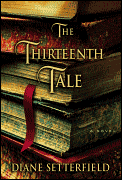
The Thirteenth Tale


The Thirteenth Tale by Diane Setterfield
Contemporary Fiction
Finished on 10/31/06
Rating: B (6/10 So-so)


Each year there seems to be one book about which everyone is talking: The Kite Runner, Bel Canto, Life of Pi, Plainsong, and Cold Mountain, to name just a few. This year’s “book buzz” award goes to Diane Setterfield’s debut novel, The Thirteenth Tale. Bloggers across the globe have been raving about this gothic tale since it hit the shelves earlier this fall (and in some cases, well before, thanks to the ubiquitous Advance Reader’s Copy). Word of mouth is an author’s best friend and bloggers have done nothing but help boost Setterfield’s fame and, undoubtedly, fortune.

I hate to be the voice of dissension, but this book failed to impress me as it did Heather, Dolce Bellezza, Carl, Booklogged, Bluestalking Reader, Di, Lesley, and thousands of other readers.

It’s not that I didn’t like the book (I love the dust jacket with it’s rich cover art and raised lettering, not to mention all the passages about reading and the love of books). I just didn’t feel the magic that so many other readers experienced.

Judging by the number of favorite passages, though, one would think I’d've given the book a higher rating. Unfortunately, I felt the narrative dragged a bit too much and I had a tough time staying focused. I’d curl up with the book, read a few pages only to discover my mind wandering or that I’d drifted off to sleep. Until the last hundred pages, I couldn’t manage to get engrossed in the narrative, only caring for one of the characters (and a secondary character, at that) and finding several that struck me as terribly mean and heartless.

Was it a case of too much hype? There are currently 2,462 posts matching “The Thirteenth Tale” at Blogger! Wrong time, wrong read? Still on too much of a book high after reading The Book Thief? Did I spend too much brain power trying to sort out all the clues in a futile attempt to unravel the book’s mystery? As the pieces of the puzzle began to fall into place during the last quarter of the book, my interest did heighten and I sat and read for a couple of hours, anxious to see how it would all turn out.

Please don’t misunderstand my disappointment. This is certainly not a terrible book. It’s not even a bad book. It simply failed to live up to my expectations for a great read. I didn’t quit reading and there were definitely enjoyable parts that kept my interest, but overall all, meh. Not one I’ll read again and I’m almost sorry I spent the money on a hardcover (although, as I said it is a gorgeous cover and my husband loved the book, so at least we got our money’s worth).


Favorite Passages:

People disappear when they die. Their voice, their laughter, the warmth of their breath. Their flesh. Eventually their bones. All living memory of them ceases. This is both dreadful and natural. Yet for some there is an exception to this annihilation. For in the books they write they continue to exist. We can rediscover them. Their humor, their tone of voice, their moods. Through the written word they can anger you or make you happy. They can comfort you. They can perplex you. They can alter you. All this, even though they are dead. Like flies in amber, like corpses frozen in ice, that which according to the laws of nature should pass away is, by the miracle of ink on paper, preserved. It is a kind of magic.

and

Time was of the essence. For at eight o’clock the world came to an end. It was reading time.

The hours between eight in the evening and one or two in the morning have always been my magic hours. Against the blue candlewick bedspread the white pages of my open book, illuminated by a circle of lamplight, were the gateway to another world.

and

There is one thing on which we are agreed: There are too many books in the world to read in a single lifetime; you have to draw the line somewhere.

and

Of course one always hopes for something special when one reads an author one hasn’t read before… I have always been a reader; I have read at every stage of my life, and there has never been a time when reading was not my greatest joy. And yet I cannot pretend that the reading I have done in my adult years matches in its impact on my soul the reading I did as a child. I still believe in stories. I still forget myself when I am in the middle of a good book. Yet it is not the same. Books are, for me, it must be said, the most important thing; what I cannot forget is that there was a time when they were at once more banal and more essential than that. When I was a child, books were everything. And so there is in me, always, a nostalgic yearning for the lost pleasure of books. It is not a yearning that one ever expects to be fulfilled. And during this time, these days when I read all day and half the night, when I sleep under a counterpane strewn with books, when my sleep was black and dreamless and passed in a flash and I woke to read again – the lost joys of reading returned to me…

and

Whether by luck or accident I cannot say, but I found my way to the library a full twenty minutes earlier than I had been commanded to attend. It was not a problem. What better place to kill time than in a library? And for me, what better way to get to know someone than through her choice and treatment of books?

and

All morning I struggled with the sensation of stray wisps of one world seeping through the cracks of another. Do you know the feeling when you start reading a new book before the membrane of the last one has had time to close behind you? You leave the previous book with ideas and themes – characters even – caught in the fibers of your clothes, and when you open the new book, they are still with you. Well, it was like that. All day I had been prey to distractions. Thoughts, memories, feelings, irrelevant fragments of my own life, playing havoc with my concentration.

August 7, 2024

Bear


Fiction
2024
Finished on August 3, 2024
Rating: 3/5 (OK)

Publisher's Blurb:

A mesmerizing novel of two sisters on a Pacific Northwest island whose lives are upended by an unexpected visitor — a tale of family, obsession, and a mysterious creature in the woods, by the celebrated, bestselling author of Disappearing Earth.

They were sisters and they would last past the end of time.

Sam and her sister, Elena, dream of another life. On the island off the coast of Washington where they were born and raised, they and their mother struggle to survive. Sam works long days on the ferry that delivers wealthy mainlanders to their vacation homes while Elena bartends at the local golf club, but even together they can’t earn enough to get by, stirring their frustration about the limits that shape their existence.

Then one night on the boat, Sam spots a bear swimming the dark waters of the channel. Where is it going? What does it want? When the bear turns up by their home, Sam, terrified, is more convinced than ever that it’s time to leave the island. But Elena responds differently to the massive beast. Enchanted by its presence, she throws into doubt the plan to escape and puts their long-held dream in danger.

A story about the bonds of sisterhood and the mysteries of the animals that live among us — and within us — Bear is a propulsive, mythical, rich novel from one of the most acclaimed young writers in America.

When is a bear just a bear? 
The bear, she said. The bear. It lit her days. Just hoping--knowing that she might see it--knowing it was there to be seen.

The bear had come and brought delight. The bear was deep-furred majesty. Without it, Elena didn't know what they'd do. The bear was their one good thing: a specter, a spirit, an extraordinary beast. A visitor from someplace enchanted. A vision of the mysterious world. 

What had the bear done to harm them? Nothing. What threat did is pose? None at all. So why bring in someone to chase it away? There was no reason. The bear was here, briefly and beautifully, teaching them what it was to love living, helping them to make it through. 

As I read the final pages of Julia Phillips' new novel Bear, I wondered if I had missed something critical in the story. Was it Phillips' intention to create a novel of magical realism or was the bear a metaphor for society's attack on the poor and lower class citizens, struggling for survival, living hand-to-mouth?

I listened to a novel almost a decade ago called The Bear (by Claire Cameron), which was both mesmerizing and terrifying. At the center of that tale are two young children and one large bear, the former of whom tugged at my heartstrings, bringing me to tears as I listened to their story, their palpable fear invading my dreams. 

Julia Phillips' strange novel is no comparison. I was drawn to the book after reading some glowing reviews, and the Pacific Northwest setting was an easy sell. I've written about my love of the San Juan Islands here, and I was easily transported to that idyllic location, picturing Samantha behind the concession stand on one of the many ferries that traverse the waters between Anacortes, San Juan, Lopez, and Orcas.
For her last twenty minutes on the boat that day, Sam rode in the open air, letting fine mist wash across her face. Seaplanes hummed overhead.

 She drove home from the harbor with the windows down. The breeze was warm, powdery with pollen, soft with the promise of early summer. Here was another day she'd almost entirely missed, penned through the daylight hours in the fluorescent-lined box on the ferry's top deck, but she'd made it at last into the sunshine. Driving lazily, playing pop on the radio. Trees brushed by on either side. Farm animals watched her pass. When she and Elena moved off-island, they would enjoy, she imagined, mentioning to people the beautiful place in which they'd grown up. The air smelled like cedar and sugar. It was lovely. With every curve in the road, her body relaxed deeper into the driver's seat. She'd gotten the final piece of the day, the sliver of goodness left.

And yet, despite the picturesque setting, the story left me shaking my head, wondering why other readers were so impressed. The characters are thinly drawn, Sam's unhealthy dependency on her older sister grew tiresome (I struggled to believe Sam was 28 when she comes across as an immature, antisocial teenager), and the manner in which Elena interacts with the grizzly is beyond belief. 

As dissatisfied as I was of the plot, I admired the author's beautiful prose, particularly her descriptions of island life.
When the sisters were young, very young, they loved living on San Juan. Summers, the girls would go over to Lime Kiln and pass entire days posted up on the rocky bluffs watching for whales. Spotting them was like catching shooting stars. You couldn't focus on any one spot--you had to let your gaze go wide. Elena was especially good at it. She would jostle Sam's elbow and say, "Humpback." The tourists next to them, outfitted with binoculars, gasped, leaning close to try to learn her secrets. Elena pointed out the pods. Humpbacks, gray whales, minkes, porpoises rolling and leaping in the surf. Gorgeous orcas, with their dorsal fins sharp as blades.

The girls hiked along the coastal cliffs as otters floated below. They went north, to English Camp, where a Coast Salish longhouse once stood, and play pretend among the thick damp ferns. Park rangers waved in their direction. Elena asked where they came from, what they did here, whether they liked it, and they told her the names of their hometowns and the list of their duties and how, yes, they treasured this place. Sam and Elena chased each other down the park's trails. They hooted and squealed. Their world seemed enchanted, a paradise. 
My first inclination was to give Bear a 2/5 (fair) rating, but as I've spent more time thinking about the novel and Phillips' prose, I've decided to nudge it up a notch. In spite of a near DNF, I did become engrossed as the story progressed, eager to learn the outcome. Would I recommend the book? Probably not. But I do highly recommend Claire Cameron's novel, which is based on the tragic story that occurred in 1991 "on Bates Island on Lake Opeongo in Algonquin Park, nearly three thousand square miles of wilderness situated two hundred miles northeast of Toronto." The audio of that book is outstanding!

March 16, 2025

Beyond That, the Sea


Beyond That, the Sea by Laura Spence-Ash
Fiction
2023
Finished on March 12, 2025
Rating: 4.5/5 (Excellent)

Publisher's Blurb:

A sweeping, tenderhearted love story, Beyond That, the Sea follows two families living on opposite sides of the Atlantic Ocean and the young woman who will call them both her own.

As German bombs fall over London in 1940, working-class parents Millie and Reginald Thompson make an impossible choice: they decide to send their eleven-year-old daughter, Beatrix, to America, where they hope she’ll stay safe.

Scared and angry, Bea arrives in Boston to meet the Gregorys, who fold her into their world. She adjusts to their affluent lifestyle and grows close to both Gregory boys, one older and one younger, filling in the gap between them. Before long, before she even realizes it, life in America feels more natural to her than her quiet, spare world back in England.

As Bea comes into herself and relaxes into summers on the coast in Maine, the girl she had been begins to fade away, until, abruptly, she is called home to London when the war ends.

Desperate as she is not to leave the Gregorys behind, Bea dutifully retraces her trip across the Atlantic. As she returns to post-war London, the memory of her American family stays with her, never fully letting her go as she tries to move on, pursuing love and a life of her own.

As we follow Bea over time, navigating between her two worlds, Beyond That, the Sea emerges as a beautifully written, absorbing novel, full of grace and heartache, forgiveness and understanding, loss and love.

I loved this book! I've read dozens of novels set during World War II, but Laura Spence-Ash's debut is the first I've read about a British child taking refuge with a family in America. Told from eight perspectives, readers are privy to the inner thoughts and emotions of each main character. Usually, this many POVs would be clumsy and confusing, but the author's use of short, alternating chapters keeps the story flowing smoothly. Even with the short chapters, I was quickly drawn into the lives of each character, all of whom are fully drawn and believable. The linear narrative also aides in the seamlessly woven story of both families, spanning nearly forty years (1940-1977). 

I can't begin to imagine how heartbreaking it must have been for parents to send their young children off to either the countryside or to another country during the Blitz.
That is what's worrying Millie. How small life would seem when Beatrix got back. There would be no fancy parties or baseball game outings or trips to the symphony. She's happy, of course, that she seems so well cared for. She seems to have a nice group of friends. But that will make the return more difficult. She will no longer be a little girl. She no longer is a little girl. They sent her away so she could have a childhood. They hadn't realized, though, that their decision meant that her childhood would, instead, be taken away from them. Millie feels as though something has been stolen from her, never to be returned.
This novel would have been a 5-star read had there been more tension, and had the conclusion not been so predictable. I also dislike the author's dialogue format. Instead of a new paragraph for each person speaking, she embeds the conversation within a paragraph, often several sentences in length. Additionally, the words are in italics rather than quotations marks. There were times when it was hard for me to distinguish who was speaking. These quibbles aside, this is an excellent novel and one I look forward to reading again. I'm also eager to see what Laura Spence-Ash has to offer next. And I'd love to find more books (fiction or nonfiction) about the evacuation of British children during World War II.

I echo Alice Elliott Dark's sentiments:

"I was utterly captivated by this beautiful story from the first page to the last. The characters are so real, their feelings so well portrayed that I had to keep reminding myself that I don’t actually know them. But I do! And I will return to the book to experience the well-wrought details of these lives again. This is a new favorite novel, and I can only hope Laura Spence-Ash has more coming soon." Alice Elliott Dark, Author of Fellowship Point and In the Gloaming

November 1, 2008

The Madonnas of Leningrad


The Madonnas of Leningrad by Debra Dean
Historical Fiction
2006 William Morrow
240 Pages
Finished on 10/21/08
Rating: 4/5 (Very Good)


Publisher's Blurb:

One of the most talked about books of the year . . . Bit by bit, the ravages of age are eroding Marina's grip on the everyday. And while the elderly Russian woman cannot hold on to fresh memories—the details of her grown children's lives, the approaching wedding of her grandchild—her distant past is preserved: vivid images that rise unbidden of her youth in war-torn Leningrad.

In the fall of 1941, the German army approached the outskirts of Leningrad, signaling the beginning of what would become a long and torturous siege. During the ensuing months, the city's inhabitants would brave starvation and the bitter cold, all while fending off the constant German onslaught. Marina, then a tour guide at the Hermitage Museum, along with other staff members, was instructed to take down the museum's priceless masterpieces for safekeeping, yet leave the frames hanging empty on the walls—a symbol of the artworks' eventual return. To hold on to sanity when the Luftwaffe's bombs began to fall, she burned to memory, brushstroke by brushstroke, these exquisite artworks: the nude figures of women, the angels, the serene Madonnas that had so shortly before gazed down upon her. She used them to furnish a "memory palace," a personal Hermitage in her mind to which she retreated to escape terror, hunger, and encroaching death. A refuge that would stay buried deep within her, until she needed it once more. . . .

Seamlessly moving back and forth in time between the Soviet Union and contemporary America, The Madonnas of Leningrad is a searing portrait of war and remembrance, of the power of love, memory, and art to offer beauty, grace, and hope in the face of overwhelming despair. Gripping, touching, and heartbreaking, it marks the debut of Debra Dean, a bold new voice in American fiction.

This is one of those popular books from a couple of years ago (Water for Elephants and Snow Flower and the Secret Fan are two others) that I held off reading until I felt the hype had settled down and I was ready to give it a try. I'm happy to report that I wasn't the least bit disappointed and thoroughly enjoyed Dean's remarkable debut novel! I was immediately drawn into the narrative, eager to return to my reading at the end of the day. I enjoyed both aspects of the story, but was more interested in Marina's present life rather than her time in Leningrad at the Hermitage Museum. This surprises me, since not only do I love reading about World War II, but I enjoy books that focus on art history. As I was reading the sections about the specific works of art, I found myself wishing I could double-click on the title of the painting in order to see what was described. I could've have stopped and searched the Internet for an image of the painting, but I didn't want to interrupt the flow of the story.

I only marked a few passages, but I think they're quite poignant:

In the Hermitage, they are packing up the picture gallery. It is past midnight but still light enough to see without electricity. It is the end of June 1941, and this far north, the sun barely skims beneath the horizon. Belye nochi, they are called, the white nights. She is numb with exhaustion and her eyes itch from the sawdust and cotton wadding. Her clothes are stale, and it has been days since she has slept. There is too much to be done. Every eighteen or twenty hours, she slips away to one of the army cots in the next room and falls briefly into a dreamless sate. One can't really call it sleep. It is more like disappearing for a few moments at a time. Like a switch being turned off. After an hour or so, the switch mysteriously flips again, and like an automaton she rises from her cot and returns to work.

and

...She is always disoriented now. The Hermitage staff has been packing almost round the clock for weeks and weeks now, eating sandwiches brought into the galleries, slipping away only to use the toilet. In the first week, they crated more than half a million pieces of art and artifacts. And then on the last night of June, an endless parade of trucks carried away the crates. A train, twenty-two cars long and armed with machine guns, waited at the goods depot to spirit the priceless art away, its destination a state secret. Walking back through the rooms, through wastelands of shredded paper, Marina had averted her eyes. Many of the older people wept.

and

"Why didn't you tell me about this? About Mama?" Helen tries not to sound reproachful.

Dmitri stares out the front window, blinking and working his lips. They pass a bookstore, a small brick post office, a market. She scans the empty sidewalks and then glances back at her father. A tear is dribbling down his cheek.

"I'm sorry, Papa. I'm not criticizing."

"We've always cared for each other." His voice is thick.

"What does Dr. Rich say? Have you at least talked with her about it?"

"They did some tests. But there's not so much to be done."

Helen steels herself. "Is it Alzheimer's?"

Dmitri nods.

He is blinking furiously now and biting down hard on his lower lip.

Helen pulls the car over to the side of the street and turns off the engine. Silence fills the interior of the car. She takes her father's freckled hand in her own and squeezes it gently. The air seems to go out of him; tears gather in the folds beneath his eyes and spill down his cheeks.

"I don't know what to do," he admits. "She's getting worse. She can't wash herself anymore. She only stands under the water and forgets to soap herself. I'm afraid to leave her alone, even for a few minutes. Last week, she put some plums in the dryer when I wasn't looking. Our underwear came out with pink splotches, and I found pits in the bottom of the barrel."

In discussing the book with my husband, I finally realized why I was more interested in Marina's later life story, rather than the period during the war. My parents are in their mid-70s and while they are very active and spry, with absolutely no signs of Alzheimer's or dementia, it is a worry that my brothers and I may have to face the possibility of dealing with this sometime in the not so distant future. I have a few friends who are already losing their parents to Alzheimer's and it's so terribly heartbreaking. I also know that it's entirely possible that I could wake up one morning and not have my husband recognize me. Or me him. I don't know which would be worse.

Does one cease to exist as a wife or a daughter if one's husband or parent doesn't recognize them? Is it not so much the person succumbing to the disease that becomes the ghost, but rather the one left behind?

I'm anxious to read more by Debra Dean (hopefully, a bit more cheery!). She's published a collection of short stories (Confessions of a Falling Woman: And Other Stories), but I've never been much for those, so I'll wait until she writes another full-length novel.


For more information about the Hermitage during the siege, go here. And to read about Debra Dean's visit to the Hermitage, go here.

June 7, 2022

The People We Keep

Fiction
2021 Simon & Schuster Audio
Narrated by Julia Whelan
Finished on June 3, 2022
Rating: 3/5 (Good)

Publisher's Blurb:

The People We Keep is about a young songwriter longing to find a home in the world.

Little River, New York, 1994: April Sawicki is living in a motorless motorhome that her father won in a poker game. Failing out of school, picking up shifts at Margo’s diner, she’s left fending for herself in a town where she’s never quite felt at home. When she “borrows” her neighbor’s car to perform at an open mic night, she realizes her life could be much bigger than where she came from. After a fight with her dad, April packs her stuff and leaves for good, setting off on a journey to find a life that’s all hers.

As April moves through the world, meeting people who feel like home, she chronicles her life in the songs she writes and discovers that where she came from doesn’t dictate who she has to be.

This lyrical, unflinching tale is for anyone who has ever yearned for the fierce power of found family or to grasp the profound beauty of choosing to belong.

Meh. I don't remember where I first heard about The People We Keep, but when it popped up on Libro.fm, I decided to accept their complimentary copy. I enjoy audiobooks narrated by Julia Whelan, which is the main reason I decided to give the book a try. The book starts off slowly and it took me several chapters before I was finally invested in April's story. However, it's one of those novels that's a decent listen (thanks to the superb narration by Whelan), but I doubt it would hold my interest had I read the print copy. I've listened to several novels this year that fall into this "ho-hum" category: The Paper Palace, Leave the World Behind, Major Pettigrew's Last Stand and The Pull of the Stars. One can surmise that I'm more patient and not so quick to call it quits when it comes to audiobooks, especially those with entertaining readers. More often than not, that persistence pays off, but not always.

I received a complimentary copy from Libro.fm. All thoughts and opinions are my own.

March 27, 2019

The Library Book


The Library Book by Susan Orlean
Nonfiction
2018 Simon & Schuster
Finished on March 19, 2019
Rating: 4/5 (Very Good)

Publisher's Blurb:

On the morning of April 28, 1986, a fire alarm sounded in the Los Angeles Public Library. As the moments passed, the patrons and staff who had been cleared out of the building realized this was not the usual fire alarm. As one fireman recounted, “Once that first stack got going, it was ‘Goodbye, Charlie.’” The fire was disastrous: it reached 2000 degrees and burned for more than seven hours. By the time it was extinguished, it had consumed four hundred thousand books and damaged seven hundred thousand more. Investigators descended on the scene, but more than thirty years later, the mystery remains: Did someone purposefully set fire to the library—and if so, who?

Weaving her lifelong love of books and reading into an investigation of the fire, award-winning New Yorker reporter and New York Times bestselling author Susan Orlean delivers a mesmerizing and uniquely compelling book that manages to tell the broader story of libraries and librarians in a way that has never been done before.

In The Library Book, Orlean chronicles the LAPL fire and its aftermath to showcase the larger, crucial role that libraries play in our lives; delves into the evolution of libraries across the country and around the world, from their humble beginnings as a metropolitan charitable initiative to their current status as a cornerstone of national identity; brings each department of the library to vivid life through on-the-ground reporting; studies arson and attempts to burn a copy of a book herself; reflects on her own experiences in libraries; and reexamines the case of Harry Peak, the blond-haired actor long suspected of setting fire to the LAPL more than thirty years ago.

Along the way, Orlean introduces us to an unforgettable cast of characters from libraries past and present—from Mary Foy, who in 1880 at eighteen years old was named the head of the Los Angeles Public Library at a time when men still dominated the role, to Dr. C.J.K. Jones, a pastor, citrus farmer, and polymath known as “The Human Encyclopedia” who roamed the library dispensing information; from Charles Lummis, a wildly eccentric journalist and adventurer who was determined to make the L.A. library one of the best in the world, to the current staff, who do heroic work every day to ensure that their institution remains a vital part of the city it serves.

Brimming with her signature wit, insight, compassion, and talent for deep research, The Library Book is Susan Orlean’s thrilling journey through the stacks that reveals how these beloved institutions provide much more than just books—and why they remain an essential part of the heart, mind, and soul of our country. It is also a master journalist’s reminder that, perhaps especially in the digital era, they are more necessary than ever.

The Library Book is sure to be a favorite of any lover of books and libraries. I couldn't put it down! I was very impressed with the amount of research that went into this work and marveled at Orlean's skill. She was able to take the two threads (the fire and the history of the library) and weave them into a compelling narrative, which piqued my curiosity, sending me to Google for images and more facts about the Los Angeles Central Library and its architect (the same individual who designed the state Capitol in Lincoln, Nebraska). To borrow another reviewer's statement about a different book, The Library Book is "broad in scope, intimate in detail." The majority of my book club enjoyed Orlean's book and if my sister-in-law, who now works for the Lincoln City Libraries, and my book-loving firefighter friend, haven't yet read this, I highly recommend it to both! I would love to hear their thoughts on this compelling account of the Los Angeles Central Library fire. I'm also eager to hear my husband's thoughts, as he grew up in L.A., although he and I were both living in San Diego when the fire occurred. Surprisingly, neither of us remember hearing anything about it, but now knowing the story, I would love to visit the library if we're ever in the area on one of our road trips.

Favorite Passages:
The library is a gathering pool of narratives and of the people who come to find them. It is where we can glimpse immortality; in the library, we can live forever.
and
A puff of outside air wafted in and down the hall. Then, in an instant, people poured in--the hoverers, who bolted from their posts in the garden, and the wall-sitters, and the morning fumblers, and the school groups, and the businesspeople, and the parents with strollers heading to story time, and the students, and the homeless, who rushed straight to the bathrooms and then made a beeline to the computer center, and the scholars, and the time-wasters, and the readers, and the curious, and the bored[...]
and 
All the things that are wrong in the world seem conquered by a library’s simple unspoken promise: Here I am, please tell me your story; here is my story, please listen.
and
The library is a whispering post. You don't need to take a book off a shelf to know there is a voice inside that is waiting to speak to you, and behind that was someone who truly believed that if he or she spoke, someone would listen. It was that affirmation that always amazed me. Even the oddest, most peculiar book was written with that kind of courage -- the writer's belief that someone would find his or her book important to read. I was struck by how precious and foolish and brave that belief is, and how necessary, and how full of hope it is to collect these books and manuscripts and preserve them. It declares that stories matter, and so does every effort to create something that connects us to one another, and to our past, and to what is still to come.
and
I have come to believe that books have souls—why else would I be so reluctant to throw one away?
and
It seems simple to define what a library is—namely, it is a storeroom of books. But the more time I spent at Central, the more I realized that a library is an intricate machine, a contraption of whirring gears. There were days when I came to the library and planted myself near the center of the main corridor and simply watched the whirl and throb of the place. Sometimes people ambled by, with no apparent destination. Some people marched crisply, full of purpose. Many were alone, some were in pairs; occasionally they traveled in a gaggle. People think that libraries are quiet, but they really aren't. They rumble with voices and footsteps and a whole orchestral range of book-related noises—the snap of covers clapping shut; the breathy whisk of pages fanning open; the distinctive thunk of one book being stacked on another; the grumble of book carts in the corridors.
and
I loved wandering around the bookshelves, scanning the spines until something happened to catch my eye. Those visits were dreamy, frictionless interludes that promised I would leave richer than I arrived. It wasn't like going to a store with my mom, which guaranteed a tug-of-war between what I wanted and what my mother was willing to buy me; in the library I could have anything I wanted.
and 
They formed a human chain, passing the books hand over hand from one person to the next, through the smoky building and out the door. It was as if, in this urgent moment, the people of Los Angeles formed a living library. They created, for that short time, a system to protect and pass along shared knowledge, to save what we know for each other, which is what libraries do every day.

I was pleasantly surprised by this book and look forward to trying more by Susan Orlean. Any recommendations? The Orchid Thief and Rin Tin Tin both sound wonderful.